
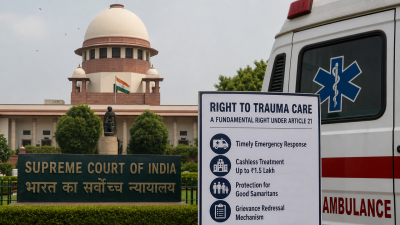
On 26 May 2026 the Supreme Court in SaveLIFE Foundation & Anr. vs Union of India & Ors. held that the right to trauma care is part of Article 21. The Court issued nine binding directions to Union, States and UTs to establish an integrated trauma response system with short implementation timelines and judicial monitoring.
What is current and why it matters
Current issue
- Legal change: Right to trauma care now recognised under Article 21, covering the period from injury site to definitive hospital treatment.
- Judicial directions: Nine binding directives require ERSS-112 integration, PM RAHAT operationalisation, National Ambulance Code (AIS-125) compliance, Good Samaritan grievance systems, a national medical rescue protocol and a Trauma Registry linked nationally.
- Implementation gap: States/UTs reported to the Court show no jurisdiction has fully implemented the required architecture as of now.
Constitutional and legal dimensions
- Article 21 expansion: The right to life now includes timely, competent trauma care from scene to definitive treatment, creating a state duty to provide emergency medical rescue and hospital care.
- Justiciability and enforceability: Court-issued directions are binding; non-compliance can be subject to judicial enforcement and administrative consequences (the judgment links PM RAHAT non-compliance to Motor Vehicles Act obligations).
- Separation of powers: The judgment invokes interpretative power of judiciary to impose policy-like obligations on the executive; continued judicial oversight via monitoring and follow-up hearings is mandated.
Key directives and policy framework
| Directive | Key content | Timeline | Lead agency |
|---|---|---|---|
| ERSS-112 integration | Unify all emergency helplines into 112; ensure call routing and coordination | Within 3 months | Home Affairs / State control rooms |
| PM RAHAT operationalisation | Cashless treatment for road accident victims up to ₹1.5 lakh for up to 7 days | Within 8 weeks | State health agencies / Ayushman Bharat implementation units |
| Ambulance standards (AIS-125) | All registered ambulances to meet National Ambulance Code and have GPS | 3–6 months for integration | Transport & Health departments |
| Good Samaritan grievance systems | Physical and digital grievance redressal to protect assisting citizens | 3–6 months | State health / police departments |
| National medical rescue protocol & Trauma Registry | Notify a uniform rescue protocol; specify Trauma Registry data format and link state registries to a national registry | Within Court-directed timelines | Ministry of Health & Family Welfare |
Institutional and federal mechanisms
- Union role: MoHFW to notify protocols and registry formats; Home Affairs to operationalise ERSS-112; Attorney General to monitor implementation before the Court.
- State/UT role: Implement PM RAHAT, equip ambulances to AIS-125, set up grievance mechanisms, maintain state trauma registries and link them to national registry.
- Inter-agency actors: Health, transport, police, emergency services, NCAHP (EMT curriculum), disaster management and local administrations must coordinate operationally.
- Accountability: Judicial oversight with follow-up hearings; non-compliance may attract administrative and legal consequences under relevant laws including the Motor Vehicles Act.
Implementation status and operational challenges
- Status: Reports submitted to the Supreme Court by 34 States/UTs show no state has fully implemented the complete trauma-care architecture ordered by the Court.
- Coordination deficit: Multiple departments and agencies lead to fragmented responsibilities and weak command-and-control in emergency response.
- Technical and procedural gaps: Absence of standard operating procedures in many jurisdictions; limited use of Trauma Registries; uneven EMS integration.
- Resource and capacity gaps: Many ambulances, including private ones, lack AIS-125 compliance and GPS; shortages of trained EMTs and graded trauma facilities persist.
- Citizen protection gaps: Grievance redressal systems for Good Samaritans are not uniformly operational, deterring bystander assistance.
Societal impact
- Bystander response: Legal protection and grievance mechanisms aim to reduce fear of legal entanglement and increase immediate assistance to victims.
- Health equity: PM RAHAT’s cashless short-term cover reduces financial barriers for road accident victims, improving access to timely care.
- Public confidence: A credible, visible emergency response system can raise public trust in state capacity to handle accidents and mass-casualty events.
Way forward: operational measures
| Challenge | Immediate measures (3–6 months) | Medium-term measures (6–24 months) |
|---|---|---|
| Poor inter-agency coordination | Designate state nodal agency; issue SOPs linking police, health, transport and emergency control rooms | Institutionalise joint training, integrated command centres and regular drills |
| Technical gaps (ambulances, GPS) | Mandate GPS retrofit and AIS-125 compliance for registered ambulances; provide subsidies for retrofit | Upgrade fleet through public procurement and PPP models; digitalise dispatch |
| Data and monitoring | Notify Trauma Registry format; start pilot state registries and link to national registry | Use registry for performance dashboards, policy design and research |
| Human resources and skills | Deploy NCAHP EMT curriculum; fast-track basic training for police and first responders | Scale accredited EMT courses, career paths, and retention incentives |
| Public awareness and Good Samaritans | Launch IEC campaign on ERSS-112, PM RAHAT and Good Samaritan protections | Integrate awareness in driver licensing, school curricula and community programmes |
Priorities for governance
- Clear legal mandates: State rules aligning Motor Vehicles Act obligations with PM RAHAT and AIS-125 compliance.
- Fund allocation: Dedicated budget lines at Union and State levels for EMS infrastructure, training and registry maintenance.
- Performance monitoring: Time-bound benchmarks with public dashboards and judicial review as fallback accountability.
- Evidence-based planning: Use Trauma Registry data to plan trauma networks, human resources and referral protocols.
Model Questions
1. Analyse the constitutional implications of the Supreme Court’s recognition of the right to trauma care as part of Article 21. [GS-II: Constitution of India & Polity]
Timely trauma care as part of Article 21 makes emergency medical response a justiciable state duty from scene to definitive treatment. It expands positive obligations of the state, subjects executive actions to judicial enforcement, and requires resource allocation and administrative reforms. The ruling may increase litigation for enforcement and necessitates legislative or executive measures for institutional capacity, SOPs and monitoring to meet fundamental-rights standards.
2. Examine the main directives for an integrated trauma response system and evaluate reasons for poor implementation across States/UTs. [GS-II: Governance]
Directives include ERSS-112 integration, PM RAHAT operationalisation, AIS-125 ambulance standards with GPS, Good Samaritan grievance systems, national rescue protocol and Trauma Registry linkage. Poor implementation stems from fragmented departmental roles, lack of SOPs, insufficient funds, weak inter-agency coordination, limited EMS capacity, absence of statewide registries and low priority in administrative agendas. Judicial monitoring and clear state nodal agencies are needed to improve compliance.
3. Discuss how PM RAHAT and the National Ambulance Code (AIS-125) operationalise the right to trauma care and which federal and institutional mechanisms are essential for pan-India execution. [GS-II: Governance]
PM RAHAT provides immediate cashless hospital cover reducing financial barriers; AIS-125 standardises ambulance equipment and operations ensuring quality pre-hospital care. Essential mechanisms include MoHFW-issued protocols and registry formats, state nodal agencies, integrated ERSS-112 control rooms, interdepartmental SOPs, dedicated funding, training under NCAHP EMT curriculum, and legal enforcement via transport and motor-vehicle regulations for uniform nationwide rollout.
4. Analyse the societal impact of Good Samaritan protections and a national medical rescue protocol; suggest measures to address implementation gaps. [GS-II: Social Justice]
Protection for Good Samaritans reduces fear of legal hassles, encouraging bystander assistance and improving survival. A national rescue protocol standardises first response, improving outcomes. To close gaps: operationalise grievance redressal, run awareness campaigns, enforce legal protections, train police and EMS in non-punitive handling, link protocol with ERSS-112 and registry monitoring, and incentivise community first responders.
Last Modified: June 26, 2026