
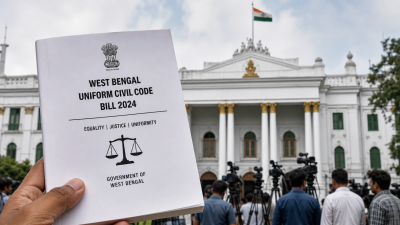
West Bengal will table a Uniform Civil Code (UCC) Bill in the State Legislative Assembly on 29 June 2026. The government proposes a common civil law for marriage, divorce, inheritance, adoption and succession and will follow a committee-led drafting process model used by other states.
What is the issue?
Brief description
The Bill proposes to replace religion-specific personal laws with a single civil code applicable to all residents of West Bengal. Reported features include uniform minimum marriage age, mandatory marriage registration, prohibition of polygamy and child marriage, equal inheritance rights for women, and registration of live‑in relationships.
Why it matters
- Governance: State-level enactment of UCC provisions tests the reach of concurrent legislative competence and administrative capacity for social regulation and registration systems.
- Law and constitution: Raises questions on the balance between Directive Principles (Article 44) and Fundamental Rights (Articles 14, 15, 21, 25–28, 29).
- Society: Impacts gender rights, minority practices and social cohesion, especially in districts with large minority populations.
- Politics: Fulfils a BJP manifesto promise and shapes centre‑state and party politics in West Bengal; likely to influence electoral narratives.
Constitutional and legal aspects
- Legislative competence: Personal law matters fall under Entry 5, Concurrent List. Both Parliament and states can legislate but divergence may create a patchwork of law.
- Directive Principles vs Fundamental Rights: Article 44 directs the State to endeavour to secure a UCC, but it is a non‑justiciable directive. Any state UCC will still be subject to fundamental rights and judicial review.
- Judicial precedent and legislative history: Courts have intervened in personal law issues (for example, decisions and statutes arising from Muslim and general family law disputes). State statutes may be challenged before higher courts on grounds of religious freedom and equality.
- Process safeguards: Government proposes a committee headed by a sitting judge to draft the law, mirroring procedures adopted in Uttarakhand, Gujarat and Assam.
Key provisions reported in the Bill
- Scope: Marriage, divorce, inheritance, adoption and succession.
- Marriage: Uniform minimum marriage age; mandatory registration; registration of live‑in relationships.
- Family structure: Ban on polygamy; ban on child marriage.
- Property and succession: Uniform rules on inheritance with explicit measures for equal rights to women.
Socio‑cultural implications and gender justice
- Gender equality: Uniform inheritance and bans on polygamy and child marriage can strengthen women’s economic and social rights across communities.
- Minority concerns: Replacement of religion‑specific personal laws affects community autonomy and religious practice, creating perceptions of cultural intrusion in minority‑majority districts (Malda, Murshidabad, North Dinajpur).
- Social acceptance: Effective outcomes depend on outreach, legal literacy, accessible dispute resolution (family courts), and measures to limit social backlash.
- Customary and tribal laws: Need clear treatment for customary practices and protection under Article 371 or other special provisions where applicable.
Federalism, uniformity and legal fragmentation
- State enactment risks: Multiple state UCC laws can produce different rules across states, undermining the concept of a single national UCC.
- Conflict potential: Divergent state laws may lead to choice‑of‑law disputes, forum shopping and litigation in higher courts.
- Coordination options: Model code by the Centre, inter‑state consultations, or eventual parliamentary intervention could reduce fragmentation.
Political dynamics and stakeholders
- Ruling party: BJP is implementing an electoral promise and treating UCC as an ideological and policy objective.
- Opposition: TMC opposes the Bill, citing lack of social consensus, constitutional safeguards and risk of political polarisation.
- Other stakeholders: Women’s groups may support gender‑equal provisions; religious bodies and minority organisations are likely to mobilise legal and public opinion against perceived intrusion.
- Adjacent legislation: The government will also table a Public Safety and Control of Anti‑social Activities Bill with preventive detention and property seizure provisions, intensifying political contestation.
Comparative analysis with Uttarakhand, Gujarat and Assam
| State | Process | Common features |
|---|---|---|
| Uttarakhand | Committee‑led drafting; state enactment | Uniform personal law emphasis; registration and inheritance rules |
| Gujarat | Committee headed by a judge; state Bill | Ban on polygamy; gender parity in inheritance |
| Assam | Committee process; state legislation | Similar focus on marriage registration and inheritance reform |
| West Bengal | Committee headed by a sitting judge; to be tabled in Assembly | Uniform marriage age, live‑in registration, polygamy ban, equal inheritance |
Implementation challenges
- Legal challenges: High probability of litigation on grounds of religious freedom and equality before law; judicial review can strike down or read down provisions.
- Administrative capacity: Need for registration infrastructure, family courts, trained magistrates and legal aid to ensure access to new rights.
- Social consent: Lack of consensus may lead to resistance, non‑compliance and communal tensions; phased implementation and stakeholder consultations are necessary.
- Interaction with existing laws: Alignment required with the Special Marriage Act, Prohibition of Child Marriage Act and state family‑law statutes to avoid conflicts.
- Enforcement and monitoring: Data systems for marriage and inheritance registrations; protection mechanisms for vulnerable groups during transition.
Policy options and safeguards for practical rollout
- Consultative drafting: Broader stakeholder consultation, including minority religious bodies and women’s organisations.
- Phased approach: Implement less contentious provisions first (registration, minimum age, anti‑child marriage) and defer contentious personal law harmonisation pending wider consensus.
- Legal clarity: Clear transitional provisions, exemptions (if any), and a framework to resolve conflicts between state and central laws.
- Institutional support: Strengthen family courts, legal aid, and awareness campaigns to ensure equitable access and reduce litigation pressure.
Model Questions
1. Examine the constitutional implications of a state enacting a Uniform Civil Code, in light of the West Bengal UCC Bill. How should Directive Principles and Fundamental Rights be balanced? [GS-II: Constitution of India & Polity]
Write a condensed answer in 60-70 words covering all points /dimensions in short. The UCC engages Entry 5 (Concurrent List) and Article 44 (DPSP). States can legislate but laws remain subject to Fundamental Rights (Articles 14,15,21,25–28,29). Balance requires that reforms pursue equality and non‑discrimination while respecting religious freedoms. Judicial review will assess proportionality and necessity. Political consensus and clear legislative intent reduce litigation; coordination with Parliament or model codes can ensure greater uniformity across states.
2. Assess how the West Bengal UCC Bill could affect gender justice and minority cultural practices. Can uniform laws reconcile both objectives? [GS-I: Indian Society]
Write a condensed answer in 60-70 words covering all points /dimensions in short. The Bill’s inheritance equality, polygamy and child‑marriage bans advance women’s rights and economic security. However, replacing religion‑specific laws can be perceived as eroding minority cultural autonomy. Reconciliation requires consultative drafting, phased implementation, exemptions for legitimate customary practices, legal aid, and awareness campaigns. Social acceptance and institutional support determine whether gender justice is achieved without alienating communities.
3. Analyse the political dynamics behind West Bengal tabling the UCC Bill and its implications for state politics and governance. [GS-II: Governance]
Write a condensed answer in 60-70 words covering all points /dimensions in short. Tabling fulfils a BJP manifesto pledge and projects ideological commitment. Opposition parties, notably TMC, frame it as lacking social consensus and risking polarisation. The timing affects electoral narratives and centre‑state alignments. Governance implications include administrative burdens of registration and dispute resolution, and potential strains from concurrent litigation. Political management and communications strategy will shape implementation feasibility and public response.
4. Compare West Bengal’s approach to UCC with Uttarakhand, Gujarat and Assam. What are the practical challenges of fragmented state‑level UCC laws? [GS-II: Governance]
Write a condensed answer in 60-70 words covering all points /dimensions in short. All four states used committee‑based drafting and pursued uniform personal law elements (inheritance, marriage registration, polygamy ban). Differences lie in specific draft provisions and legislative design. Fragmented state laws risk inconsistent rights across India, choice‑of‑law disputes and increased litigation. Practical challenges include administrative divergence, interstate mobility issues and the need for central coordination or a national model to ensure coherence.
Last Modified: June 28, 2026