
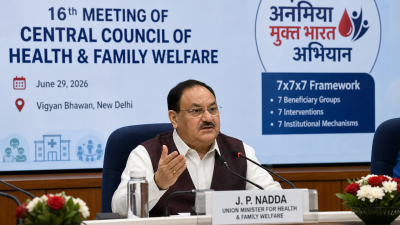
Union Health Minister J.P. Nadda will release the Anemia Mukt Bharat Abhiyaan Operational Guidelines at the 16th CCHFW meeting on 29 June 2026, Vigyan Bhawan, New Delhi. The existing 6x6x6 strategy is expanded into a 7x7x7 framework with added beneficiary, intervention and institutional mechanism.
The 7x7x7 Framework — Additions
- Seventh beneficiary group: Low Birth Weight (LBW) babies aged 0–6 months (LBW = birth weight <2500 g).
- Seventh intervention: “Eating Right” approach — routine promotion of iron-rich and dietary diversification.
- Seventh institutional mechanism: Strengthened monitoring and evaluation supported by digital tracking via a unified portal.
T4 Service Delivery Model
- T4: Test, Treat, Talk, Track — adds systematic tracking to earlier T3 model.
- Testing emphasis: Intensified haemoglobin testing across beneficiary cohorts with digital capture.
Therapeutic Measures
- Intravenous iron: Ferric Carboxymaltose (FCM) and Iron Sucrose included for severe anaemia in pregnant and lactating women and oral-iron non-responders.
- Clinical use: FCM permits larger single doses; Iron Sucrose used in multiple smaller infusions.
Digital Ecosystem & Portals
- Data integration: Haemoglobin data for pregnant women via JANANI; children via RBSK and U-WIN; all converge into an AMB Abhiyaan Portal.
- Objective: Real‑time monitoring, programme planning and treatment outcome tracking.
IASPOINT Booster Facts
- Administrative forum: CCHFW is the central–state health coordination forum under the Ministry of Health and Family Welfare.
- LBW standard: WHO definition for low birth weight is <2500 g.
- Portals: JANANI, RBSK and U-WIN are existing national digital platforms for maternal and child health data.