
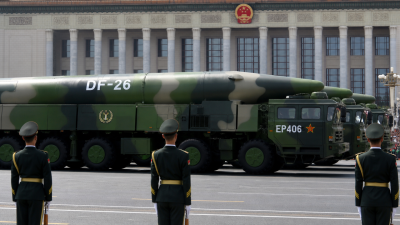
China has massed over 200 conventional missile launchers opposite India and fields operational hypersonic systems. India’s long‑range missiles are maturing but lack unified command, hypersonic capability and real‑time targeting. Urgent institutional and technological responses are required to preserve deterrence and manage escalation risks.
What is the issue
China’s People’s Liberation Army Rocket Force has deployed large numbers of conventional launchers near India and operates hypersonic weapons capable of deep, time‑sensitive strikes. Its doctrine treats conventional missiles as instruments of coercion and war‑fighting. The combination of mobility, range and hypersonic speed creates detection, attribution and response challenges for India.
Why it matters
Security: conventional missile coercion can paralyse infrastructure without full war, complicating crisis stability and escalation control. Strategic signalling: missile deployments alter deterrence equations. Technology and industry: India must bridge propulsion, material and semiconductor gaps. Governance: command, rules of engagement and legal control over pre‑delegated strikes require institutional reform under the CDS.
China’s missile capabilities and doctrine
- Force posture: Over 200 conventional launchers opposite India deployed from bases such as Korla and Kunming.
- Key systems: DF‑15B, DF‑16, DF‑21C, DF‑26 (dual‑capable, long range), plus operational hypersonic systems (DF‑17 with DF‑ZF glide vehicle, DF‑100, CJ‑1000).
- Doctrine: Use of conventional missiles for political coercion, counter‑value and battlefield effects short of all‑out nuclear exchange.
- Operational effect: Mobility and concealment of launchers, rapid strike timelines for hypersonics, and capacity to threaten logistics, airfields, ports and C4ISR.
India’s missile capabilities and gaps
- Inventory: Agni series (strategic), BrahMos (supersonic cruise), Nirbhay (LR‑LACM) — systems maturing and moving into operational service.
- Integration gap: Assets are dispersed across services and commands; no dedicated conventional Rocket Force for unified conventional strike authority.
- Technology shortfalls: Advanced air‑breathing/hypersonic propulsion, high‑grade materials, semiconductors, and real‑time seeker/targeting integration.
- Nuclear posture: Arsenal growth to ~190 warheads with about 12 operationally deployed warheads increases strategic readiness but does not substitute for conventional strike integration.
| Dimension | China (selected) | India (selected) |
|---|---|---|
| Operational hypersonics | DF‑17, DF‑100, CJ‑1000 (operational) | No operational hypersonic weapon yet; R&D ongoing |
| Intermediate range, dual‑capable | DF‑26 (5,000 km range) | Agni family (strategic), conventional long‑range options limited |
| Conventional launcher density | 200+ launchers opposite India | Fewer mobile conventional launchers, dispersed across services |
Imperatives for a conventional Rocket Force under CDS
- Purpose: Unify conventional long‑range strike assets for strategic, operational and tactical use under a single command chain.
- Authority: Enable calibrated counter‑value and counter‑force options with clear rules of engagement and pre‑delegated launch authority during crises.
- C4ISR integration: Fuse space, SIGINT, MASINT, airborne and ground surveillance for real‑time targeting of mobile launchers.
- Operational benefits: Faster decision cycles, reduced service rivalry, standardised training, logistics and sustainment for strike missions.
- Risks to manage: Escalation control, political oversight, legal framework and safeguards against inadvertent use.
Strategic and technological challenges
- Deterrence stability: Managing crisis credibility without lowering the threshold for escalation; calibrating conventional strikes against doctrines that blur nuclear/conventional lines.
- Technology gaps: Need for hypersonic propulsion, advanced seekers, high‑temperature materials, microelectronics and robust testing infrastructure.
- Industrial base: Scaling production, supply‑chain security for semiconductors and specialised alloys, and private sector integration.
- Organisational reform: Legal and institutional frameworks for a Rocket Force, rules for pre‑delegation, and inter‑service coordination with Strategic Forces Command and Integrated Defence Staff.
- Intelligence and space: Increase synthetic aperture radar (SAR) and electro‑optical satellite coverage, improve on‑orbit revisit and data fusion for mobile launcher detection.
Response: Interim measures
- Airbase resilience: Disperse, harden and camouflage IAF bases; create alternate operating locations and rapid runway repair capabilities.
- Air‑defence optimisation: Prioritise layered AD assets (SAMs, interceptors) for critical nodes and high‑value infrastructure; mobile AD to protect advancing formations.
- Surveillance expansion: Expand satellite EO/SAR tasking, shipborne and airborne ISR for early detection of mobile launchers such as DF‑26.
- Strike posture: Operationalise long‑range conventional strike options to hold bases and launch corridors in western China (Tibet, Xinjiang) at risk.
- Force employment: Use Integrated Battle Groups for rapid combined‑arms response and improved coordination with strike and air assets.
Response: Long‑term measures
- Institutional reform: Establish a conventional Rocket Force under the CDS with clear C2, legal oversight and integrated doctrine aligning with Strategic Forces Command.
- Technology and industry: Prioritise hypersonic R&D, propulsion, seekers and resilient microelectronics via DRDO, public‑private partnerships and selective foreign acquisition where necessary.
- C4ISR and space: Build a persistent, resilient space architecture (EO/SAR, signals intelligence), hardened comms and AI‑enabled targeting chains.
- Production and logistics: Expand manufacturing capacity for missiles, seekers and solid/volatile propellants; ensure material supply chains for high‑temperature alloys and semiconductors.
- Doctrine and arms control: Develop calibrated escalation management doctrine, clear signalling frameworks and explore crisis communication channels with Beijing to reduce miscalculation.
Model Questions
1. Discuss the evolving nature of China’s missile challenge to India and its strategic implications for regional stability. [GS‑II: International Relations]
India faces a densified conventional launcher presence and operational hypersonic systems that shorten decision timelines and complicate attribution. China’s doctrine uses missiles for coercion and limited war. Implications: reduced crisis stability, higher risk of rapid escalation, pressure on India’s deterrence credibility, and incentive for arms modernisation. Responses require improved ISR, rapid conventional strike options, and calibrated diplomatic channels to manage crises and signalling.
2. Examine the rationale and implications of creating a conventional Rocket Force under the Chief of Defence Staff for India. [GS‑III: Internal & External Security]
A Rocket Force would unify dispersed long‑range conventional assets, streamline command and control, enable pre‑delegated strikes and improve response times. It strengthens conventional deterrence and targeting of mobile threat systems. Implications include need for legal frameworks, doctrine to manage escalation, resource reallocation, inter‑service integration with Strategic Forces Command, and safeguards to prevent unintended escalation during crises.
3. Analyse India’s key technological gaps in missile development and outline measures to bridge them, with reference to hypersonics and real‑time targeting. [GS‑III: Science & Technology]
Gaps: hypersonic propulsion, high‑temperature materials, advanced seekers, and secure semiconductors. Measures: concentrate DRDO and industry on propulsion and materials testbeds; public‑private partnerships; targeted foreign collaboration or buys for critical components; expand on‑orbit ISR and data fusion for targeting; establish secure microelectronics supply chains; increase test ranges, trial cadence and validation for hypersonic flight and seeker integration.
4. Beyond creating a Rocket Force, what interim and long‑term measures should India adopt to strengthen defence preparedness along the China border and deter conventional missile attacks? [GS‑III: Internal & External Security]
Interim: disperse and harden airbases, optimise layered air‑defence, expand EO/SAR satellite tasking, operationalise long‑range conventional strike options, and employ IBGs for rapid response. Long‑term: establish Rocket Force under CDS, invest in hypersonics and C4ISR, build indigenous production and secure supply chains, codify escalation management doctrine, and enhance space and SIGINT capabilities for persistent mobile launcher detection.
Last Modified: July 1, 2026