
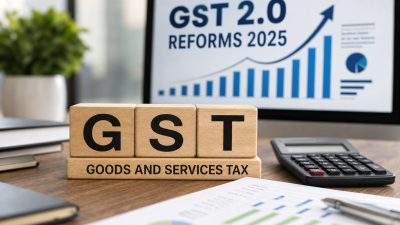
Recently the Centre acknowledged the Next‑Generation GST reforms (GST 2.0) of 2025 as a step in India’s tax reform journey. The 56th GST Council approved a simplified rate structure and compliance changes that are now being implemented and fine‑tuned through administrative and technological interventions.
What is current and why it matters
- Policy action — GST 2.0 was approved by the GST Council and became effective from 22 September 2025.
- Rate rationalisation — Primary rates now 5% (essential), 18% (normal), and 40% (luxury/sin); 12% and 28% slabs largely removed.
- Sectoral change — Life and health insurance made GST‑exempt; durable consumer goods saw lower tax incidence and prices.
- Revenue and compliance — GST collections rose to ₹22.27 lakh crore in 2025–26; April–May 2026 collections were ~₹4.37 lakh crore. Taxpayer registrations reached ~1.65 crore by May 2026.
- Administration — Deadline for filing appeals before GSTAT was extended to 31 July 2026 under Sections 112(1) and 112(3) of the GST Act due to technical issues.
- Technology focus — GSTN provides the digital backbone; emphasis on e‑invoicing, real‑time data capture and AI for monitoring and refunds in 2026.
Key features of GST 2.0 reforms
| Dimension | Pre‑reform | GST 2.0 |
|---|---|---|
| Tax slabs | Multiple slabs including 5%, 12%, 18%, 28% | Primarily 5%, 18%, and 40% (luxury/sin) |
| Exemptions | Varied; life & health insurance taxed in many cases | Life and health insurance exempt |
| Compliance model | GST returns, provisional IT systems | E‑invoicing, real‑time invoice capture, simplified returns |
| Digital infrastructure | GSTN operational since rollout | GSTN enhanced with AI analytics and larger data sharing |
Economic impact and outcomes
- Consumption — Lower effective tax on many durables (cars, TVs, ACs) reduced retail prices and aimed to stimulate household spending and demand for manufactured goods.
- Revenue performance — Aggregate GST mop‑ups rose materially since rollout. Collections in 2025–26 and early 2026 indicate revenue buoyancy alongside improved compliance.
- Formalisation — Registered taxpayers increased markedly to ~1.65 crore, signalling deeper tax net penetration and formal sector growth.
- Sectoral effects — Insurance sector adjustments require product redesign and pricing review; manufacturing and retail benefit from lower tax rates and simpler compliance.
- Distributional effect — Rate compression reduces incidence variability; the 40% rate aims to preserve progressivity by taxing luxury/sin goods at a higher rate.
Governance, federalism and institutional aspects
- GST Council — A statutory decision‑making forum for Centre and States. GST 2.0 outcomes reflect inter‑governmental agreement on rates, exemptions and procedures.
- Statutory framework — Changes implemented under the GST Act; administrative corrections and tribunal procedures continue to be important for dispute resolution (Sections 112(1), 112(3)).
- Inter‑governmental balance — Rationalisation reduces compliance heterogeneity; however, states and Centre must monitor revenue composition and adjust fiscal planning accordingly.
- Adjudication and administration — Extension of GSTAT filing deadline illustrates ongoing operational teething problems and the need for responsive administrative processes.
Technology and compliance enforcement
- GSTN — A 50:50 Centre‑State owned company providing the digital platform for registration, returns, e‑invoicing and data analytics.
- E‑invoicing and real‑time data — Enables invoice‑level visibility, reduces input tax credit fraud and improves matching of ledgers across businesses.
- AI and analytics — AI‑driven monitoring targets evasion patterns, flags mismatches and prioritises cases for audit. Also used to speed refunds through risk‑based scoring.
- Operational priorities for 2026 — Further reduce compliance cost, accelerate refunds, expand data sharing while ensuring data security and taxpayer privacy safeguards.
Challenges and way forward
- Residual complexity — Some classification, valuation and sector‑specific issues persist. Continued tariff rationalisation and clearer notifications are required.
- Revenue predictability — Short‑run effects of rate changes need monitoring to protect sub‑national fiscal positions. Periodic revenue analysis is necessary.
- Technical stability — Platform outages and stakeholder difficulties (evident from appeal deadline extension) demand higher uptime, user support and phased roll‑outs.
- Capacity building — Training for tax officials, taxpayers and tax practitioners on new procedures and digital tools is necessary to reduce disputes and compliance cost.
- Dispute resolution — Strengthen adjudicatory bodies and streamline appeal processes to lower litigation and accelerate finality.
- Data governance — Introduce clear rules on data use, retention and privacy while enabling inter‑agency analytics to detect fraud and speed refunds.
- Policy review mechanism — Institutionalise periodic impact assessment of rate structure, exemptions and administrative rules; use empirical evidence to calibrate policy.
Model Questions
1. Evaluate the economic impact of the Goods and Services Tax (GST) 2.0 reforms of 2025 on India’s growth trajectory, consumer welfare, and formalisation of the economy. What role has the rationalisation of tax slabs played in achieving these objectives? [GS-III: Economic Development]
Lower tax incidence on many consumer durables and a simpler rate structure increased demand, helping short‑term consumption and manufacturing output. Broader taxpayer registration and higher collections indicate deeper formalisation and improved compliance. Rate rationalisation reduced price dispersion, eased compliance for businesses and aided demand revival, while the high 40% slab retained progressivity on luxury/sin items. Monitoring revenue composition and sectoral impacts remains necessary.
2. Analyse how the GST Council’s decision‑making under GST 2.0 illustrates cooperative federalism. Discuss institutional strengths and remaining governance risks. [GS-II: Governance]
The GST Council, a statutory Centre–State forum, approved GST 2.0 by collective decision, demonstrating shared fiscal policymaking. Strengths include joint rate setting, coordinated administration, and a common IT platform. Risks stem from implementation gaps, revenue volatility across states, technical disruptions and litigation. Mitigation requires better impact assessment, transparent sharing of collections data, administrative capacity building and timely dispute resolution.
3. How has technology, particularly GSTN and AI, been used to enhance compliance, reduce evasion and improve GST efficiency? What further technological priorities should be pursued in 2026? [GS-III: Science & Technology]
GSTN enables e‑invoicing and real‑time invoice capture, improving input credit matching and reducing fake invoices. AI analytics identify anomaly patterns, prioritise audits and speed refunds. Priorities for 2026 include strengthening platform reliability, expanding AI‑driven risk models, improving taxpayer UX, automating refunds further, and introducing robust data governance and cybersecurity measures to protect taxpayer information.
4. Despite GST 2.0 reforms, what challenges remain in achieving a simplified and efficient indirect tax system in India? Propose a practical way forward. [GS-III: Economic Development]
Challenges include residual classification disputes, technical platform stability, state revenue adjustments and litigation backlog. A practical way forward: institutionalise periodic tariff reviews, enhance GSTN uptime and taxpayer support, streamline appeal timelines and strengthen tribunal capacity, invest in official and taxpayer training, and adopt transparent data‑driven monitoring to adjust policy based on empirical outcomes.
Last Modified: July 1, 2026