
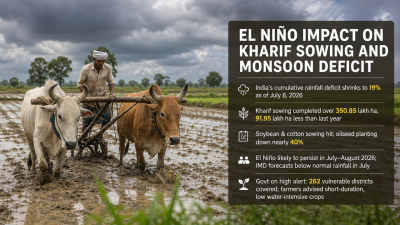
As of 8 July 2026, India faces a weakened monsoon linked to El Niño with kharif sowing completed on 350.85 lakh hectares, about 91.95 lakh hectares below last year. June rainfall was sharply deficient and oilseed sowing, especially soybean, has fallen steeply, raising economic and livelihood risks.
What is the issue?
Core facts
- Monsoon status: Cumulative rainfall deficit has narrowed recently to about 19% after a very dry June. IMD forecasts below‑normal rainfall for July with reduced activity over central India.
- Sowing status: Kharif sowing stands at 350.85 lakh ha, c. 91.95 lakh ha lower than the same period last year. Oilseed area fell from 10.9 mha to 6.6 mha (near 40% decline).
- El Niño signal: Weak–moderate El Niño conditions are present and expected to persist through July–August; not all El Niño years guarantee deficient rainfall but risk is elevated.
Why it matters for governance and economy
- Food supply: Reduced acreage for oilseeds, pulses and cotton can affect domestic availability and import requirements, with implications for food and edible oil inflation.
- Rural livelihoods: Delayed sowing and possible yield loss threaten farmer incomes, credit repayment capacity and rural employment linked to farm operations.
- Fiscal exposure: Government outlays may rise for relief, procurement, import support and accelerated expenditure on irrigation and insurance claim settlements.
El Niño mechanism and monsoon influence
- Physical mechanism: El Niño is anomalous warming of equatorial Pacific. It alters Walker circulation and shifts convective zones, affecting Indian monsoon moisture inflow and dynamics.
- Monsoon response: Typical impacts include delayed onset, longer dry spells and spatially uneven rainfall. The 2026 pattern showed a very dry June followed by partial recovery in early July but forecast remains cautious.
Current status of monsoon and kharif sowing
- Rainfall trajectory: From a steep deficit in June, rainfall improved in early July; government reports showed narrowing deficits but IMD warned of below‑normal activity for July.
- Crop-wise impact:
- Oilseeds (soybean): Area down nearly 40% (10.9 → 6.6 mha).
- Cotton and pulses: Notable delays and area reductions in major growing states.
- Rice: Some transplanting delayed; irrigated rice less affected where water available.
- Geographic vulnerability: 111 high‑risk districts across 12 states identified with low (<25%) irrigation; contingency plans prepared for 262 vulnerable districts.
Economic implications
- Production risk: Reduced sowing likely to lower kharif output for oilseeds and rain‑fed pulses, increasing reliance on reserves and imports.
- Price effects: Shortfalls may transmit into higher prices for edible oils and pulses, adding to food inflation pressures.
- Farmer income and credit: Lower area and yields reduce farm earnings; stress on informal and formal credit; insurance claims under PMFBY may increase and require timely settlement.
- Agri‑GDP and rural demand: Adverse kharif season can dampen rural consumption and slow aggregate demand recovery in affected districts.
Government preparedness and policy responses
- High‑level coordination: A review chaired by the Principal Secretary to PM assessed kharif progress and El Niño readiness.
- Monitoring and planning: Central monitoring activated; District Agriculture Contingency Plans issued for 262 vulnerable districts.
- Advisories and SOPs: SOPs for ‘Managing El Niño Risks in Indian Agriculture’ disseminated through Krishi Vigyan Kendras; farmers advised to shift to short‑duration, low water‑intensive crops (maize, bajra, moong).
- Relief and procurement: Preparedness for insurance claims, targeted procurement and market interventions to stabilise prices if required.
Institutional roles and risk management
- IMD: Provides forecasts, sub‑seasonal guidance and district‑level advisories for sowing windows and dry spells.
- Agriculture Ministry & States: Track sowing, identify vulnerable districts and implement contingency plans; coordinate with KVKs for outreach.
- KVKs and extension: Key channel for SOPs, seed distribution for short‑duration varieties, and on‑ground advisories on irrigation scheduling and crop choice.
- Insurance & credit agencies: PMFBY, NABARD and rural banks must expedite claims and loan restructuring in stress areas.
Challenges and vulnerabilities
- Irrigation gap: Many high‑risk districts have <25% irrigation cover, amplifying drought exposure.
- Spatial variability: Localised dry spells can cause crop failure even if aggregate rainfall improves.
- Input and seed availability: Rapid switch to alternate crops needs timely seed, fertiliser and advisory support.
- Administrative capacity: District‑level planning and rapid claim settlement require strengthened human resources and digital systems.
Mitigation strategies and way forward
- Short term (operational): Promote short‑duration, low water crops; provide seed and micro‑irrigation kits; prioritise timely insurance claim settlement and targeted procurement to stabilise markets.
- Medium term (infrastructure): Accelerate micro‑irrigation, watershed programmes, repair and expand local irrigation and water harvesting structures.
- Long term (resilience): Expand irrigation coverage, scale climate‑resilient seed varieties, strengthen sub‑seasonal forecasts and agri‑extension, and diversify cropping patterns away from water‑intensive options in high‑risk districts.
- Institutional reforms: Integrate IMD sub‑seasonal forecasts into district contingency plans; enhance KVK capacity; digitise claims and farm advisories for faster response.
Model Questions
1. Explain the El Niño phenomenon and analyse its observed impact on the 2026 Indian monsoon and kharif sowing. [GS-III: Environment & DM]
Recent weak–moderate El Niño warming in the equatorial Pacific altered atmospheric circulation, reducing monsoon moisture inflow and causing a very dry June followed by partial recovery. Consequences include delayed onset, reduced sowing (350.85 lakh ha vs c. 442.8 lakh ha last year), near 40% fall in oilseed area, and increased drought risk in low‑irrigation districts. IMD forecasts and district contingency plans drive operational response.
2. Assess the economic consequences of a delayed and deficient monsoon for India’s kharif crops and farmer livelihoods, and outline government mitigation measures. [GS-III: Economic Development]
Deficient monsoon reduces kharif output, especially oilseeds, raising import needs and food inflation. Farmer incomes decline from lower area and yields, increasing credit stress. Government measures include monitoring, District Agriculture Contingency Plans for 262 districts, SOPs via KVKs, advisories on short‑duration crops, insurance processing under PMFBY, and potential targeted procurement and market support to stabilise prices.
3. Examine institutional preparedness and policy responses to El Niño‑related monsoon variability in 2026. What elements constitute India’s agricultural risk management? [GS-II: Governance]
Preparedness combines IMD forecasting, central monitoring, high‑level reviews, district contingency planning, KVK extension, and insurance mechanisms. Key elements: early warning (IMD), district SOPs, seed and advisory support, expedited insurance claims, and coordination between Centre and states. Gaps include irrigation shortfall and district capacity; strengthening these completes the risk management chain.
4. Suggest long‑term strategies to enhance climate resilience in Indian agriculture in the context of recurrent El Niño events. [GS-III: Economic Development]
Prioritise irrigation expansion, micro‑irrigation and watershed revival; diversify crops towards short‑duration, low‑water varieties; invest in drought‑tolerant seeds and seed systems; integrate sub‑seasonal forecasts into advisory services; reform insurance for faster settlements; and enhance KVKs and district planning to mainstream climate‑smart agriculture and reduce dependency on monsoon variability.
Last Modified: July 8, 2026