
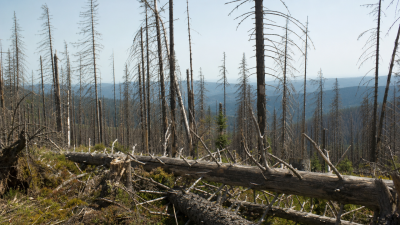
France’s forests are experiencing marked premature tree mortality. A multi‑institution study using National Forest Inventory data (2015–2023) links warmer or wetter springs, heatwaves and drought to a 1.5–4× rise in mortality for some species and widespread regional decline with implications for carbon sinks, biodiversity and forest management.
What is the current issue?
Tree mortality rates in French forests have risen sharply. Analysis of over 500,000 trees indicates that nearly 48% of 52 species showed significant mortality increases. For nine common species mortality rose 1.5–4 times. Hotspots are concentrated in north‑east France (Jura, Vosges, Grand Est). National authorities report a doubling of mortality over the last decade and projections place roughly 30% of species at risk by mid‑century.
Why it matters for governance and economy
- Climate policy: Forest carbon uptake has fallen by over half since the early 2000s, jeopardising France’s 2050 carbon neutrality goal and complicating LULUCF accounting under the Paris Agreement.
- Disaster risk: Heatwaves, higher wildfire risk and ecosystem degradation increase public health and emergency management burdens.
- Rural economies: Timber supply, forest industries and rural livelihoods face reduced yields and higher management costs.
- Biodiversity & ecosystem services: Loss of habitat, altered water regulation and reduced recreational value affect multiple ministries and stakeholders.
Causes of premature tree mortality
Direct climatic drivers
- Heatwaves: Extreme temperatures raise evaporative demand and induce physiological stress.
- Drought: Chronic soil moisture deficits cause hydraulic failure and carbon starvation.
- Warmer winters/springs: Break dormancy early, increase metabolic rates and vulnerability to pests and late frost.
Indirect and compounding mechanisms
- Warm or wet springs: Increased leaf flush and canopy growth raise water demand; later droughts cause structural overshoot and hydraulic failure, especially in tall species such as silver fir.
- Pests and pathogens: Climate stress lowers tree resistance and enables pest outbreaks.
- Wildfires: Higher area burned amplifies mortality and landscape fragmentation.
| Cause | Mechanism of impact |
|---|---|
| Heatwave | Elevated evapotranspiration → hydraulic stress → mortality |
| Spring warming/wetting | Early/overgrowth → increased water demand → vulnerability in subsequent drought |
| Pest outbreaks | Weakened trees → higher mortality rates |
Observed trends and hotspots
- Spatial pattern: Mortality concentrated in Jura, Vosges and Grand Est regions; also widespread across other biomes.
- Species most affected: European beech (Fagus sylvatica), pedunculate oak (Quercus robur), Norway spruce (Picea abies), silver fir and others showed strong increases.
- Recent extremes: June 2026 heatwaves and continuing summer heat increased mortality and wildfire area (~110 km² burned so far this year), compounding ecosystem stress.
Ecological and environmental consequences
- Carbon balance: Reduced uptake from dying stands, slower regrowth and higher harvests have halved net forest absorption since early 2000s.
- Biodiversity: Loss of old trees and changes in species composition reduce habitat heterogeneity and specialist species.
- Hydrological impacts: Canopy loss alters evapotranspiration, runoff and soil moisture regimes, affecting downstream water users.
- Fire regime shift: Increased dead biomass raises fuel loads and fire severity.
Socio‑economic dimensions
- Human health: Heatwaves have caused excess mortality and place added burden on health systems.
- Forestry sector: Economic losses from reduced timber quality and supply; need for salvage logging and altered harvesting schedules.
- Public finance: Increased emergency response, forest protection and adaptation expenditure.
- Rural communities: Income volatility, employment shifts and altered recreational values.
Adaptive forestry practices and policy interventions
Silvicultural measures
- Species selection: Promote drought‑tolerant and mixed‑species stands rather than monocultures; assisted migration where ecologically appropriate.
- Stand structure: Thinning to reduce competition for water; promote heterogeneous age and size classes to reduce synchronous vulnerability.
- Harvest timing: Earlier harvesting of large vulnerable trees to reduce catastrophic losses and recover economic value.
- Fuel management: Create fire breaks, manage litter and deadwood to reduce wildfire risk while retaining ecological deadwood where safe.
Policy, governance and finance
- Monitoring & research: Strengthen long‑term inventories, remote sensing and early‑warning systems; support institutes such as ONF, WSL and national research labs.
- Incentives: Align subsidies and CAP measures to support climate‑resilient afforestation, diversification and adaptive silviculture.
- Carbon accounting: Update LULUCF methodologies to reflect increased mortality and manage expectations for net‑zero targets.
- Cross‑sector planning: Integrate forest adaptation with water management, fire services and rural development policies.
Challenges and way forward
- Uncertainty: Species responses to combined stressors vary; adaptive measures must remain flexible and evidence‑based.
- Trade‑offs: Balancing carbon storage, biodiversity and timber production requires transparent decision criteria and stakeholder engagement.
- Funding gap: Scaling adaptation needs public and private finance instruments, insurance mechanisms and market incentives.
- Time lag: Forests respond slowly; policy must act now to influence mid‑century outcomes.
International implications and cooperation
- Global carbon cycle: Reduced European forest uptake affects EU emissions pathways and global efforts to limit warming.
- Shared science: Cross‑border research on mechanisms (e.g. hydraulic failure after wet springs) and species trials will speed adaptation.
- Policy coordination: EU level measures (forest strategy, CAP reforms) and multilateral agreements on land‑use must reflect increased forest vulnerability.
- Financial mechanisms: International climate finance and carbon markets should support resilience investments and fair compensation for ecosystem service losses.
Model Questions
1. Analyse the multifaceted climate‑driven factors causing premature tree mortality in French forests and outline consequent ecological impacts. [GS-III: Environment & DM]
Premature mortality stems from heatwaves, chronic drought, warmer winters/springs and unexpectedly wet springs that increase later drought vulnerability. Mechanisms include hydraulic failure, metabolic stress and pest susceptibility. Ecological impacts cover reduced carbon sequestration, biodiversity loss, altered hydrology and higher wildfire risk. Together these alter forest composition, reduce ecosystem services and complicate landscape‑scale resilience, requiring integrated monitoring and adaptive silviculture.
2. Critically examine how rising tree mortality in France affects national carbon neutrality objectives and forest carbon accounting. [GS-III: Environment & DM]
Rising mortality reduces net forest carbon uptake; France’s absorption has fallen by over half since early 2000s. Mortality, slower growth and increased harvests undermine LULUCF credits and the pathway to 2050 neutrality. Accurate accounting must include mortality‑driven fluxes, salvage emissions and regrowth uncertainty. Policy must combine emission reductions with investments in resilient forests and revised carbon assumptions in national strategies.
3. Suggest adaptive forestry practices and policy measures to improve resilience of French forests to climate stress. [GS-III: Environment & DM]
Silviculture should favour mixed, drought‑tolerant species, thinning, and diverse age structures; consider assisted migration for suitable species. Operational changes include earlier salvage harvesting and fuel management to reduce wildfire risk. Policy measures: align subsidies for adaptive planting, increase research and monitoring, update LULUCF accounting, and mobilise public–private finance for landscape‑scale restoration and water‑sensitive management.
4. Discuss the international implications of widespread forest decline in France and the need for cooperative responses. [GS-II: International Relations]
French forest decline reduces regional carbon sinks, affecting EU emissions commitments and global mitigation. Shared risks call for coordinated research, harmonised monitoring standards, and EU policy responses (forest strategy, CAP alignment). International climate finance and knowledge exchange can support resilience. Cooperation on transboundary fire management and species trials will spread best practice and reduce systemic risks to global forest carbon and biodiversity.
Last Modified: July 8, 2026