
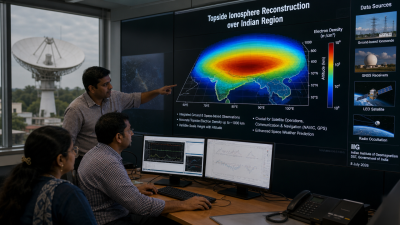
On 8 July 2026 the Indian Institute of Geomagnetism (DST) reported a novel method to reconstruct the topside ionosphere over the Indian region by combining ground‑based ionosonde and COSMIC radio‑occultation data.
Method and Data
- Data sources: ground ionosondes paired with space‑based COSMIC radio occultation profiles.
- Technique: joint inversion to derive continuous electron density profiles above the F‑region peak.
- Model improvement: computes altitudinal variation of topside scale height instead of assuming it constant.
Key Findings
- Vertical reach: accurate electron density reconstruction up to ≈1000 km altitude.
- Equatorial dynamics: resolves complex scale‑height variation over the geomagnetic equator.
- Publication: results published in AGU Radio Science.
Operational Relevance
- Navigation systems: refines ionospheric delay estimates for GPS and India’s NAVIC.
- Satellite operations: improves LEO orbit prediction and mitigation of space‑weather effects.
- Regional monitoring: method can be adapted to other regions for enhanced ionospheric observation.
IASPOINT Booster Facts
- Topside ionosphere: region above the F‑layer peak where electron density decays with scale height.
- Scale height: altitude interval over which density falls by a factor e; influenced by temperature and composition.
- Ionosonde observables: foF2 (F‑region critical frequency) and virtual height for bottomside profiling.
- Radio occultation: GNSS‑based technique from LEO providing precise electron density versus altitude.
- LEO relevance: most LEO satellites operate within ~1000 km, where topside electron density is critical for signal propagation.