
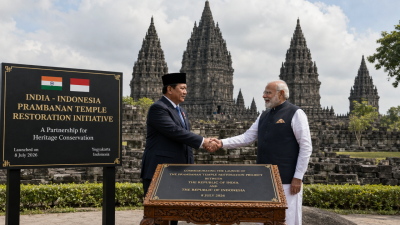
On 8 July 2026 Prime Minister Narendra Modi and Indonesian President Prabowo Subianto inaugurated an India-supported conservation and restoration project at the Prambanan Temple complex in Yogyakarta. The Archaeological Survey of India (ASI) is leading restoration work on the site’s companion temples.
Key features of Prambanan
- Period and polity: Constructed in the 9th century under the Hindu Mataram Kingdom.
- World Heritage status: Inscribed on the UNESCO World Heritage List in 1991.
- Complex composition: Originally about 240 temples; core trio of main shrines with a central Shiva temple rising c.47 metres; dedicated shrines to Vishnu and Brahma.
- Iconography: Extensive stone reliefs depicting the Ramayana and other Hindu epic narratives.
Restoration project — India–Indonesia cooperation
- Lead agency: Archaeological Survey of India undertaking technical conservation and restoration.
- Focus: Restoration of the perwara — smaller companion temples surrounding the three main shrines.
- Scope and status: Approximately 200 perwara exist; Indonesia had restored six; the three principal temples are already complete.
- Timeline: India pledged completion before 2029, accelerating the earlier 2026–2036 projection.
- Associated measures: Follow-up to the 2025 India–Indonesia Joint Statement; 2026–2027 designated Tagore–Dewantara Year for cultural and educational exchanges; discussions on possible IIM/IIT campuses in Indonesia were held.
IASPOINT Booster Facts
- ASI: India’s central archaeological agency under the Ministry of Culture; provides conservation expertise and project implementation.
- Comparative projects: India has supported conservation of My Son (Vietnam), Thiruketheeswaram (Sri Lanka), Bagan (Myanmar) and Angkor (Cambodia) since 2014.
- Term: “Perwara” denotes secondary or companion temples in Javanese temple complexes.