
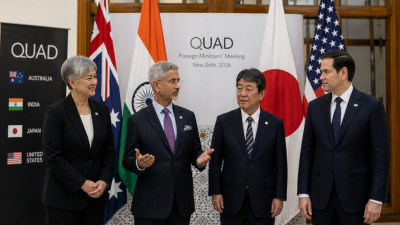
The Quad’s 11th Foreign Ministers’ Meeting in New Delhi refreshed its agenda by launching the Indo‑Pacific Maritime Surveillance Collaboration and a Critical Minerals Initiative Framework, and by moving into joint infrastructure, energy and technology projects that link maritime security, supply‑chain resilience and regional capacity building.
Issue and significance
What is current
The Quad (India, Australia, Japan, United States) now combines maritime domain awareness, supply‑chain and critical‑resource cooperation, infrastructure projects in the South Pacific, and technology partnerships to operationalise a free, open and inclusive Indo‑Pacific. Key announcements include IPMSC, a Critical Minerals Initiative Framework (commitment to mobilise up to USD 20 billion), and the Fiji port project.
Why it matters for governance and security
The grouping moves from declaratory diplomacy to deliverable projects. Improved maritime surveillance addresses unlawful activities and fisheries security. Critical minerals and undersea cable work seek economic resilience. Regional infrastructure and HADR capacity build state capability and influence local governance choices in the Pacific.
Origin and evolution
Originated in coordinated tsunami relief after the 2004 Indian Ocean disaster and first met formally in 2007. The Quad lapsed and re‑emerged as an informal strategic partnership focused on maritime stability, connectivity and technology cooperation. It now pursues project delivery across security, economic and development domains.
Core objectives and principles
- Primary objective: Promote a free, open and inclusive Indo‑Pacific.
- Security: Enhance maritime domain awareness, interoperability and lawful maritime order.
- Economic resilience: Diversify and de‑risk critical supply chains, and mobilise investment.
- Technology and capacity: Cooperate on telecommunications, next‑generation networks, AI and agriculture R&D.
- Humanitarian and development: Strengthen HADR, health training and infrastructure for small island states.
Key initiatives and areas of cooperation
| Initiative | Domain | Purpose / Output |
|---|---|---|
| Indo‑Pacific Maritime Surveillance Collaboration (IPMSC) | Maritime security | Information sharing, maritime domain awareness; initial focus on Indian Ocean Region |
| Quad‑at‑Sea Ship Observer Mission | Operational interoperability | Ship observers to improve coordination against unlawful maritime activities |
| Critical Minerals Initiative Framework | Economic resilience | Coordination and finance for supply chains; up to USD 20 billion commitment |
| Fiji port project; undersea cable commitments | Infrastructure, connectivity | First joint regional infrastructure project; secure cables for Pacific Island Forum countries with USD 25+ million support |
| Open RAN, 6G cooperation, AI‑ENGAGE | Technology & innovation | Telecom resilience, next‑gen R&D, and agricultural AI projects (USD 6 million for six projects) |
| Quad Initiative on Indo‑Pacific Energy Security | Energy security | Cooperation on technology, policy and emergency response for regional energy resilience |
| HADR and health training | Humanitarian assistance | Training and exercises exceeding USD 50 million in value across the Indo‑Pacific |
India’s role and contribution
- Diplomatic host: Hosted the 11th Quad Foreign Ministers’ Meeting and leads political coordination on several initiatives.
- Operational participation: Will host the next Quad‑at‑Sea Ship Observer Mission; contributes naval, coastguard and surveillance assets.
- Technology & development: Engages in Open RAN, AI‑ENGAGE projects and regional HADR capacity building aligned with its SAGAR and maritime security objectives.
- Strategic balance: Uses Quad engagement to advance strategic autonomy while promoting regional public goods.
Challenges and concerns
- Political coherence: Diverse national priorities and domestic politics can limit sustained leaders‑level engagement; the 2025 Leaders’ Summit in New Delhi was postponed earlier.
- Operational friction: Information sharing and rules for maritime surveillance require technical, legal and trust arrangements among members and partners.
- Perception management: Risk of being perceived as a bloc aimed at a specific third country, complicating relations with regional states that prefer non‑alignment.
- Geopolitical signalling: Rebranding of U.S. command structures and other policy shifts create uncertainty about long‑term US commitments.
- Delivery constraints: Mobilising USD 20 billion for critical minerals and synchronising private‑public finance with host governments entails regulatory, commercial and environmental hurdles.
Implications for policy and strategic planning
- Rule framing: Institutionalise data‑sharing protocols, legal safeguards and common standards for IPMSC and undersea cables.
- Financing models: Combine grants, concessional finance and private investment for infrastructure and mineral projects while enforcing transparency and environmental safeguards.
- Regional partnerships: Expand cooperation with Pacific island states and multilateral institutions to reduce perception of external strategic competition.
- Capacity building: Prioritise interoperable systems, training and local institutional support for HADR and maritime law enforcement.
- Domestic alignment: Coordinate national policies on critical minerals, telecom security and defence logistics to translate Quad agreements into operational capacity.
Model Questions
1. Trace the strategic evolution of the Quad from humanitarian cooperation to a security and development platform in the Indo‑Pacific. What are its core objectives and principal instruments? [GS-II: International Relations]
The Quad evolved from post‑2004 tsunami coordination to a strategic partnership addressing maritime security, supply‑chain resilience, technology cooperation and HADR. Core objectives: a free, open, inclusive Indo‑Pacific; maritime domain awareness; economic resilience; technology and capacity building. Key instruments: IPMSC, Critical Minerals Framework (USD 20 billion mobilisation), infrastructure projects (Fiji port, secure undersea cables), Open RAN/6G collaboration and AI‑ENGAGE.
2. Examine how the Indo‑Pacific Maritime Surveillance Collaboration and the Critical Minerals Initiative enhance regional security and economic resilience. [GS-III: Economic Development]
IPMSC strengthens maritime domain awareness and information sharing to counter unlawful activities and protect fisheries and trade routes. The Critical Minerals Initiative coordinates sourcing, processing and investment to reduce supply‑chain concentration, aiming to mobilise up to USD 20 billion. Together they address security risks to commerce and strategic industries, lower import dependence, and improve deterrence through better situational awareness and diversified resource networks.
3. Assess the Quad’s contributions to infrastructure, technology cooperation and disaster response in the Indo‑Pacific. Provide examples. [GS-II: Governance]
The Quad advances infrastructure via the Fiji port project and secure undersea cables for Pacific island connectivity (USD 25+ million support). Technology cooperation includes Open RAN, 6G research and AI‑ENGAGE (USD 6 million for agricultural R&D). HADR capacity consists of medical training and disaster exercises exceeding USD 50 million. These projects combine technical assistance, finance and interoperability to strengthen governance and resilience of partner states.
4. Identify the principal challenges facing the Quad and evaluate prospects for maintaining strategic coherence among member states. [GS-II: International Relations]
Challenges: divergent national priorities, perception risks, legal and technical barriers to intelligence sharing, financing complexity for large projects, and shifts in US force posture. Prospects depend on consistent leaders‑level engagement, clear delivery timelines, binding protocols for data sharing, inclusive regional outreach to avoid geopolitical alienation, and integrated financing that aligns private capital with development safeguards.
Last Modified: July 9, 2026