
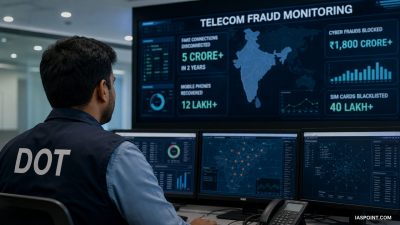
The Department of Telecommunications disconnected over five crore fraudulent mobile connections in the two years up to July 2026. The action formed part of an integrated fraud-control effort using the Financial Fraud Risk Indicator, CEIR-based device tracking and a newly opened Network Security Laboratory to curb telecom-linked cybercrime and recover stolen devices.
What is the current issue
The telecom ecosystem contains a large number of SIMs issued with forged or misused identity documents. Such connections enable financial scams, identity theft and criminal coordination. Regulatory, technical and enforcement gaps allow syndicates to exploit Point of Sale (PoS) agents and cloned devices.
Why it matters
- Governance: Unverified SIMs weaken enforcement and burden law enforcement with cross-jurisdictional investigations.
- Economy: Telecom-enabled financial frauds caused losses exceeding ₹1,800 crore and impose costs on banks and consumers.
- Security: Fake connections can be used for organised crime, terror communication and cross-border coordination.
- Technology: Device cloning and weak identity checks undermine technical countermeasures such as IMEI-based blocking.
- Citizen rights: Victims face financial loss and reputational harm from SIM misuse in their name.
National security and cybercrime threats
Threat vectors
- Financial fraud: SIMs aid OTP interception, SIM-swap attacks and account takeover through social engineering.
- Identity crimes: Forged SIM registrations enable fraudulent KYC and synthetic identities.
- Organised use: Networks of fake SIMs support call frauds, phishing campaigns and coordination of illegal activity.
Scale and impact
- Over five crore fraudulent connections were disconnected in a two-year period up to July 2026.
- Telecom checks and analytics helped prevent cyber-enabled financial frauds worth more than ₹1,800 crore and recover over 12 lakh lost or stolen phones.
Regulatory and governance framework
Role of DoT and operators
- DoT authority: Regulates subscriber verification, SIM issuance and security standards through licence conditions.
- PoS agents: Authorised intermediaries required to perform KYC before SIM issuance. Lax oversight enables collusion and fake registrations.
Enforcement actions and precedent
- August 2023 actions disconnected over 52 lakh fraudulent SIMs and blacklisted over 67,000 PoS agents for aiding fake registrations.
- May 2024 exercise flagged about 6.8 lakh connections for mandatory KYC re‑verification to detect forged identity documents.
- Blacklisting, targeted re-verification and disconnection are primary administrative levers used by DoT.
Technical and institutional infrastructure
Financial Fraud Risk Indicator (FRI)
- Design: FRI is an analytic module within the Digital Intelligence Platform launched in May 2025.
- Function: It classifies numbers as Medium, High or Very High risk using inputs from the National Cybercrime Reporting Portal, Chakshu and financial institutions.
- Outcome: FRI-supported actions helped block frauds worth over ₹1,800 crore.
Device and network tools
| Tool | Primary function | Outcome |
|---|---|---|
| CEIR | IMEI-based blocking and tracking | Contributed to recovery of over 12 lakh lost/stolen phones |
| Digital Intelligence Platform (DIP) | Aggregate analytics and threat scoring | Enabled FRI risk classification |
| Network Security Laboratory (Hyderabad) | Research, threat simulation and forensic testing | Supports DoT technical response and regional capacity building |
Institutional leadership
- DoT’s analytical and enforcement capacity expanded with specialised labs and DIP tools. The Hyderabad Network Security Lab was inaugurated in July 2026 to support advanced telecom security research.
State-level implementation and case study
Andhra Pradesh Licensed Service Area (AP LSA)
- AP LSA busted 11 illegal telecom and cybercrime setups in 2025–26.
- It recovered about 2.04 lakh lost or stolen mobile phones—the highest single-LSA recovery nationally.
- The AP example shows how local enforcement plus DoT tools yield measurable results.
Challenges and gaps
- Decentralised PoS network: Millions of agents complicate monitoring, audit and compliance enforcement.
- Information delays: Slow data-sharing between operators, banks and police reduces the window to block fraud.
- Device cloning: IMEI spoofing diminishes CEIR effectiveness without hardware-level safeguards.
- Legal and privacy limits: Surveillance measures require statutory backing and oversight to avoid misuse.
- Capacity shortfall: Limited forensic and analytic capacity in some LSAs hampers rapid response.
Way forward (practical measures)
- Strengthen PoS controls: Mandate live biometric Aadhaar verification with liveness detection at SIM activation and periodic audits of agents.
- Enhance FRI analytics: Integrate machine learning to detect anomalous patterns and automate temporary suspension of Very High risk numbers pending enquiry.
- Harden CEIR: Combine IMEI checking with device manufacturer attestation and tamper-detection to counter cloning.
- Scale labs: Replicate Network Security Laboratory capability across all 22 Licensed Service Areas for local threat intelligence and rapid forensic support.
- Speed up SOPs: Standardise rapid data‑sharing protocols among operators, banks and law enforcement with clear timelines and accountability.
- Legal and privacy safeguards: Operate surveillance and profiling tools under statutory limits, judicial oversight and data protection standards; use proportionality tests for interventions.
- Consumer empowerment: Promote Sanchar Saathi and similar portals for citizens to check active connections in their name and report unauthorised SIMs.
Model Questions
1. Analyse the security threats posed by fraudulent mobile connections and evaluate the systemic measures required to counter telecom-linked cybercrimes in India. [GS-III: Internal & External Security]
Over five crore fraudulent connections were disconnected, showing scale. Threats include financial fraud, identity theft and facilitation of organised crime. Systemic measures require strict PoS verification, nationwide CEIR and FRI-based analytics, live biometric activation, rapid inter‑agency data sharing and regional forensic labs. Combine administrative sanctions with technical controls, audit of agents and legal frameworks that enable timely takedown while preserving rights.
2. Discuss the regulatory and governance challenges faced by the Department of Telecommunications in managing subscriber verification and combating financial fraud. [GS-II: Governance]
Challenges include monitoring a decentralised PoS network, forged identity documents, delayed information flows and uneven enforcement across LSAs. Governance responses need robust KYC enforcement, blacklisting of colluding agents, standard operating procedures for data exchange, accountability for operators, capacity building for regional units and integrating FRI outputs into enforcement. Legal clarity and independent oversight are necessary to ensure due process.
3. Examine why technical interventions are essential to secure India’s telecommunications infrastructure and suggest key technical priorities. [GS-III: Science & Technology]
Administrative disconnections are necessary but insufficient. Technical priorities: enhance FRI with ML for predictive detection; strengthen CEIR with manufacturer attestation to counter IMEI cloning; deploy live biometric liveness checks at activation; scale network security labs for forensics; and standardise secure APIs for real-time data sharing with banks and law enforcement. Technical controls reduce fraud speed and increase attribution.
4. Evaluate the ethical balance between state-led telecom surveillance for public safety and the protection of individual privacy. [GS-IV: Ethics, Integrity and Aptitude]
State measures like risk-profiling, re‑verification and device tracking protect citizens and financial systems but raise privacy risks. Ethical balance requires statutory authority, necessity and proportionality tests, clear retention limits, independent oversight, grievance redress and transparency. Data minimisation, consent where practicable, and strict access controls should accompany technical measures to prevent mission creep and safeguard civil liberties.
Last Modified: July 14, 2026