
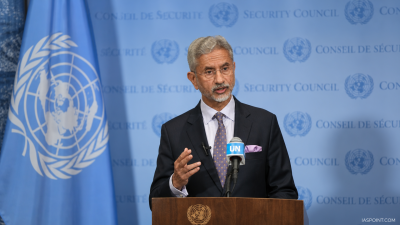
India launched its official campaign at UN headquarters on 13 July 2026 for a non‑permanent Security Council seat for 2028–29. External Affairs Minister S. Jaishankar unveiled the SHANTI vision — Securing Holistic Advancement through Norms, Trust and Integrity — as India prepares to contest the Asia‑Pacific seat against Tajikistan in the June 2027 election.
What is the current issue?
India seeks a non‑permanent UNSC seat for 2028–29 under the SHANTI framework. The immediate task is to obtain a two‑thirds majority in the UN General Assembly (129 of 193 votes) in June 2027. The campaign links India’s candidature to six priority areas: peacekeeping, maritime security, terrorism and terror financing, responsible AI, sustainable development, and governance reforms.
Why it matters
The bid affects India’s international standing, its claim for permanent representation, and the voice of the Global South in security decision‑making. A successful campaign would strengthen India’s ability to shape UN responses on conflicts, counter‑terrorism, technology governance and development finance. Failure would constrain India’s diplomatic momentum and influence in multilateral security governance.
Geopolitical strategy and Global South representation
- Electoral mathematics: The election requires 129 votes. Vote mobilisation must cover regional groups, Africa, Latin America, Caribbean, Pacific states and SIDS.
- Competitive environment: India faces Tajikistan for the Asia‑Pacific slot. Tajikistan’s regional ties in Central Asia and with some OIC members shape voting patterns.
- Diplomatic assets: India’s advantages include founding‑member status, eight prior non‑permanent tenures, recent 2021–22 term experience, and long participation in UN peacekeeping.
- Campaign tools: Development assistance, lines of credit, capacity‑building, vaccine and medical diplomacy, diaspora influence, and high‑level visits form the operational outreach strategy.
Institutional reforms in global governance
SHANTI affirms India’s demand for UNSC reform. Key reform agendas include expansion of permanent membership to reflect contemporary geopolitics, better representation for Africa and Asia, and measures to reduce decision‑making asymmetries caused by the veto. India intends to use a non‑permanent term to demonstrate leadership, coalition‑building capacity and practical contributions to collective security as evidence for permanent membership claims.
Security and technology dimensions of SHANTI
Peacekeeping and operational reforms
- Contributions: India remains a major troop contributor and advocates stronger protection, better mandate clarity, and modern logistics for peacekeepers.
- Doctrine: Emphasis on rapid deployment, situational awareness, and integration of defensive technologies consistent with UN mandates.
Maritime security
- Focus: Open, safe sea lanes; adherence to UNCLOS; cooperative action against piracy and trafficking in the Indian Ocean Region.
- Instruments: Naval diplomacy, information‑sharing mechanisms, and capacity building for littoral states.
Terrorism and terror financing
- Policy priorities: Push for the Comprehensive Convention on International Terrorism, stronger global enforcement against terror financing, and implementation of UN sanctions and FATF standards.
- Operational measures: Information‑sharing, asset‑tracking, and multilateral legal assistance.
Responsible use and governance of AI
- Objective: Global standards to prevent weaponisation, misuse in disinformation, and discriminatory outcomes while ensuring equitable access for developing states.
- Approach: Multistakeholder norms, transparency requirements, capacity building for AI governance in Global South states, and rules for dual‑use technologies.
Ethical and normative pillars: Norms, Trust and Integrity
Norms: Sovereign equality, territorial integrity and peaceful dispute settlement as central legal principles. Trust: Buildable through consistent state behaviour, predictable multilateral processes, and equal treatment of member states. Integrity: Transparent decision‑making, avoidance of double standards in issues such as terrorism and human rights, and accountability mechanisms for UN bodies.
Challenges and way forward
| Challenge | Mitigation / Way forward |
|---|---|
| Electoral competition and regional rivalries | Targeted diplomacy in Africa, Latin America, SIDS and Central Asia; use of bilateral and multilateral exchanges to secure commitments. |
| Perception of great‑power politics | Cast India’s candidature as Global South representation; highlight independent voting record and developmental partnerships. |
| Operational credibility on SHANTI priorities | Publish concrete policy proposals on AI governance, terror finance enforcement and maritime cooperation; offer capacity‑building packages. |
| Structural limits of UNSC | Work within reform coalitions (G4 and other reform‑minded states) to advance expansion and procedural reforms incrementally. |
Model Questions
1. Analyse the geopolitical factors and electoral challenges India faces in securing a non‑permanent UNSC seat for 2028–29 against Tajikistan. [GS‑II: International Relations]
India needs a two‑thirds majority (129/193) in the General Assembly. Key challenges include Tajikistan’s Central Asian support and mobilisation among regional blocs. India must convert development partnerships, peacekeeping credentials, and diplomatic outreach in Africa, Latin America and SIDS into votes. Tactical priorities: secure early commitments, address abstention risks, coordinate with regional groups, and deploy targeted high‑level diplomacy and capacity‑building offers.
2. How does the SHANTI framework align with India’s demand for structural reforms in the UN Security Council? [GS‑II: International Relations]
SHANTI links normative principles to reform advocacy. By emphasising norms, trust and integrity, India frames expansion and better regional representation as necessary for legitimate security governance. A non‑permanent term serves as a proving ground to demonstrate coalition‑building, consensus management and operational competence. India will use performance on SHANTI priorities to strengthen arguments for permanent membership and for reforms reducing decision‑making asymmetries.
3. Examine the security and technological dimensions of SHANTI with reference to maritime security, terrorism financing and AI governance. [GS‑III: Internal & External Security]
SHANTI addresses non‑traditional security: maritime security relies on UNCLOS adherence, naval cooperation and capacity building. Terrorism financing focus includes pushing for the Comprehensive Convention on International Terrorism, stricter enforcement of UN and FATF regimes, and asset‑tracking. AI governance calls for global norms to prevent weaponisation and disinformation, transparency standards, and technical assistance to ensure equitable access for developing states.
4. Discuss the roles of ‘Trust’ and ‘Integrity’ in SHANTI as ethical imperatives for multilateral credibility. [GS‑IV: Ethics, Integrity and Aptitude]
Trust requires predictable behaviour, rule‑based decision‑making and consistent application of international law. Integrity entails transparency, rejection of double standards and institutional accountability. Together they aim to restore credibility eroded by selective compliance and great‑power unilateralism. Practically, this means clearer mandates, equal treatment in counter‑terrorism actions, and mechanisms for monitoring adherence to agreed norms.
Last Modified: July 14, 2026