
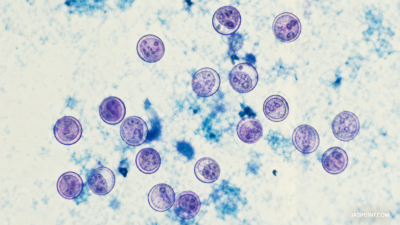
As of 15 July 2026 the US CDC confirmed 1,645 domestically acquired Cyclospora cases across 34 states and is reviewing over 5,100 additional reports.
Organism and Taxonomy
- Scientific name: Cyclospora cayetanensis, a single‑celled protozoan in the phylum Apicomplexa.
- Reservoir: Human‑restricted; no confirmed animal reservoir.
- Oocyst biology: Oocysts are excreted unsporulated and require days in the environment to sporulate and become infective.
Transmission and Sources
- Primary route: Faecal–oral ingestion of sporulated oocysts in contaminated food or water.
- Produce links: Leafy greens, bagged salads, herbs and berries frequently implicated in outbreaks.
- Person‑to‑person: Uncommon due to environmental sporulation requirement.
- Resistance: Oocysts tolerate routine chlorination and may persist despite standard washing.
Clinical, Diagnosis and Treatment
- Incubation period: Typically 2–14 days (median ≈7 days).
- Symptoms: Watery diarrhoea, abdominal cramps, anorexia, weight loss; illness can be prolonged without therapy.
- Diagnosis: Microscopy with modified acid‑fast stain, UV autofluorescence, or PCR of stool.
- Treatment: Trimethoprim‑sulfamethoxazole (TMP‑SMX) is the drug of choice; no vaccine available.
IASPOINT Booster Facts
- Surveillance: FoodNet made Cyclospora reporting optional from 1 July 2025, affecting national trend comparability.
- Lead agency: Centres for Disease Control and Prevention (CDC) coordinates US outbreak investigations.