
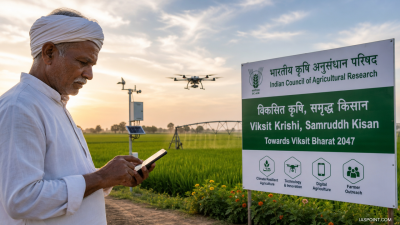
The Indian Council of Agricultural Research (ICAR) released a Viksit Krishi roadmap at its 98th Foundation Day. The roadmap sets centenary targets (by 2029) for 100 Climate Smart Villages, outreach to 100 million farmers, tech commercialisation of ₹10,000 crore, One Institute–One Grand Innovation (by 2028), an Open Digital Knowledge Platform, and multiple variety and technology releases.
What is current
- Event: ICAR marked its 98th Foundation Day in New Delhi led by Union Minister Shivraj Singh Chouhan and Secretary DARE & DG ICAR Dr Mangi Lal Jat.
- Centenary targets (by 2029): 100 Climate Smart Villages; extend ICAR technologies to 100 million farmers; generate ₹10,000 crore through technology commercialisation.
- Near-term obligations: One Institute–One Grand Innovation to deliver a nationally impactful breakthrough by 2028.
- Deliverables: Release of 43 crop varieties, 17 technologies/products, 14 publications; 72 MoUs with 51 industry partners.
- Outreach: Viksit Krishi Sankalp Abhiyan conducted over 55,000 programmes and directly interacted with 1.35 crore farmers across phased campaigns.
Why it matters for governance and economy
- Food security: Climate-resilient varieties and wider tech adoption reduce yield variability and dependency on imports.
- Rural incomes: Technology commercialisation and mechanisation can raise labour productivity and non-farm employment.
- Environment and risk: Climate-smart practices lower vulnerability to extreme weather and conserve resources.
- Governance: Digital platforms and institutional targets require coordination across ministries, states, PRIs and private partners.
Technological transition and farm mechanisation
Aim: raise mechanisation from a 47% baseline (2025) to at least 75% by 2047. Key technology areas are precision agriculture (sensors, drones, satellite analytics), robotics for labour-intensive tasks, and AI for decision support and predictive advisories.
Constraints
- Fragmented landholdings: Average holding around 1–2 hectares limits economies of scale for owned machinery.
- Capital costs: High purchase price of precision tools and robotics is unaffordable for marginal farmers.
- Skill and maintenance: Low technical literacy and weak service networks impede sustained use.
Policy responses
- Custom Hiring Centres (CHCs): Scale CHCs and mobile service units to offer pay-per-use access to advanced machines.
- Cooperative and land-pooling models: Incentivise farmer producer organisations (FPOs) and community leasing for shared machinery.
- Targeted finance and subsidies: Low-interest credit, risk-sharing facilities, and hire-purchase schemes for smallholders.
- Skill development: Short modular courses through KVKs and polytechnics for operators and maintenance technicians.
Climate resilience, Climate‑Smart Villages and food security
Centenary targets include developing 100 Climate Smart Villages and deploying climate-resilient varieties, livestock and fisheries vaccines. Scientific outputs released target higher yield stability and reduced losses.
Implementation barriers
- Scaling pilots: Pilots require adaptation to local agro-ecologies and social contexts.
- Upfront cost: Conservation agriculture, micro-irrigation and soil-health measures need initial capital.
- Advisory gaps: Absence of localized agro-meteorological services reduces timely adoption.
Operational levers
- Local planning: Integrate village plans with PRIs and district climate action plans.
- Public works linkage: Use MGNREGS and watershed schemes to build water and soil conservation assets.
- Risk-transfer: Strengthen crop and livestock insurance schemes (PMFBY reforms) and index-based products.
Institutional extension and digital governance
ICAR’s Open Digital Knowledge Platform is intended as a mobile-first public repository of advisories. The Viksit Krishi Sankalp Abhiyan reached millions through phased campaigns. KVKs and extension cadres remain central to delivery.
Gaps
- Human resources: Vacancies and weak capacity at state extension services and some KVKs.
- Digital divide: Low smartphone penetration, poor connectivity, and language barriers constrain uptake.
Practical fixes
- Multilingual, voice-based advisories: Use regional languages and audio-visual content for low-literacy farmers.
- Hybrid extension: Combine digital platforms with village-level facilitators and field demonstrations.
- Performance metrics: Track lab-to-land conversion rates; reward institutes under One Institute–One Grand Innovation for field deployment.
Economic sustainability, technology commercialisation and counterfeits
ICAR aims to generate ₹10,000 crore in internal resources by 2029 through commercialisation. Public‑private partnerships and 72 MoUs with industry partners are intended to scale technologies to market.
Risks from counterfeit inputs
- Yield and income loss: Fake seeds and sub‑standard pesticides reduce outputs and degrade soil health.
- Biosecurity risk: Poor-quality agrochemicals can spur pest resistance and environmental harm.
Regulatory and market responses
- Legal framework: Use the Seeds Act, PPV&FR Act and Insecticides Act for enforcement and penalties.
- Traceability: Mandatory QR codes and blockchain-enabled supply‑chain tagging for seed and pesticide consignments.
- Fast-track transfer: Create a clearance window in regulatory bodies for market-ready public innovations; standardise licensing and benefit-sharing.
- Quality labs: Strengthen state and central seed and pesticide testing laboratories and sample surveillance.
| Dimension | Core challenge | Policy response |
|---|---|---|
| Mechanisation | Small farms, cost | CHCs, co-operatives, credit, low-cost machines |
| Climate resilience | Scale and finance | Village plans, MGNREGS assets, insurance |
| Extension | Digital divide, vacancies | Multilingual platforms, KVK capacity, hybrid delivery |
| Quality control | Counterfeit inputs | Traceability, stronger labs, legal enforcement |
Model Questions
1. Analyse the role of precision agriculture and artificial intelligence in achieving 75% farm mechanisation by 2047. What are the key economic barriers and policy measures to overcome them? [GS-III: Science & Technology]
Precision tools and AI optimise input use, enable yield forecasting, automate monitoring and reduce labour dependence, aiding the shift to 75% mechanisation. Economic barriers include fragmented holdings, high capital costs, weak service markets and low technical skills. Policy measures: expand Custom Hiring Centres, promote co-operatives and land-pooling, targeted credit/subsidies, modular machine designs for small plots, skill training through KVKs and PPPs for maintenance networks.
2. Assess the capability of Climate‑Smart Villages and climate‑resilient varieties to reduce climate risk to Indian food security. How do ICAR’s centenary targets contribute? [GS-III: Environment & DM]
Climate‑Smart Villages combine resilient varieties, water conservation and adaptive practices to reduce yield variability and buffer shocks. Resilient varieties lower disease and heat sensitivity. ICAR’s centenary focus on 100 villages and outreach to 100 million farmers creates demonstration nodes and rapid diffusion. Challenges are local adaptation, capital needs and advisory services; addressing these requires village planning, public works funding and enhanced agro‑meteorological advisories.
3. Evaluate the role of institutional extension and digital governance platforms in bridging the lab‑to‑land gap for small and marginal farmers. [GS-II: Governance]
Digital platforms offer scalable advisories and knowledge repositories. Institutional outreach (KVKs, Viksit Krishi Sankalp Abhiyan) supplies demonstration and trust. Gaps include connectivity, languages and extension vacancies. Bridging measures: mobile‑first, multilingual and voice interfaces; hybrid delivery combining village facilitators with digital tools; capacity building for KVKs; performance incentives for institutes to translate innovations into field‑ready solutions.
4. Examine economic and security challenges posed by counterfeit seeds and pesticides. How can technology commercialisation and public‑private partnerships address these risks? [GS-III: Economic Development]
Counterfeit inputs reduce yields, degrade soils and create pest resistance, harming farmer incomes and food security. Commercialisation and PPPs can widen distribution of certified products, finance traceability systems and scale genuine innovations. Policy tools: QR code/blockchain tagging, stronger testing labs, enforcement under Seeds/PPV&FR/Insecticides Acts, fast‑track licensing for validated public innovations and revenue sharing to incentivise quality supply chains.
Last Modified: July 17, 2026