
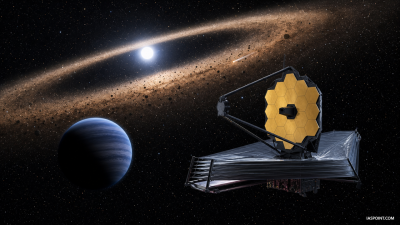
Scientists announced the discovery of exoplanet Beta Pictoris d on 15 July 2026 from observations by NASA’s James Webb Space Telescope and the European Southern Observatory’s Very Large Telescope.
Beta Pictoris System
- Distance & age: System lies ≈63 light‑years away; estimated age ≈23 million years.
- Planetary inventory: Hosts previously known giant planets Beta Pictoris b and c; d is the third confirmed giant.
Detection & Techniques
- Instruments used: JWST NIRSpec Integral Field Unit and ESO’s VLT provided combined space‑ and ground‑based data.
- Spectral method: Detected via carbon monoxide absorption lines in the near‑infrared—chemical fingerprinting complementing imaging.
- Imaging: Planet resolved in direct images with follow‑up spectroscopy for atmospheric signature.
Planetary Characteristics
- Mass: Estimated at least 2.0–2.4 Jupiter masses.
- Orbit & brightness: Orbital radius ≈30 astronomical units; about 100 times fainter than Beta Pictoris b.
- Detectability: Among the lowest‑mass exoplanets directly imaged so far.
Publication & Facilities
- Publication: Results reported by two independent teams in The Astrophysical Journal Letters on 15 July 2026.
- Facilities note: JWST operates primarily in infrared; VLT is a flagship ESO observatory in Chile.
IASPOINT Booster Facts
- Spectroscopy role: NIRSpec IFU yields spatially resolved spectra crucial for molecular detection in exoplanet atmospheres.
- Classification: Gas giant; direct imaging is most effective for young, hot planets on wide orbits.
- Scientific use: Beta Pictoris provides a laboratory for studying early planet formation and migration.