
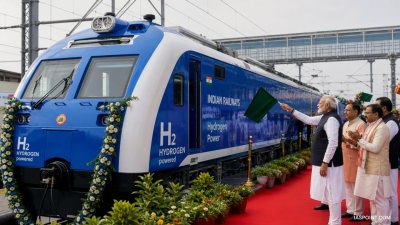
Prime Minister Narendra Modi flagged off the NaMo Green Rail, India’s first indigenous hydrogen-powered train, from Jind (Haryana) on 17 July 2026. The 10‑coach train runs two return trips daily on the 89‑km Jind–Sonipat route, uses PEM fuel cells and a dedicated refuelling facility at Jind.
What is current and why it matters
- Deployment: Indigenous 10‑coach hydrogen train (capacity ~2,600) operating under Northern Railway with two driving power cars (1,200 kW each; combined 2,400 kW).
- Policy relevance: Links Make in India, Atmanirbhar Bharat, National Green Hydrogen Mission and the Hydrogen for Heritage initiative for sensitive routes.
- Governance and economy: Tests feasibility of zero‑emission traction where overhead electrification is impractical or undesirable.
Technology and scientific principles
- Core technology: Proton Exchange Membrane (PEM) fuel cells combine onboard compressed hydrogen with atmospheric oxygen to produce electricity, water vapour and heat through an electrochemical reaction. No combustion at point of use.
- Energy system: Fuel cells supply traction motors; surplus energy captured by onboard lithium iron phosphate (LFP) batteries during braking for peak shaving and auxiliary loads.
- Specifications: Approved operating speed 75 km/h, design speed up to 110 km/h; two driving power cars plus eight passenger coaches; two return trips daily on the Jind–Sonipat run with 12 intermediate stops.
- Support infrastructure: Integrated hydrogen storage and refuelling facility established at Jind; PESO clearances obtained for operations.
Environmental dimensions
- Emission profile: Zero point‑of‑use CO2, NOx and particulate emissions; exhaust is water vapour and low‑grade heat.
- Local ecology: Removes diesel soot and noise from heritage and hill routes, protecting fragile biodiversity and tourist environments.
- Climate alignment: Supports India’s rail decarbonisation goals and the National Green Hydrogen Mission; contributes to national Net Zero trajectory when hydrogen is green (renewable‑based).
- Life‑cycle caveat: Overall emissions depend on hydrogen production pathway (green vs grey/blue). Green hydrogen is essential for genuine decarbonisation benefits.
Economic and infrastructural viability
- Capital costs: Indicative estimates: ~₹80 crore per trainset and ~₹70 crore per route for ground infrastructure. High initial investment relative to conventional rolling stock.
- Comparative efficiency: Conversion losses occur when electricity → hydrogen → electricity; direct grid electrification is more energy‑efficient where overhead lines are feasible.
- Network context: Over 99% of Indian broad‑gauge routes are electrified; hydrogen traction is thus suited to niche cases — heritage, mountain railways, and isolated non‑electrified stretches where visual or ecological concerns prevent overhead electrification.
- Fuel supply and logistics: Scaling requires large‑scale green hydrogen production, compression/transport infrastructure, and standardised refuelling protocols along corridors.
- Financing options: Public‑private partnerships, viability gap funding for heritage routes, retrofitting existing DEMU rakes to reduce costs, and state incentives for green hydrogen may lower barriers.
Policy, governance and domestic manufacturing
- Manufacturing capability: Integral Coach Factory, Chennai, designed and built the NaMo Green Rail under Make in India and Atmanirbhar Bharat priorities.
- Regulatory framework: Inter‑ministerial coordination (Railways, MNRE, MoPNG where relevant) and safety oversight by PESO are necessary for storage, transport and station refuelling licences.
- Support measures: National Green Hydrogen Mission targets capacity scale‑up, cost reduction, and demand aggregation; standards for hydrogen storage, leak detection and emergency response remain priorities.
- Human resources: Training for specialised maintenance crews, station staff and first responders required. Certification and operational manuals must be standardised.
Operational safety and technical challenges
- Storage and handling: Compressed hydrogen requires high‑pressure vessels or cryogenic systems; material compatibility and leak detection are essential to prevent ignition risks.
- System redundancy: Batteries provide auxiliary power and emergency backup; multiple sensors and automatic shut‑offs reduce human error risks.
- Maintenance regime: Fuel cell stacks, high‑pressure lines and LFP batteries require new maintenance protocols and supply chains for spare parts.
Comparison: traction options (selected dimensions)
| Dimension | Hydrogen Fuel Cell | Diesel | Overhead Electrification |
|---|---|---|---|
| Point‑of‑use emissions | None (water vapour) | CO2, NOx, PM | None (depends on grid mix) |
| Energy efficiency | Lower (conversion losses) | Combustion efficiency limited | Higher (direct) |
| Capital cost | High for train + infrastructure | Lower rolling stock cost | High for track electrification; lower operating cost |
| Best use case | Non‑electrified, ecologically sensitive routes | Remote routes without alternatives | Mainline high‑traffic corridors |
Operational roadmap and policy actions
- Prioritise routes: Deploy hydrogen trains on heritage and ecologically sensitive routes where overhead lines are undesirable.
- Scale green hydrogen: Accelerate renewable capacity, electrolyser deployment and demand aggregation to reduce hydrogen cost.
- Cost reduction: Support manufacturing scale‑up for fuel cells and high‑pressure tanks; encourage retrofitting DEMUs as lower‑cost pilots.
- Standards and safety: Fast‑track unified standards for storage, transport and refuelling; mandate training and emergency protocols.
- Finance and partnerships: Use PPP, concessional finance and outcome‑based contracts to share risks and attract private investment in refuelling networks.
- R&D: Fund research on higher‑efficiency fuel cells, hydrogen carriers (LOHCs, ammonia) and battery‑fuel cell integration to improve range and reduce costs.
Model Questions
1. Explain the scientific principle behind Proton Exchange Membrane (PEM) fuel cells used in hydrogen trains and evaluate their environmental benefits over conventional traction systems. [GS-III: Science & Technology]
Hydrogen in a PEM fuel cell reacts electrochemically with oxygen at the cathode to produce electricity, water vapour and heat; protons pass through a polymer membrane while electrons flow through an external circuit to drive motors. Environmental benefits: zero point‑of‑use CO2, NOx and particulate emissions; lower noise; removal of diesel soot on scenic routes. Net climate gain requires green hydrogen production.
2. Assess the economic and infrastructure challenges in scaling hydrogen‑powered rail in India, given extensive electrification of the broad‑gauge network. [GS-III: Economic Development]
Scaling faces high capital costs (~₹80 crore per train, ~₹70 crore per route), energy conversion inefficiency versus direct electrification, and lack of green hydrogen supply chains. Since 99% broad‑gauge is electrified, hydrogen is niche for non‑electrified, sensitive routes. Solutions: retrofitting, PPP finance, electrolyser scale‑up, corridor refuelling hubs and demand aggregation to lower unit costs.
3. Under the Hydrogen for Heritage scheme, explain the ecological rationale for deploying hydrogen trains on heritage and sensitive routes and discuss alignment with India’s climate targets. [GS-III: Environment & DM]
Heritage and hill railways suffer diesel soot, noise and local ecological damage. Hydrogen trains remove tailpipe particulates and NOx and reduce noise, protecting biodiversity and cultural landscapes. Alignment: supports Indian Railways’ decarbonisation targets and the National Green Hydrogen Mission; contribution to national Net Zero depends on hydrogen being produced from renewable electricity.
4. Examine the policy, governance and institutional measures that enabled indigenous development of the NaMo Green Rail and outline further governance actions required for wider deployment. [GS-II: Governance]
Enablers: Make in India and Atmanirbhar Bharat priorities, ICF Chennai design and manufacture, PESO safety clearances and coordination between Railways and MNRE. Required actions: unified regulatory standards, inter‑ministerial fuel‑supply planning, financing mechanisms (PPP, subsidies), workforce training, and clear procurement rules to scale manufacturing and refuelling infrastructure.
Last Modified: July 18, 2026