
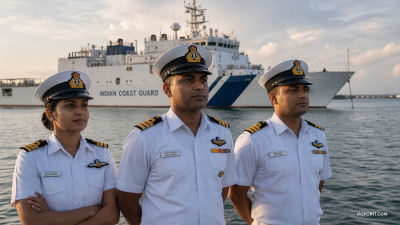
On 28 July 2026, Raksha Mantri Rajnath Singh announced two policy reforms for the Indian Coast Guard at Kartavya Bhavan‑2, New Delhi, in the presence of Defence Secretary Rajesh Kumar Singh and DG ICG Paramesh Sivamani. Reforms introduce a gender‑neutral officer induction framework and a streamlined ex‑gratia procedure for personnel missing at sea.
What changed
The Indian Coast Guard (ICG) adopted a gender‑neutral officer induction policy and simplified administrative rules for ex‑gratia assistance to Next of Kin of personnel reported missing at sea. Women may now join both Short Service Appointments (SSA) and Permanent Appointments (PA) on equal terms; SSA has been standardised for all genders. Ex‑gratia can be fast‑tracked by declaring personnel “presumed dead” solely for payment purposes.
Why this matters
Governance: Faster relief delivery reduces bureaucratic hardship for bereaved families. Security: Enlarged talent pool strengthens operational readiness across the EEZ and island territories. Society: Advances gender justice and career equality for women in uniform. Morale: Clear career pathways and welfare assurance improve retention and risk‑taking willingness on hazardous missions.
Institutional profile and legal basis
The ICG is a maritime armed force under the Ministry of Defence. It was established in 1977 and operates under the Coast Guard Act, 1978. Jurisdiction covers India’s coastline, Exclusive Economic Zone (EEZ) and island territories. The service is approaching its Golden Jubilee in 2027. Current leadership includes DG Paramesh Sivamani and Defence Secretary Rajesh Kumar Singh.
Gender‑neutral induction: key elements
- Scope: Equal terms for recruitment into SSA and PA for all genders.
- Career parity: Equal career progression from ab‑initio training; PA officers eligible for promotion subject to eligibility rules.
- Conversion: Serving women on SSA may convert to PA under prescribed conditions.
- Operational integration: Early operational examples include deployment of women officers on platforms such as pollution control vessels.
Administrative reform: ex‑gratia for missing personnel
- Objective: Reduce delay in financial relief to families of personnel reported missing at sea while on duty.
- Mechanism: Authorises a “presumed dead” declaration strictly to trigger ex‑gratia payment without awaiting prolonged administrative or judicial outcomes.
- Effect: Streamlines payment approvals and reduces temporary financial distress for Next of Kin.
Operational and security implications
- Human resources: Standardised entry routes expand the recruitment base for specialist roles — pilots, observers, technical officers and maritime pollution controllers.
- EEZ operations: Increased personnel flexibility supports persistent maritime surveillance, SAR (search and rescue) missions and pollution response in the EEZ and island chains.
- Force readiness: Clear career prospects and welfare assurances improve retention and encourage service on high‑risk deployments.
Legal, social and ethical dimensions
- Equality: Reform aligns with constitutional principles of non‑discrimination and equal opportunity (Articles 15 and 16).
- Institutional empathy: Fast‑track ex‑gratia reflects a duty of care by the state towards services and families affected by operational loss.
- Cultural change: Institutional rules must be supported by training, grievance redress and transparent promotion norms to prevent informal barriers.
Implementation challenges and operational checklist
| Dimension | Action required |
|---|---|
| Infrastructure | Upgrade accommodation, ablution and training facilities for co‑educational use. |
| Training & culture | Mandatory gender‑sensitisation, leadership courses and mixed‑team exercises. |
| Policy clarity | Publish transparent criteria for SSA→PA conversion and promotion eligibility. |
| Coordination | Align with civil authorities on legal effects of “presumed dead” declarations for inheritance, insurance and pensions. |
| Data & HR metrics | Track recruitment, retention, promotion and incident‑welfare statistics to guide further reform. |
Practical measures to sustain reform
- Standard operating procedures: Issue clear SOPs for ex‑gratia release, with timelines and delegated authority.
- Legal safeguards: Ensure “presumed dead” for ex‑gratia is time‑limited and confined to payment, not broader legal determinations unless separately adjudicated.
- Capacity building: Increase female recruitment targets for specialist cadres and provide sponsored training for career progression.
- Monitoring: Periodic review by Ministry of Defence and ICG HQ with civil‑military coordination for coastal states.
Model Questions
1. Analyse how the Indian Coast Guard’s gender‑neutral induction framework addresses historical gender disparities in maritime security forces, with reference to the idea of Nari Shakti. [GS-I: Indian Society]
The framework removes differential entry and service terms by allowing all genders into SSA and PA on equal terms, and enabling SSA→PA conversion for serving women. It integrates women from ab‑initio training, opens specialist cadres, and creates promotion eligibility. This expands the talent pipeline, supports leadership access, and aligns service practice with the state’s commitment to women’s equal participation under Nari Shakti and constitutional non‑discrimination norms.
2. Examine the governance value of simplifying ex‑gratia procedures for families of Indian Coast Guard personnel reported missing at sea. [GS-II: Governance]
Simplified ex‑gratia reduces procedural delay, providing immediate financial relief and lowering economic distress for Next of Kin. Delegating “presumed dead” status for payment purposes isolates welfare action from protracted legal processes. The change improves administrative responsiveness, demonstrates institutional empathy, and strengthens public trust in state duty‑of‑care to uniformed families while preserving longer legal adjudication where needed.
3. Assess how the personnel and structural reforms in the Indian Coast Guard will affect maritime security and operational capability in India’s EEZ. [GS-III: Internal & External Security]
Standardised induction increases available specialists and encourages flexible deployments, improving surveillance, SAR and pollution response capacity across the EEZ and islands. Career clarity and welfare assurances boost retention for risky postings. Expanded human resources support persistent presence, quicker crisis response, and integrated operations with the Navy and civil agencies, thereby strengthening maritime domain awareness and protection of the blue economy.
4. Evaluate the reforms from the perspective of ethics, institutional empathy and professional morale in uniformed services. [GS‑IV: Ethics, Integrity and Aptitude]
The gender‑neutral policy advances distributive justice by ensuring equal opportunity. Fast‑track ex‑gratia demonstrates compassion in administrative practice, addressing immediate needs of bereaved families. Together they reinforce ethical leadership, signal institutional respect for dignity, and improve morale. Sustained effect depends on transparent promotion criteria, fair grievance redress and consistent application to prevent perceptions of tokenism or unequal implementation.
Last Modified: July 28, 2026