
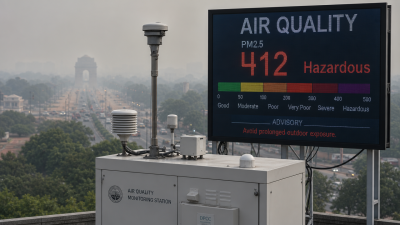
On 26 June 2026 Delhi announced it will implement an AI-powered Decision Support System (DSS) developed with IIT Kanpur’s AIRAWAT Research Foundation to forecast air pollution 48–72 hours ahead as part of a five‑year air quality management plan.
Key features of the AI-driven DSS
- Forecast horizon: Predicts pollution 48–72 hours in advance using machine‑learning models.
- Data inputs: Integrates live pollution sensors, meteorological data and historical AQI patterns.
- Monitoring expansion: Plan includes more low‑cost sensors, mobile monitoring laboratories and satellite data integration.
- Granularity: Aims to deliver location‑specific outputs to identify hotspots and airsheds.
- Source attribution: Uses models to estimate contributions from local and regional sources.
Implementation details
- Institutional link: MoU between Delhi Environment Department and AIRAWAT Research Foundation (IIT Kanpur) for five years, extendable; no immediate financial commitment.
- Programme fit: Positioned to inform Delhi’s Graded Response Action Plan (GRAP) and the National Clean Air Programme (NCAP).
Concerns & recommendations
- Audit and accountability: No announced independent audit or algorithm accountability framework as of the announcement.
- Inventory update: CEEW recommends updating Delhi’s emission inventory every 2–3 years for model accuracy.
IASPOINT Booster Facts
- AIRAWAT Research Foundation: Non‑profit established at IIT Kanpur under the Government of India’s AI Centre of Excellence for Sustainable Cities.
- GRAP: Set of pre‑defined response actions triggered by AQI categories for Delhi and NCR.
- NCAP: Launched 2019 with a national target to reduce particulate matter concentrations by 20–30% by 2024 relative to 2017 baseline.