
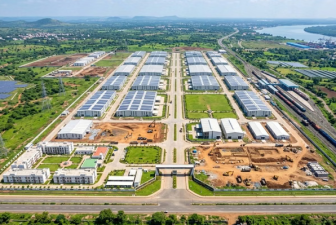
The Department for Promotion of Industry and Internal Trade (DPIIT), under the Ministry of Commerce and Industry, has released the operational guidelines for the Bharat Audyogik Vikas Yojana (BHAVYA) scheme. This Central Sector programme holds a total financial outlay of ₹33,660 crore to construct 100 world-class, investment-ready industrial parks across the country between fiscal year 2026-27 and fiscal year 2031-32. The scheme aims to lower gestation periods for businesses, minimize initial capital expenditures for manufacturers, and boost national manufacturing competitiveness by providing pre-cleared land with integrated plug-and-play facilities.
Core Objectives and Strategic Alignment
Strengthening Manufacturing Infrastructure
The primary purpose of BHAVYA is to transform India into a globally competitive manufacturing destination. The scheme provides plug-and-play infrastructure, meaning companies can establish production units immediately without undergoing lengthy land preparation or utility procurement phases.
Integration with PM Gati Shakti
Every industrial park developed under the scheme will integrate directly with the PM Gati Shakti National Master Plan. This alignment ensures systematic planning for multimodal logistics connectivity, last-mile access, and optimized transport networks via road, rail, and ports.
Supporting Make in India
By offering pre-approved land, streamlined regulatory approvals, and shared specialized facilities, BHAVYA works to attract substantial domestic and foreign direct investment in core manufacturing sectors.
Key Technical and Land Benchmarks
Spatial Thresholds
The operational guidelines prescribe clear land area metrics to ensure viability across diverse Indian terrains:
- General Category States: A minimum land requirement of 100 acres.
- Hilly and Northeastern States: A relaxed minimum requirement of 25 acres to accommodate challenging terrain, also applicable to Union Territories and smaller states.
- Maximum Limit: The scheme permits the development of large-scale industrial parks stretching up to 1,000 acres.
Financial Assistance Structure
The Central Government will provide infrastructure development funding of up to ₹1 crore per acre. This fiscal assistance is structured to support internal park development alongside necessary external connectivity links.
Implementation Architecture and Project Governance
Phased Rollout
The development of 100 industrial parks will follow a phased execution schedule. The first phase targets the competitive selection of up to 50 industrial parks, beginning with 20 parks in the initial two months, followed by another 30 parks shortly after.
Challenge-Based Selection Model
Discretionary allocations are replaced by a challenge-based competitive selection process. States and developers submit detailed proposals that are scored objectively on the following parameters:
- Quality and availability of the proposed land parcel.
- Proximity to major transport and logistics corridors.
- Existing strength of the regional industrial ecosystem.
- Readiness of digital governance tools.
- Long-term environment and sustainability measures.
Institutional Framework
The National Industrial Corridor Development Corporation (NICDC) serves as the official Project Management Agency (PMA). The physical execution of each selected park will be managed by a dedicated Special Purpose Vehicle (SPV) incorporated under the Companies Act, 2013. These SPVs will feature joint participation from the Central Government, respective State Governments, and private sector partners.
Integrated Park Features and Sustainability
Plug-and-Play Utilities
The parks will feature advanced underground utility networks, guaranteeing continuous supply of industrial water, high-voltage electricity, and high-speed data cables without surface disruptions.
Worker-Centric Facilities
To stabilize the industrial labor force and minimize migration-induced employee turnover, the guidelines mandate the construction of integrated worker housing and on-site skill-development centers.
Green and Common Infrastructure
The parks are designed to operate sustainably by incorporating renewable energy systems, common effluent treatment plants (CETPs), modern waste handling systems, and shared testing laboratories to verify product quality.
Comparison of National Industrial Development Interventions
| Parameter | BHAVYA Scheme | National Industrial Corridor Programme |
| Primary Focus | 100 decentralized plug-and-play industrial parks. | Large-scale greenfield industrial smart cities. |
| Implementation Period | FY 2026-27 to FY 2031-32 (6 Years). | Long-term multi-phase corridor development. |
| Financial Outlay | Dedicated ₹33,660 crore. | Project-specific funds under corridor trusts. |
| Land Size Scope | 25 acres to 1,000 acres per park. | Massive clusters spanning thousands of acres. |
| Selection Method | Challenge-based competitive state bidding. | Strategic trunk infrastructure corridor planning. |
IASPOINT Booster Facts for UPSC
- Central Sector vs Centrally Sponsored: BHAVYA is a Central Sector scheme, meaning it receives 100% funding from the Union Government for its assigned components, unlike Centrally Sponsored schemes where states share a fixed percentage of the financial load.
- NICDC Structure: The National Industrial Corridor Development Corporation operates under the administrative control of DPIIT, Ministry of Commerce and Industry. It acts as an intermediary to channel funds, build smart industrial cities, and maintain the PM Gati Shakti portals.
- The Plug-and-Play Concept: In industrial economics, plug-and-play refers to ready-to-use factory buildings or plots equipped with power, water, sewage connectivity, and environmental clearances. It removes the regulatory compliance burden from incoming entrepreneurs, lowering the cost of doing business.
- Manufacturing GVA Target: The National Manufacturing Policy aims to increase the share of manufacturing in India’s Gross Domestic Product (GDP) to 25%. Currently, the sector contributes around 17% to the gross value added (GVA).
- Single-Window Systems: The BHAVYA guidelines mandate integration with the National Single Window System (NSWS), a digital platform that allows investors to identify, apply for, and track all necessary central and state clearances in one place.