
Daily Activities

UPSC Prelims Current Affairs

UPSC Mains Current Affairs

Current Affairs

BRICS Agriculture Ministers Joint Declaration

BRICS Agriculture Ministers Joint Declaration

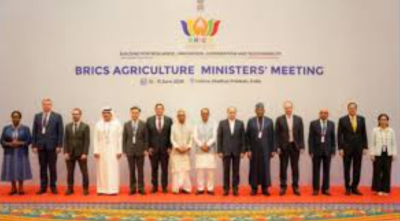
The 16th BRICS Agriculture Ministers’ Meeting concluded in Indore, Madhya Pradesh, on 13 June 2026, with the unanimous adoption of the Indore Declaration. Hosted under India’s presidency, the convention brought together nearly 100 delegates from member and partner countries to address global food security challenges. The ministerial dialogue focused on the central theme of empowering smallholder farmers, women, and youth to build resilient food systems. The resulting joint declaration establishes four new institutional frameworks to enhance South-South cooperation, tech-driven farming, and sustainable agricultural practices.

Core Institutional Initiatives

Agroecology and Regenerative Agriculture Network

The declaration formalizes the creation of the BRICS Network of Centres of Excellence on Agroecology and Regenerative Agriculture. This initiative coordinates collaborative research, capacity building, and knowledge transfers to scale up natural farming methods. The Indian Council of Agricultural Research – Indian Institute of Farming Systems Research (ICAR-IIFSR) at Modipuram serves as the central coordinating node and India’s specialized Centre of Excellence on Natural Farming.

Digital Agriculture Architecture

Member states approved the establishment of the BRICS Network on Digital Agriculture to introduce advanced technological solutions to field operations. The framework coordinates research on artificial intelligence, geospatial technologies, big data analytics, and digital public infrastructure. The Indian Institute of Technology (IIT) Delhi acts as the nodal implementing authority during the initial operational phase.

Input Security and Farmer Protection

The declaration balances technological growth with conservation and resource rights through two key international mechanisms:

InitiativePrimary Implementing FocusKey Operational Area
Global Forum on Farmers’ RightsProtection of traditional agrarian knowledge, equity in seed access, and genetic resource preservation.Seed Systems Management
BRICS AGRIN FrameworkCollaborative resource sharing, data tracking networks, and input supply chain stabilization.Agro-Inputs and Genetic Resources Information Network

Strategic Priorities and Market Dynamics

Four-Pillar Cooperation Agenda

The BRICS Agriculture Working Group executed multi-month technical discussions to align national policies across four main policy verticals:

  • Food Security and Livelihoods: Safeguarding nutritional self-reliance and improving the economic stability of smallholder production blocks.
  • Trade Facilitation: Expanding open agricultural commerce among member nations and actively rejecting unilateral trade restrictions that create supply vulnerabilities.
  • Resilient Infrastructure: Standardizing adaptive practices to counter macro-environmental shocks like El Niño cycles and regional climate variations.
  • Investment Pathways: Directing public and private capital injections into sustainable rural storage, supply chains, and food processing systems.
Institutional Platform Upgrades

The summit resolved to modernize the existing BRICS Agricultural Research Platform (BARP). The platform transitions from an administrative directory into a functional Knowledge-to-Action Hub. This institutional update applies a direct “Lab to Land” model, ensuring raw laboratory research outputs translate directly into scalable, low-cost field applications for marginal landholders.

IASPOINT Booster Facts for UPSC

  • The Smallholder Reality: Small and marginal landholders holding less than two hectares of land account for approximately 87% of India’s domestic farming population and nearly 70% of the total agricultural workforce across BRICS nations.
  • Expanded Bloc Composition: This ministerial round marks the active integration of expanded BRICS membership, including Egypt, Ethiopia, Iran, the United Arab Emirates, and partner countries under India’s chairship.
  • Agrarian Productivity Milestone: The declaration matches India’s domestic output trends, where the agricultural sector achieved an average annual growth rate of 4.5% over the past decade, raising total food production to nearly 376 million tonnes.
  • Targeted Waste Reduction Interventions: The joint framework includes a dedicated component to integrate outcomes from technical dialogues on food loss reduction, livestock technologies, and precision aquaculture into state welfare programs.
  • The Meghdoot Resolution: To mark the conclusion of the high-level dialogue and highlight collective intergenerational responsibility, ministers executed a joint tree plantation campaign at the Meghdoot Garden in Indore.
Last Modified: June 15, 2026

Leave a Reply

Your email address will not be published. Required fields are marked *

Archives