
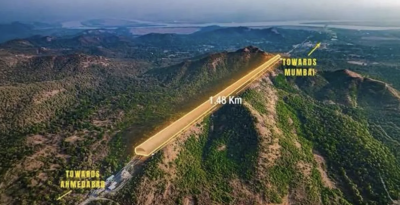
The Mumbai-Ahmedabad High Speed Rail project has achieved a major construction milestone with the breakthrough of its second tunnel in Palghar, Maharashtra. The 1.5 km mountain tunnel, known as MT-5, is the first mountain tunnel of the project in the state. It lies between the proposed Virar and Boisar bullet train stations and was excavated from both ends using the drill and blast method.
Key Tunnel Milestone
The MT-5 tunnel was completed in about 18 months. The excavation method allowed real-time monitoring of ground conditions. Support systems such as shotcrete, rock bolts and lattice girders were deployed as per site requirements. Safety measures, including ventilation, fire prevention and proper access arrangements, were maintained throughout the work.
Project Scale and Route
The Mumbai-Ahmedabad High Speed Rail corridor is 508 km long. It covers 352 km in Gujarat and Dadra & Nagar Haveli, and 156 km in Maharashtra. The route will connect Sabarmati, Ahmedabad, Anand, Vadodara, Bharuch, Surat, Bilimora, Vapi, Boisar, Virar, Thane and Mumbai. The project includes a total tunnel length of 27.4 km, including 21 km of underground tunnels and 6.4 km of surface tunnels.
Mountain Tunnels in Maharashtra
Seven mountain tunnels are being built in Maharashtra, with a combined length of about 6.05 km. MT-1 is 820 metres long and has achieved 15 per cent progress. MT-2 is 228 metres long and is under preparatory works. MT-3 is 1,403 metres long with 35.5 per cent completion. MT-4 is 1,260 metres long with 31 per cent progress. MT-6 is 454 metres long with 35 per cent progress, while MT-7 is 417 metres long with 28 per cent completion.
Economic And Environmental Impact
The project is expected to reduce travel time between Mumbai and Ahmedabad to 1 hour and 58 minutes. It is also projected to generate employment, support industrial and IT hubs, and strengthen economic links between major commercial centres. The corridor is expected to cut carbon dioxide emissions by nearly 95 per cent compared with road transport.
Last Modified: April 25, 2026