
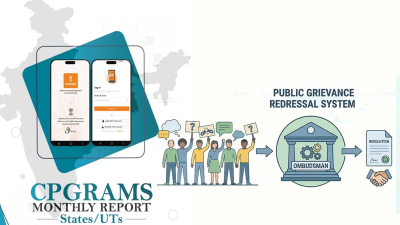
The Department of Administrative Reforms and Public Grievances (DARPG) released the 48th monthly report on the Centralized Public Grievance Redress and Monitoring System (CPGRAMS) for Central Ministries and Departments in May 2026. Covering the performance of April 2026, the report highlights the status of public grievance filings, speed of resolution, and new user enrollments. Simultaneously, the 45th monthly report for States and Union Territories was made public, indicating a multi-tiered push toward responsive governance. The central secretariat maintained its performance by crossing the one-lakh disposal mark for the 46th consecutive month, achieving an average grievance disposal time of 13 days.
Performance Analysis of Central Ministries
Central entities are categorized into distinct groups based on the volume of incoming complaints to evaluate their systemic efficiency accurately. The performance is indexed through the Grievance Redressal Assessment and Index (GRAI).
Group A Ministries (Higher Grievance Volume)
Group A comprises departments handling large-scale public interfaces and high volumes of cases. The top performers are:
- Department of Telecommunications: Ranked first in resolution efficiency and timelines.
- Department of Posts: Secured the second position by streamlining grassroot-level receipt mechanisms.
- Central Board of Indirect Taxes and Customs (CBIC): Positioned third, showing optimized processing of commercial and duty-related citizen issues.
Group B Ministries (Lower Grievance Volume)
Group B includes ministries receiving fewer than 500 grievances per monitoring cycle. The leading organizations are:
- Department of Official Language
- Ministry of Textiles
- Ministry of Steel
Monthly Central Performance Metrics
- Grievance Receipts and Resolution: In April 2026, central ministries received 1,88,577 public grievance cases and successfully redressed 1,88,969 cases, utilizing clearing mechanisms to address legacy backlogs.
- Total Central Pendency: At the end of the month, the absolute pendency across all central departments stood at 81,847 cases.
- Appellate Status: The portal received 31,018 public grievance appeals within the month, while appellate authorities disposed of 31,338 appeals, leaving a net annual appeal pendency of 20,976 cases.
Regional and Decentralized Progress
The report highlights regional variations in citizen engagement, along with a push toward digital integration through common service portals.
User Registration and State-Level Filing
- Total New Registrations: The portal onboarded 76,643 new users during April 2026 across various web and mobile options.
- Regional Distribution: Uttar Pradesh recorded the highest citizen enrollment with 13,379 new user accounts, indicating localized awareness and grievance patterns.
- State and Union Territory Disposals: States and UTs collectively received 88,057 new cases and redressed 77,445 cases. Uttar Pradesh cleared the highest volume with 34,959 completed disposals, followed by Gujarat with 5,829 cases. The cumulative state-level pendency across India stands at 2,11,701 cases, with 22 states reporting more than 1,000 pending matters each.
Common Service Centre (CSC) Infrastructure
To accommodate populations with limited digital literacy, CPGRAMS operates an integration layout with the CSC network.
| Operational Component | Infrastructure Scale (April 2026) |
| Total Functional CSCs Integrated | More than 5 Lakh centres |
| Active Village Level Entrepreneurs (VLEs) | 2.5 Lakh entrepreneurs |
| Grievances Filed via CSCs | 8,001 cases |
| Historical Leading State (CSC filings) | Karnataka |
Quality Control and Administrative Modules
The assessment framework relies on institutional mechanisms to verify citizen satisfaction and improve the skills of oversight officers.
Citizen Feedback Channels
The Feedback Call Centre collected 73,601 citizen responses during April 2026 to track performance quality. Of these, 42,980 responses evaluated central ministries, while 30,621 tracked state resolutions. Historically, these checks yield a resolution satisfaction rate of approximately 63% among completed entries.
Institutional Review Meetings
The Review Meeting Module allows secretary-level officials to evaluate unresolved matters directly. Since its launch, a total of 331 high-level review meetings have taken place across ministries, with 25 specialized sessions held in April 2026 alone.
IASPOINT Booster Facts for UPSC
- Nodal Department Profile: DARPG is a core department under the Ministry of Personnel, Public Grievances and Pensions. It acts as the nodal agency for administrative reforms, citizen charters, and public grievance structures.
- Core Technology Architecture: CPGRAMS is an online web-enabled platform developed by the National Informatics Centre (NIC) in collaboration with DARPG. It functions 24/7, allowing citizens to file grievances and track their real-time resolution status.
- The 10-Step Reform Process: Adopted by DARPG to modernize public grievance management. It includes universal language translations, integrating AI-driven analytical tools, automatic root-cause mapping, and formatting dedicated appellate options.
- The Sevottam Scheme: A structural model for citizen-centric service delivery. It includes three components: Citizen’s Charter, Public Grievance Redress Mechanism, and Service Delivery Capability. Over the last five financial years (FY 2022-23 to FY 2026-27), the scheme has conducted 1,159 training courses, upgrading the skills of 38,270 grievance officers.
- Exclusion Criteria of CPGRAMS: The platform explicitly bars certain matters from registration, including sub-judice cases, matters under judgment by any court or tribunal, personal or family disputes, suggestions, and queries falling under the Right to Information (RTI) Act.