
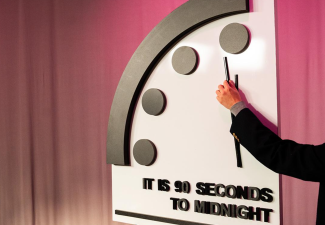
The Doomsday Clock moved four seconds closer to midnight in January, from 89 to 85 seconds, marking the closest humanity has ever been to self-destruction. The warning by the Bulletin of the Atomic Scientists comes at a moment when great power rivalry is intensifying and the global nuclear arms control architecture has all but collapsed. The expiry of the New START treaty between the United States and Russia has sharpened concerns that the world is entering an unregulated nuclear age.
Why the expiry of New START matters
The New Strategic Arms Reduction Treaty, or , was signed in 2010 by then US President and Russian President . It capped deployed strategic nuclear warheads, delivery systems, and launchers, and crucially allowed for mutual inspections.
With its expiry on February 4, the US and Russia — together accounting for nearly 90% of the world’s nuclear weapons — are no longer bound by any legally enforceable limits on their arsenals. This is unprecedented since the Cold War era.
A brief history of START and arms reduction
Arms control under the Strategic Arms Reduction Treaty framework began with START-I in 1991, signed as the Cold War ended. It imposed verifiable limits on nuclear warheads and delivery systems, significantly reducing US and Soviet stockpiles.
START-II sought deeper cuts but never entered into force after President George W Bush withdrew from the Anti-Ballistic Missile (ABM) Treaty, angering Moscow. The post-Cold War arms control momentum peaked with New START, which survived into the 2020s despite growing geopolitical tensions.
That stability eroded further in 2023, when Russia suspended inspections under New START amid the Ukraine war. Although Vladimir Putin proposed a one-year voluntary extension in 2025, negotiations failed to materialise.
A hollowed-out arms control system
The collapse of New START follows the earlier demise of major treaties such as the ABM Treaty and the Intermediate-Range Nuclear Forces (INF) Treaty. The result is a near-total absence of binding constraints on nuclear competition between the US and Russia.
This vacuum is especially dangerous in a global environment marked by distrust, nationalism, and confrontational postures, aggravated by the unpredictability of President Donald Trump’s foreign policy and Russia’s continued military assertiveness in Ukraine.
The first danger: a renewed arms race
Without limits, both Washington and Moscow face incentives to expand or modernise their nuclear stockpiles. International relations theory describes this dynamic as a security dilemma: one side’s attempt to increase security by acquiring more weapons is perceived as a threat by the other, prompting retaliation.
Trump’s announcement in October last year directing the resumption of US nuclear weapons testing — for the first time in over three decades — underscores this risk. Any return to testing could trigger a cascading arms race, increasing the probability of conflict not just among nuclear powers, but also between nuclear and non-nuclear states.
The second danger: the stability–instability paradox
The late scholar Glenn Snyder described how nuclear deterrence can simultaneously prevent large-scale war while encouraging smaller, more frequent conflicts. This stability–instability paradox becomes sharper without arms control.
Treaties provide transparency about arsenal size, posture, and readiness. In their absence, uncertainty grows. Misreading an adversary’s nuclear threshold becomes easier, raising the risk that limited conflicts or proxy wars spiral out of control.
The third danger: nuclear proliferation elsewhere
When the leading nuclear powers abandon restraint, the incentive for others to acquire nuclear weapons increases. This risk is acute in West Asia. Even as China undertakes its largest nuclear expansion, attention is focused on Iran, where talks with the US over its nuclear programme are scheduled.
Should Iran acquire nuclear weapons, regional rivals such as Saudi Arabia, Turkey, and Egypt are likely to follow. The result would be a multipolar nuclear West Asia, dramatically increasing the risk of catastrophic escalation.
The fading memory of nuclear restraint
There was a time when nuclear restraint was a shared understanding among superpowers. Former US President famously recalled how watching the film “The Day After” shaped his commitment to arms control and helped pave the way for the INF Treaty with .
That consensus — that excessive nuclear arsenals threaten human survival — appears to have weakened in today’s geopolitical climate.
Is there still space for diplomacy?
Despite the bleak outlook, the expiry of New START does not preclude renewed negotiations. Trump could respond to Putin’s extension proposal with counter-offers on reductions and inspections, even outside a formal treaty framework. Dialogue itself would slow escalation and preserve space for future agreements.
Without such efforts, the arms race is likely to accelerate, and the Doomsday Clock will inch even closer to midnight.
What to note for Prelims?
- The Doomsday Clock is maintained by the Bulletin of the Atomic Scientists.
- New START was the last major nuclear arms control treaty between the US and Russia.
- ABM and INF treaties have already collapsed.
- US and Russia together hold the majority of global nuclear weapons.
What to note for Mains?
- Analyse the implications of the collapse of global nuclear arms control regimes.
- Explain the security dilemma and the stability–instability paradox with examples.
- Discuss how great power behaviour influences nuclear proliferation elsewhere.
- Evaluate the relevance of arms control in contemporary geopolitics.