
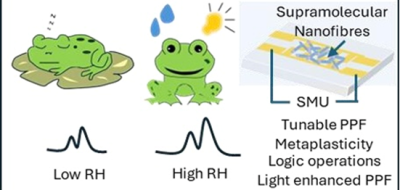
A research team has developed a humidity-responsive neuromorphic sensor that can sense, process and store information in a single device. The innovation uses one-dimensional supramolecular nanofibres and is designed to mimic biological sensory systems, which combine detection and computation with high energy efficiency. The work is for low-power electronics, edge computing and artificial intelligence applications.
What the Device Does
The sensor responds to changes in moisture levels and produces electrical signals that show synapse-like behaviour. It can demonstrate:
- facilitation, where repeated signals strengthen the response;
- depression, where the response weakens after stimulation;
- metaplasticity, where past exposure changes future behaviour.
The device also shows temporary memory of earlier humidity signals, making it closer to biological information processing than conventional sensors.
How It Was Built
The active layer was formed from supramolecular nanofibres grown from a charge-transfer complex of donor and acceptor molecules. These nanofibres were drop-coated on interdigitated gold electrodes on a glass substrate. The device was then tested in a humidity-controlled chamber, where humidified nitrogen was used to regulate relative humidity. Electrical measurements were taken under different humidity pulses and light conditions.
Bio-Inspired Design
The sensor was inspired by the moisture-sensitive behaviour of cricket frogs, whose activity changes with humidity and daylight. The device similarly shows altered response under varying moisture and light conditions. This bio-inspired approach aims to replicate how natural sensory systems process external stimuli efficiently in real time.
Significance and Applications
The development is important because most neuromorphic sensors still depend on separate sensing and memory units, which increases energy use and data transfer. By integrating sensing, memory and processing into one platform, the device may support:
- smart environmental monitoring;
- wearable and healthcare sensors;
- energy-efficient edge computing;
- Internet of Things devices;
- next-generation sustainable electronics.