
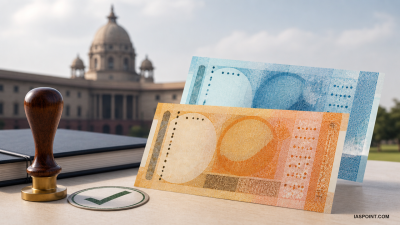
The government approved on 27 July 2026 the RBI proposal to issue one billion polymer ₹10 and one billion polymer ₹20 notes each for field trials; the proposal was placed under Section 25 of the Reserve Bank of India Act, 1934 after RBI Central Board recommendation.
Key facts of the trial
- Quantum: One billion polymer notes each for ₹10 and ₹20 approved for field trials.
- Approval route: Placed under Section 25 of the Reserve Bank of India Act, 1934 (form and design of banknotes).
- Post-trial issuance: Regular circulation contingent on successful field trials and assessments.
Technical features
- Substrate: Opacified polymer substrate — plastic-based sheet used for security printing of banknotes.
- Properties: Higher resistance to moisture, dirt and tearing; longer in-circulation life than paper-substrate notes.
- International use: Polymer notes adopted by Australia, Canada, New Zealand and the United Kingdom in various denominations.
Printing and supply arrangements
- Printer: Bharatiya Reserve Bank Note Mudran Private Limited (BRBNMPL) is RBI’s currency-printing subsidiary involved in procurement.
- Procurement: BRBNMPL issued a Global EOI on 17 July 2026 for opacified polymer substrate sheets.
- Circulation mix: Polymer notes to circulate alongside existing paper-substrate notes; no official plan to replace paper entirely at this stage.
IASPOINT Booster Facts
- Section 25 RBI Act: Empowers the central government to determine the form and design of banknotes on RBI recommendation.
- Issuing authority: Reserve Bank of India issues banknotes; Government of India issues coins.