
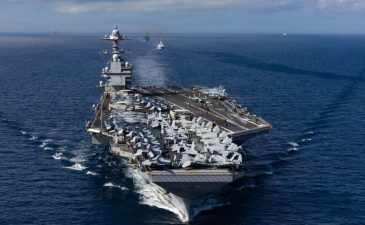
The United States has increased troop presence in the Caribbean at the end of 2025, while its 2025 National Security Strategy places Latin America and the Caribbean among priority theatres. The shift is linked to renewed attention on the Western Hemisphere and a relative reduction in Europe’s centrality in U.S. strategy.
About America’s Hemisphere Turn
- The term refers to a renewed U.S. focus on the Western Hemisphere, especially Latin America and the Caribbean.
- It is linked to the logic of the Monroe Doctrine, which opposed outside powers gaining decisive influence in the region.
- The current U.S. approach places greater stress on regional primacy and less on distant security commitments.
Key Strategic Features
- The mobilisation includes an aircraft carrier, submarines, amphibious vessels and large troop deployments in the Caribbean.
- The 2025 National Security Strategy gives priority status to Latin America and the Caribbean.
- China is treated as the main external power expanding economic and political influence in the region.
- The strategy fits the idea of offshore balancing, which favours limiting commitments in distant regions.
Shift in U.S. Security Posture
- Since the Second World War, the United States has been Europe’s main security provider.
- During the Cold War, this role expanded through NATO.
- The present approach expects Europe to bear greater responsibility for its own defence.
- This marks a relative downgrading of Europe in American strategic planning.
Global Power Structure
- The post-1991 unipolar phase ended as other great powers regained capacity.
- Russia annexed Crimea in 2014, which tested the post-Cold War European order.
- China and Russia now share the space with the United States in a more fluid multipolar order.
- Middle powers such as India, Japan, Germany and Brazil often hedge between competing blocs.
Prelims Pointers
- Monroe Doctrine: opposition to external powers dominating the Americas.
- Offshore balancing: reducing commitments in distant theatres and focusing on nearby strategic space.
- China is the principal systemic challenger to the United States.
- Russia remains a disruptive power through nuclear weapons, energy resources and force projection.
China’s economy is already more than two-thirds the size of the U.S. economy and continues to grow faster. NATO expansion after the Soviet collapse remained central to U.S. policy in Europe. The Ukraine war remains a major obstacle to any limited U.S.–Russia reset.
Last Modified: June 15, 2026