
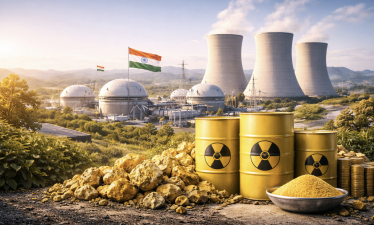
India recently signed a major uranium supply deal with Canadian company Cameco. The contract will provide 22 million pounds of uranium from 2027 to 2035. This deal worth 2.6 billion Canadian dollars supports India’s plan to increase nuclear power capacity by over ten times by 2047. It follows a similar agreement with Kazakhstan’s Kazatomprom. These contracts are crucial for India’s nuclear energy ambitions amid limited domestic uranium quality.
India’s Uranium Import Dependency
India relies heavily on uranium imports, meeting over 70% of its needs from abroad. Domestic uranium ore quality is low, ranging from 0.02% to 0.45%, compared to global averages of 1-2%. Some Canadian mines have ore grades as high as 15%. Domestic uranium is costlier but vital for India’s nuclear weapons and energy security. India’s uranium consumption was about 1,884 tonnes in 2025, expected to rise to 5,400 tonnes annually by 2047.
Domestic Uranium Production and Exploration
India’s uranium mining is mainly in Jharkhand and Andhra Pradesh, with seven active mines. Other states like Rajasthan, Telangana, and Meghalaya also have deposits. Total uranium ore reserves are estimated at 430,000 tonnes, with 40% already extracted from UCIL-controlled mines. Exploration continues across 15 states to find new deposits. Domestic production is expected to meet only 30% of future uranium needs despite increased mining efforts.
International Uranium Supply and Bilateral Relations
India sources uranium from Canada, Kazakhstan, Uzbekistan, and Russia. The Russian supply supports reactors at Kudankulam. The new Cameco deal marks improved India-Canada nuclear cooperation, which dates back to the 1950s with projects like the CIRUS reactor. Future agreements may include countries like Australia and the USA. Indian firms are also exploring uranium mining opportunities abroad to diversify supply.
India’s Three-Stage Nuclear Programme
India aims to develop a thorium-based nuclear energy system through a three-stage programme. The first stage uses uranium-fuelled reactors. The second stage involves fast-breeder reactors, with a prototype nearing operation in Kalpakkam. The third stage will use thorium as fuel, leveraging India’s vast thorium reserves. This programme, unique to India, has progressed slowly since its inception in the 1950s but promises long-term energy independence.
Topics for Prelims:
Uranium
- Uranium is a key fuel for nuclear reactors.
- India’s domestic uranium ore has low uranium concentration.
- Canada and Kazakhstan are major uranium suppliers to India.
- Uranium consumption in India is projected to increase by 2047.
- Uranium is essential for both civilian energy and weapons programmes.
India’s Nuclear Energy Programme
- India plans to increase nuclear capacity from 9 GW to 100 GW by 2047.
- The three-stage nuclear programme aims to use thorium in the long term.
- The fast-breeder reactor is part of the second stage of the programme.
- India’s nuclear cooperation with Canada dates to the 1950s.
- Thorium reserves in India are among the largest globally.
International Uranium Supply
- India imports over 70% of its uranium needs.
- Major suppliers include Canada, Kazakhstan, Uzbekistan, and Russia.
- New supply agreements help diversify India’s uranium sources.
- India is exploring uranium mining opportunities abroad.
- International uranium deals support India’s nuclear energy expansion.
Questions for Mains:
- Discuss the strategic importance of uranium imports for India’s nuclear energy security in the light of domestic resource limitations. [GS-III-Economic Development]
- Critically examine India’s three-stage nuclear programme and its potential impact on future energy independence and sustainability. [GS-III-Science & Technology]
- Explain the role of international cooperation in India’s nuclear energy sector and discuss the challenges and opportunities it presents. [GS-II-International Relations]
- With suitable examples, discuss the implications of nuclear energy expansion on India’s environmental and security policies. [GS-III-Environment & DM, GS-III-Internal & External Security]
Answer Hints:
1. Discuss the strategic importance of uranium imports for India’s nuclear energy security in the light of domestic resource limitations. [GS-III-Economic Development]
- India’s domestic uranium ore quality is low (0.02-0.45%) compared to global average (1-2%), making domestic mining expensive and limited.
- Over 70% of India’s uranium needs are met through imports from countries like Canada, Kazakhstan, Uzbekistan, and Russia.
- Long-term uranium supply agreements (e.g., Cameco, Kazatomprom) are critical to meet rapidly growing nuclear energy demands (target 100 GW by 2047).
- Domestic production is essential for strategic needs like the nuclear weapons programme and as a buffer against supply disruptions.
- Diversification of supply sources reduces geopolitical risks and enhances energy security.
- Despite ramping up domestic production, imports will remain indispensable due to limited high-grade uranium reserves.
2. Critically examine India’s three-stage nuclear programme and its potential impact on future energy independence and sustainability. [GS-III-Science & Technology]
- The programme aims to transition from uranium-fuelled reactors (Stage 1) to fast-breeder reactors (Stage 2) and finally thorium-based reactors (Stage 3).
- India has vast thorium reserves, offering potential for energy independence and sustainability in the long term.
- The fast-breeder reactor prototype at Kalpakkam marks progress toward Stage 2 but overall advancement has been slow since the 1950s.
- Thorium reactors are technologically challenging and require proven reactor designs, which are still under development.
- Successful implementation could reduce dependence on imported uranium and provide a cleaner, safer nuclear fuel cycle.
- The programme is unique globally, positioning India as a pioneer in thorium-based nuclear energy if fully realized.
3. Explain the role of international cooperation in India’s nuclear energy sector and discuss the challenges and opportunities it presents. [GS-II-International Relations]
- India’s nuclear cooperation with countries like Canada dates back to the 1950s (e.g., CIRUS reactor, Rajasthan Atomic Power Project).
- Recent uranium supply agreements with Canada (Cameco), Kazakhstan (Kazatomprom), Russia, and Uzbekistan diversify supply and ensure fuel security.
- International deals help India ramp up nuclear capacity and support energy expansion goals amid limited domestic uranium.
- Challenges include geopolitical tensions, export control regimes, and past troubled relations (e.g., India-Canada relations fluctuated).
- Opportunities exist for further partnerships with Australia, the USA, and overseas uranium mining ventures by Indian firms.
- International cooperation also facilitates technology transfer, safety standards, and adherence to non-proliferation norms.
4. With suitable examples, discuss the implications of nuclear energy expansion on India’s environmental and security policies. [GS-III-Environment & DM, GS-III-Internal & External Security]
- Nuclear energy expansion supports India’s clean energy goals by providing low-carbon electricity and reducing fossil fuel dependence.
- Safety and environmental concerns include radioactive waste management, accident risks, and uranium mining impacts.
- Security policies must address protection of nuclear facilities, securing uranium supply chains, and preventing nuclear proliferation.
- Examples – Kudankulam reactors supplied by Russia require robust bilateral security cooperation and safety protocols.
- Expansion necessitates strengthening disaster management frameworks and emergency preparedness around nuclear sites.
- Balancing energy security with environmental sustainability and geopolitical risks remains a key policy challenge.