
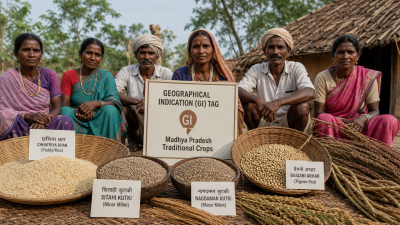
On 26 June 2026 the GI Registry, Chennai granted Geographical Indication tags to four Madhya Pradesh traditional crops: Sitahi Kutki, Nagdaman Kutki, Baigani Arhar and Chhatriya Dhan.
The Four GI-Tagged Crops
- Sitahi Kutki: Minor millet; high dietary fibre, minerals and antioxidants; climate-resilient; conserved by Baiga tribe (Dindori).
- Nagdaman Kutki: Minor millet with similar nutritional and climate-resilience traits; traditional Baiga cultivation.
- Baigani Arhar: Local pigeon pea (pigeon pea/ Cajanus cajan); noted for higher natural protein, sweet flavour and superior grain quality.
- Chhatriya Dhan: Traditional paddy from Jabalpur–Katni; aromatic, distinct taste; retains bran with vitamin B1; locally adapted variety.
GI Registration & Institutional Support
- Registration Date & Office: GI Registry, Chennai — 26 June 2026; Registry operates under DPIIT, Ministry of Commerce and Industry.
- Facilitators: Jawaharlal Nehru Agricultural University (JNAU/JNKVV), MP Department of Farmer Welfare and Agriculture Development, MP State Agricultural Marketing Board.
- State GI Cell: Madhya Pradesh’s first GI Cell established at JNAU, Jabalpur; financed by MP State Agricultural Marketing Board for documentation and verification.
- Community Origin: Varieties traditionally preserved by the Baiga tribal community in Dindori district.
IASPOINT Booster Facts
- Legal framework: Geographical Indications of Goods (Registration and Protection) Act, 1999 governs GI protection in India.
- TRIPS: Article 22(1) defines GI as a sign identifying goods as originating in a territory where quality, reputation or other characteristic is essentially attributable to that origin.
- Rights conferred: GI registration grants exclusive use of the GI to authorised producers from the defined geographical area and provides legal remedy against unauthorised use.
- Earlier precedent: Darjeeling Tea was India’s first GI-tagged product (2004–05).