
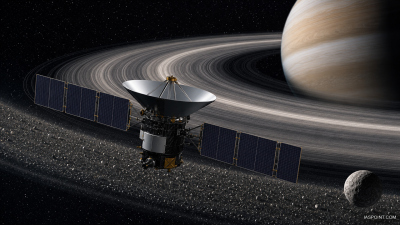
NASA proposed the PRAXIS mission on 26 July 2026 to collect and analyse in-situ particles from Saturn’s rings.
Mission overview
- Full name: Planetary Rings Autonomous EXploration with In-situ Sampling (PRAXIS).
- Target: Saturn’s ring system for direct particle collection and analysis.
- Programme status: Selected for NASA NIAC Phase I funding (Innovative Advanced Concepts) in March 2026.
- Lead institution: Concept developed at NASA’s Jet Propulsion Laboratory (JPL).
Sampling technology
- Collection method: AI-guided, bio‑inspired robotic system with a long deployable boom for touch‑and‑go sampling.
- Collision avoidance: Designed to collect particles without direct collision with dense ring structures.
- Target particle size: Millimetre to centimetre scale (larger than fine dust, smaller than pebbles).
- Onboard analysis: In-situ measurements of particle size, porosity and composition.
Science objectives
- Formation and evolution: Constrain models of ring origin and age through composition and structure data.
- Particle dynamics: Measure microphysical properties that control aggregation, fragmentation and orbital behaviour.
- Comparative study: Technology and results applicable to faint ring systems of Uranus and Neptune.
Important facts for exams
- Cassini legacy: Cassini (NASA‑ESA‑ASI) studied Saturn and its rings from 2004 to 2017.
- Ring composition: Saturn’s rings are largely water ice with minor silicate and dust admixtures.
- NIAC purpose: NIAC funds early‑stage studies of advanced aerospace concepts (Phase I = concept feasibility).
- JPL location: Jet Propulsion Laboratory is in Pasadena, California; manages robotic planetary missions.