
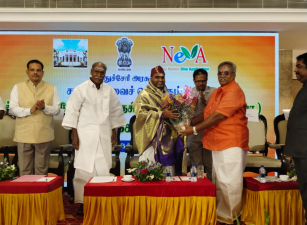
The West Bengal Legislative Assembly has signed a tripartite Memorandum of Understanding to implement the National e-Vidhan Application, making it the 33rd legislative body in India to adopt the platform. Signed in the presence of the Union Minister for Parliamentary Affairs, this agreement brings India closer to its structural goal of establishing a unified digital governance framework. Out of these 33 participating assemblies, 21 legislatures have transitioned to completely paperless, digital operations. The initiative uses technology to improve public transparency and structural accountability across state houses.
Core Institutional and Operational Framework
Institutional Structure
The National e-Vidhan Application is a Mission Mode Project executed under the Digital India Programme. The Ministry of Parliamentary Affairs oversees the funding, strategic direction, and multi-state implementation. The initiative operates on a centralized technical design to consolidate the governance of all 37 distinct State and Union Territory legislative chambers into a single, integrated platform.
Funding and Execution Mechanism
The project uses a centrally sponsored funding model to distribute financial responsibilities between the central government and state administrations.
- General Category States: The funding is distributed using a 60:40 financial ratio between the Centre and the States.
- North-Eastern and Hilly States: The Centre provides 90 percent of the required capital, while the state government provides the remaining 10 percent.
- Union Territories: The central government provides 100 percent of the operational and infrastructural funding.
Tripartite MoU Framework
Before deploying software and hardware, three distinct entities must sign a binding legal agreement:
- The Ministry of Parliamentary Affairs representing the Government of India.
- The concerned State or Union Territory Government.
- The Secretariats of the respective Legislative Assemblies or Councils.
Technical Architecture and Functional Capabilities
Cloud and Mobility Framework
The software suite runs entirely on the National Informatics Centre cloud infrastructure, known as MeghRaj. This cloud hosting ensures data isolation, multi-tenant security, and disaster-recovery capabilities. The application operates through a device-neutral architecture, meaning lawmakers can access data through desktops, tablets, and smartphones using the mobile version, mNeVA.
Core Functional Modules
The workflow system digitizes the traditional lifecycle of legislative transactions from inception to archiving.
- Question Processing Module: Manages the submission, tracking, balloting, and final processing of starred and unstarred parliamentary questions, while directly connecting state departments for electronic replies.
- Legislative Business Automation: Tracks the introduction, reading, amendment tracking, and passage of Government and Private Members’ Bills.
- Committee Management System: Digitizes meeting notices, tracks attendance, distributes minutes, and archives final committee reports for institutional review.
- Digital House Operations: Provides real-time digital access to the daily List of Business, official Bulletins, Papers Laid, and statutory Assurances made by ministers on the floor.
Strategic Benefits and Governance Impacts
Environmental and Fiscal Impact
Transitioning to digital workflows removes the need to print thousands of tons of legislative documents annually. This shift reduces public paper consumption, prevents regional deforestation, and saves state exchequers money on printing, storage, transport, and administrative processing.
Citizens’ Right to Information
The application hosts a public-facing web portal that translates complex legislative processes into accessible formats for ordinary citizens. It provides access to daily questions, tabled documents, live webcasts, and historical assembly archives, which bridges the informational gap between elected representatives and their constituents.
Comparative Status of Legislative Digitalization
The adoption of digital systems varies across states, with different legislatures currently at various stages of technological integration.
| State / UT Legislature | Implementation Milestone | Operational Standing |
| Himachal Pradesh | Pioneer Assembly | First to go paperless via a pilot project in 2014 |
| Nagaland | NeVA Pioneer | First state assembly to implement the full NeVA platform |
| National Capital Territory of Delhi | 28th Assembly | Implemented via a specialized 100-day governance agenda |
| West Bengal | 33rd Assembly | Signed the tripartite MoU in June 2026 |
| Total Fully Digital Houses | 21 Legislatures | Complete shift to electronic workflows and digital voting |
IASPOINT Booster Facts for UPSC
- The Slogan Driving NeVA: The initiative operates under the national concept of “One Nation – One Application,” aiming to standardize legislative workflows across diverse state architectures.
- Nodal Ministry vs Tech Partner: The Ministry of Parliamentary Affairs is the executive nodal ministry for NeVA, while the National Informatics Centre under the Ministry of Electronics and Information Technology serves as the core technology partner.
- Language Localisation Capacity: The public portal of NeVA handles multi-lingual translation, making records available in regional languages like Hindi, Bengali, Gujarati, Odia, Tamil, Telugu, Malayalam, Punjabi, Marathi, and Urdu.
- The Pilot Precursor: Before NeVA was upgraded into a unified national app, the pilot e-Vidhan model in Himachal Pradesh saved approximately 5.08 crore rupees annually in paper costs.
- Constitutional Provisions for Rules of Procedure: Article 208 of the Indian Constitution empowers each State Legislature to make rules for regulating its procedure and the conduct of its business, which requires individual assemblies to pass house resolutions before modifying traditional physical rules to match digital NeVA protocols.
- Central Project Monitoring Unit (CPMU): A dedicated CPMU sits inside the Ministry of Parliamentary Affairs to handle capacity building, continuous video-conferencing support, and orientation workshops for state government typists, programmers, and legislators.
