
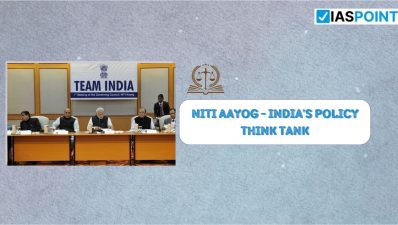
NITI Aayog, or the National Institution for Transforming India, was established on January 1, 2015. It replaced the Planning Commission and serves as the policy think tank of the Government of India. The organisation aims to promote inclusive development and sustainable growth while encouraging cooperative federalism.
Key Functions
NITI Aayog performs several key functions:
- Policy Formulation: Develops long-term and strategic policies.
- Cooperative Federalism: Bridges central and state governments for effective policy implementation.
- Monitoring and Evaluation: Assesses the outcomes of government schemes.
- Think Tank: Provides knowledge and thought leadership to tackle national challenges.
Composition
The Governing Council of NITI Aayog includes:
- Chairperson: The Prime Minister of India.
- Vice Chairperson: Appointed by the Prime Minister.
- Ex-Officio Members: Up to four members from the Union Council of Ministers.
- Governing Council: Comprises Chief Ministers of states and Union Territories.
- Chief Executive Officer (CEO): Manages daily operations, appointed by the Prime Minister.
- Full-Time Members: Experts in various fields.
- Special Invitees: Nominated experts from diverse domains.
Objectives
NITI Aayog aims to achieve several objectives:
- Promote inclusive development.
- Foster cooperative federalism.
- Focus on vulnerable sections of society.
- Design long-term policies and credible planning.
- Encourage innovation and technology.
- Establish a resource centre for governance.
Pillars of Governance
NITI Aayog’s operations are built on seven foundational pillars:
- Pro-People Orientation: Policies reflect societal aspirations.
- Proactivity: Swift responses to emerging challenges.
- Participation: Promotes public involvement in policymaking.
- Empowerment: Focuses on women, youth, and marginalised communities.
- Inclusivity: Ensures equal access and opportunities.
- Equality: Creates an environment for all to realise potential.
- Transparency: Advocates for open data and accountability.
Significance
NITI Aayog plays important role in advancing India’s development agenda. It promotes cooperative federalism and drives strategic policies tailored to India’s socio-economic landscape. The organisation aims to create a “Bhartiya” model of development that is adaptive and inclusive.
Cooperative vs Competitive Federalism
NITI Aayog encourages both cooperative and competitive federalism. It facilitates dialogue between central and state governments to address regional priorities. It also promotes transparency and collaboration among states through initiatives like the Sustainable Development Goals (SDG) Index.
Strategic Policy Formulation
As a think tank, NITI Aayog advises on long-term strategies across various sectors including health, education, and agriculture. It incorporates insights from state governments and civil society to ensure effective policies.
SDG Monitoring
NITI Aayog is responsible for overseeing India’s progress towards the UN Sustainable Development Goals. It aligns central and state schemes with global targets.
Innovation Promotion
The Atal Innovation Mission is a flagship initiative aimed at encouraging a culture of innovation and entrepreneurship. It supports startups and introduces best practices to enhance governance.
Capacity Building
NITI Aayog provides training and technical support to strengthen state capacities. This helps states implement national policies effectively, aligning them with local needs.
Inclusive Growth Initiatives
The organisation focuses on marginalised communities. It promotes policies to bridge socio-economic gaps and encourage social equity.
Transparency and Accountability
NITI Aayog emphasises open data initiatives and regular reporting. This enhances public trust in governance and ensures accountability.
Inter-Sectoral Coordination
NITI Aayog improves coordination across sectors. This allows for streamlined policy implementation and effective responses to complex challenges.
Comparison with Planning Commission
NITI Aayog represents shift from the Planning Commission. The key differences include:
- Nature: NITI Aayog is an advisory think tank; the Planning Commission was an extra-constitutional body.
- Approach: NITI Aayog uses a bottom-up approach; the Planning Commission employed a top-down strategy.
- Role of States: NITI Aayog encourages active participation; the Planning Commission limited state roles.
- Funding Authority: NITI Aayog does not allocate funds; the Planning Commission had this authority.
Key Initiatives
NITI Aayog has launched several initiatives:
- Atal Innovation Mission: Promotes innovation and entrepreneurship.
- Aspirational District Programme: Transforms districts lagging in socio-economic development.
- National Data and Analytics Platform: Enhances accessibility to government data.
- Poshan Abhiyan: Focuses on improving nutritional outcomes.
- SDG Index: Monitors progress towards Sustainable Development Goals.
Limitations and Concerns
NITI Aayog faces several limitations:
- Advisory Role: Lacks authority to implement policies directly.
- Resource Constraints: Does not allocate funds for projects.
- Centralised Structure: May hinder local adaptability.
- Bureaucratic Delays: Can affect timely implementation of initiatives.
- Politicisation Risks: Recommendations may be influenced by political factors.