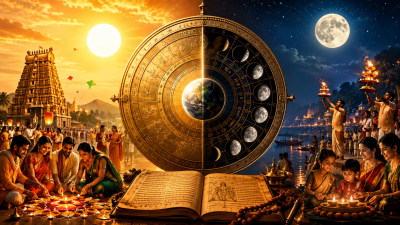
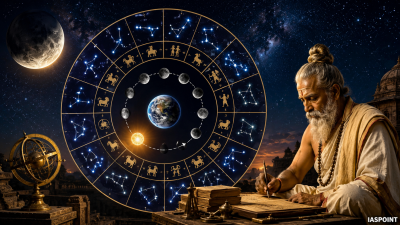
Indian festivals are primarily governed by the Luni-Solar Calendar, a sophisticated system that synchronizes the movements of both the Sun (Solar) and the Moon (Lunar). Unlike the Gregorian...
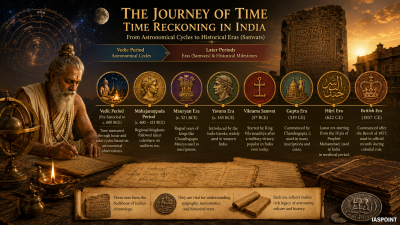
The history of time reckoning in India is characterized by a transition from the astronomical cycles of the Vedic period to the establishment of specific eras (Samvats) to...
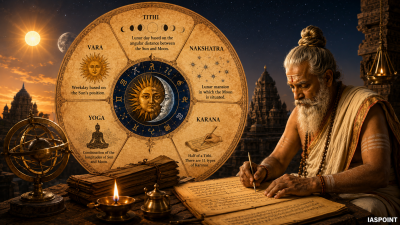
The term Panchangam is derived from the Sanskrit words Pancha (Five) and Anga (Limbs). It refers to the traditional Hindu almanac that serves as a vital tool for...
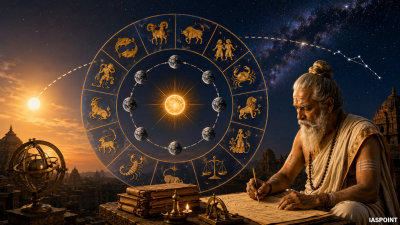
In the Indian astronomical tradition (Jyotisha), the Rashi system represents the division of the ecliptic—the Sun's apparent path around the Earth—into twelve equal segments. While the lunar-based Nakshatra...
The term Nakshatra refers to the lunar mansions or stellar constellations along the ecliptic (the path of the Sun). While the Sun traverses the 12 signs of the...
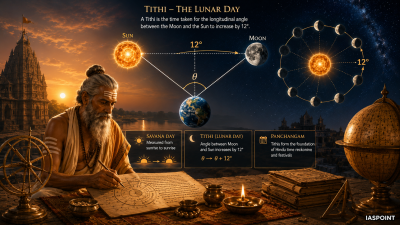
In Indian astronomy and the Panchangam system, a Tithi is defined as a lunar day, representing the time it takes for the longitudinal angle between the Moon and...
The hallmark of Indian time reckoning is the sophisticated synthesis of the solar cycle (the Earth’s revolution around the Sun) and the lunar cycle (the Moon’s phases). While...
The Vedanga Jyotisha is the earliest formal Indian treatise on astronomy and time reckoning, serving as one of the six auxiliary disciplines (Vedangas) of the Vedas. Its primary...
The Border Security Force (BSF) is set to expand . The Government of India has given in-principle approval to raise 16 new battalions. This expansion will add approximately...
The National Biodiversity Authority of India has introduced new regulations to manage the sharing of benefits derived from biological resources. The Biological Diversity (Access to Biological Resources and...