
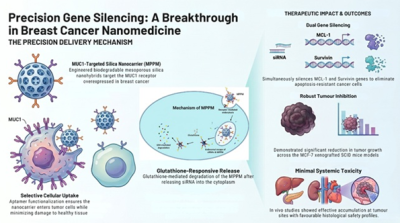
Scientists at the Agharkar Research Institute (ARI), Pune, have developed a precision biodegradable nanomedicine platform to treat breast cancer. This platform utilizes an innovative gene-silencing strategy to deliver small interfering RNA (siRNA) directly to tumor sites, offering a safer alternative to conventional chemotherapy.
The Nanocarrier Mechanism
- Targeting: The system uses Mesoporous Silica Nanoparticles functionalized with a protamine biopolymer and an MUC1-specific aptamer. The aptamer acts as a tracking device, binding exclusively to MUC1 receptors, which are overexpressed in breast cancer cells.
- Controlled Release: Once inside the tumor, a glutathione-responsive mechanism triggers the disintegration of the nanocarrier, ensuring drug release only within the target cells.
- Dual Gene Silencing: The carrier simultaneously delivers siRNA against MCL-1 and Survivin genes. Silencing these anti-apoptotic genes prevents cancer cells from evading programmed cell death (apoptosis).
- Efficacy: Research on animal models confirmed significant tumor reduction with minimal systemic toxicity, as the localized delivery avoids damaging healthy tissues.
IASPOINT Booster Facts
- Agharkar Research Institute (ARI): An autonomous institute under the Department of Science and Technology (DST), established in 1946.
- Aptamers: Short, single-stranded DNA or RNA molecules that act like chemical antibodies to bind specific targets.
- RNA Interference (RNAi): A biological process where RNA inhibits gene expression; awarded the Nobel Prize in 2006.
- Apoptosis: The natural process of programmed cell death, which cancer cells often deactivate to proliferate.
- SCID Mice: Gene-mutated mice used in research due to their lack of immune rejection of human tumor grafts.