With the new Lok Sabha (2014), most of the constitutional Amending bills have been elapsed. The constitution (121st Amending bill) has after being passed, becomes the 99th constitutional...
The Constitution of India has, more or less, opted f or a parliamentary democracy in the country. In adopting such a parliamentary system, the framers of the Constitution...
There have been 98 amendments, beginning from 1951 to mid-2014, i.e., 98 amendments in roughly 64 or so years, a little more than one and a half every...
Parliamentary form of government had, by way of chance and not design, evolved in Britain. The major features of the parliamentary system as are usually known or described...
Constitutional Provisions: A reading of the articles relating to the parliamentary system in India is likely to help us understand the parliamentary pattern in the country: As executive...
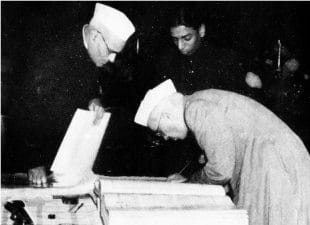
The constitution of a country, including India, is usually, framed by the people through their elected representatives. The Indian Constitution, framed by the Constituent Assembly as established through...
The Constitution of India which came into effect in 1950 is said to be the result of borrowings, both external as well as internal. The framers of the...
The Constitution of India is, indeed, unique'unique because of it numerous aspects. Some of the major salient features of the Constitution of India can be summed up as...
The Constitution, implicitly, provides for a secular state, allowing its people to profess, practise and propagate the religion of their choice and manage their religious affairs. The Constitution...
The Constitution of India, when enacted in 1950, had 22 parts. Parts VII was repealed in 1956 by the seventh amendment, reducing the number of parts to 21...