
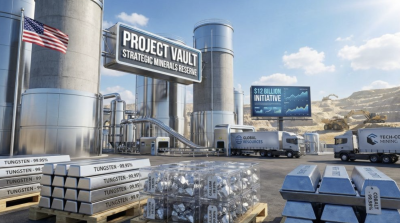
The United States has announced a $12 billion plan to build a strategic stockpile of critical minerals and rare earth elements under a new initiative called Project Vault. The programme is designed to reduce dependence on China for materials vital to defence, technology and manufacturing. It combines private sector funding with government support and is intended to protect American industries from supply disruptions and price shocks.
What Project Vault Is
Project Vault is a public-private partnership that will buy, store and manage critical minerals for future use. The stockpile will include materials such as gallium and cobalt, which are important for batteries, jet engines, smartphones and defence systems. The plan is being backed by $1.67 billion in private seed funding and $10 billion from the US Export-Import Bank.
How the System Will Work
- Companies will commit to buy materials later at a fixed inventory price.
- They will pay upfront fees and carrying costs for storage and financing.
- Project Vault will purchase the required minerals and keep them in reserve.
- Firms may access their stock only if they replace what they take out.
- During a major disruption, companies can draw from the full stockpile.
Companies and Industrial Use
More than a dozen companies have joined the initiative. These include General Motors, Stellantis, Boeing, Corning, GE Vernova and Google. Three commodities trading firms will handle procurement for the stockpile. The project is expected to support sectors such as automotive, aerospace, electronics, energy and advanced manufacturing.
Strategic Significance for the US
The initiative reflects Washington’s effort to reduce vulnerability in critical mineral supply chains. China dominates global production and processing of many such minerals, making the US dependent on external supplies. The new stockpile is similar in concept to the Strategic Petroleum Reserve, but it focuses on minerals instead of oil. It also fits into wider US efforts to strengthen domestic mining, processing and international partnerships.
Last Modified: April 27, 2026