
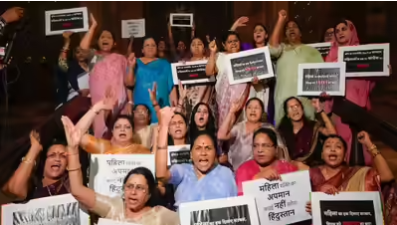
The Constitution (One Hundred and Thirty-First Amendment) Bill, 2026, aimed at implementing one-third reservation for women in the Lok Sabha and State Legislative Assemblies, failed to secure passage in the Lower House. The Bill fell short of the required two-thirds majority. Its defeat also halted consideration of two linked Bills on delimitation and Union Territories laws. The development has renewed debate on women’s political representation, delimitation, and the timing of the reservation rollout.
Bill and Voting Outcome
The Bill was placed before the Lok Sabha for approval as a constitutional amendment. It received 298 votes in favour and 230 against, but this was not enough for the special majority required for such legislation. The Speaker announced that the Bill could not move forward. Since the measure failed, the House did not proceed with the Delimitation Bill, 2026, and the Union Territories Laws (Amendment) Bill, 2026.
Purpose of the Proposed Legislation
The Bill was intended to operationalise women’s reservation through a delimitation exercise based on the latest published census. It sought to ensure one-third reservation for women in the Lok Sabha and State Legislative Assemblies. The related Delimitation Bill proposed a Delimitation Commission to redraw constituencies and identify seats to be reserved for women, including women from Scheduled Castes and Scheduled Tribes.
Linked Constitutional and Legal Measures
The Union Territories Laws (Amendment) Bill, 2026 sought changes to the Government of Union Territories Act, 1963, the Government of National Capital Territory of Delhi Act, 1991, and the Jammu and Kashmir Reorganisation Act, 2019. These amendments were designed to support readjustment of parliamentary and assembly constituencies by the Delimitation Commission. The government linked all three Bills as part of one legislative package.
Political and Federal Implications
The debate also centred on delimitation and regional balance. Concerns were raised about possible losses for southern states, while the government argued that no state would suffer a reduction in representation. It said delimitation would rationalise voter distribution and increase seats for Scheduled Castes and Scheduled Tribes. The issue has also revived discussion on the implementation of the 2023 constitutional amendment on women’s reservation and its impact on the 2029 general election.
Last Modified: April 27, 2026