

Poverty alleviation in India has evolved from a “trickle-down” approach in the early planning years to direct targeted interventions. The strategies are broadly classified into three categories: Asset Linkage/Self-Employment, Wage Employment, and Social Security Schemes.
Self-Employment and Entrepreneurship Programmes
These schemes aim to provide the poor with productive assets and skills to create sustainable livelihoods.
- Deendayal Antyodaya Yojana – National Rural Livelihoods Mission (DAY-NRLM): Launched in 2011 (rebranding SGSY), it focuses on organizing the rural poor into Self Help Groups (SHGs). It operates on the principle of “social mobilization” and “financial inclusion” through revolving funds and community investment supports.
- Deendayal Antyodaya Yojana – National Urban Livelihoods Mission (DAY-NULM): This addresses urban poverty by providing skills training, credit for micro-enterprises, and shelters for the urban homeless.
- Pradhan Mantri MUDRA Yojana (PMMY): Provides loans up to ₹10 lakh to non-corporate, non-farm small/micro-enterprises. It categorizes loans into Shishu (up to ₹50,000), Kishor (₹50,000 to ₹5 lakh), and Tarun (₹5 lakh to ₹10 lakh).
- PM SVANidhi: A micro-credit facility launched during the COVID-19 pandemic to provide street vendors with collateral-free working capital loans.
Wage Employment Programmes
These programmes act as a safety net by providing guaranteed manual work, especially during agricultural lean seasons.
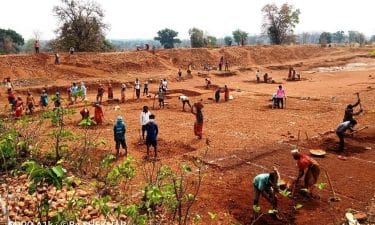
- Mahatma Gandhi National Rural Employment Guarantee Act (MGNREGA), 2005:
- Legal Guarantee: Provides at least 100 days of guaranteed wage employment in a financial year to every rural household whose adult members volunteer to do unskilled manual work.
- Key Features: 1/3rd of beneficiaries must be women; wages are linked to Consumer Price Index-Agricultural Labourers (CPI-AL); work must be provided within 15 days of demand, failing which an unemployment allowance is paid.
- Focus: Creation of durable assets like ponds, roads, and canals to improve rural productivity.
Food and Nutritional Security Schemes
These interventions target “hidden hunger” and absolute poverty through subsidized food grains.
- National Food Security Act (NFSA), 2013:
- Coverage: Legal entitlement to 75% of the rural and 50% of the urban population.
- Entitlement: Provides 5 kg of food grains per person per month at subsidized prices (₹3 for rice, ₹2 for wheat).
- Antyodaya Anna Yojana (AAY): The poorest of the poor households receive 35 kg of food grains per month.
- Pradhan Mantri Garib Kalyan Anna Yojana (PMGKAY): Initially a pandemic relief measure, it provides 5 kg of free food grains per month to NFSA beneficiaries, over and above their regular entitlement.
Social Security and Welfare Schemes
These schemes target specific vulnerable groups such as the elderly, widows, and the disabled.
- National Social Assistance Programme (NSAP): A Centrally Sponsored Scheme comprising:
- Indira Gandhi National Old Age Pension Scheme (IGNOAPS).
- Indira Gandhi National Widow Pension Scheme (IGNWPS).
- Indira Gandhi National Disability Pension Scheme (IGNDPS).
- Pradhan Mantri Jan Dhan Yojana (PMJDY): The world’s largest financial inclusion initiative. It ensures access to financial services like savings accounts, remittance, credit, insurance, and pensions, forming the “D” in the JAM (Jan Dhan-Aadhaar-Mobile) Trinity.
Housing and Infrastructure for the Poor
Poverty is multidimensional; hence, improving living conditions is a core objective.
- Pradhan Mantri Awas Yojana (PMAY): Aimed at “Housing for All.”
- PMAY-G (Gramin): Provides financial assistance for the construction of pucca houses with basic amenities to rural BPL families.
- PMAY-U (Urban): Targets the urban poor, including slum dwellers, through credit-linked subsidies and in-situ slum redevelopment.
- Pradhan Mantri Ujjwala Yojana (PMUY): Provides LPG connections to women from BPL households to replace unclean cooking fuels, reducing respiratory diseases and “energy poverty.”
- Jal Jeevan Mission (JJM): Aims to provide Functional Household Tap Connections (FHTC) to every rural household (“Har Ghar Nal Se Jal”) by 2024.
Comparative Table: Key Poverty Alleviation Interventions
| Programme Name | Launch Year | Target Group | Primary Objective |
| MGNREGA | 2005 | Rural Unskilled Labour | Right to Work / Asset Creation |
| PMAY-G | 2016 | Rural Homeless / BPL | Provision of Pucca Houses |
| PM-Kisan | 2019 | All Landholding Farmers | Income Support (₹6000/year) |
| PM-JAY (Ayushman Bharat) | 2018 | Bottom 40% Population | Health Cover of ₹5 Lakh/family |
| SBM (Swachh Bharat) | 2014 | Universal | ODF Status / Sanitation |
UPSC Trivia: Historical Committees & Facts
- Integrated Rural Development Programme (IRDP): Launched in 1980, it was the first major attempt at providing self-employment through a mix of subsidy and bank credit.
- Garibi Hatao: The famous slogan coined by Indira Gandhi during the 1971 election, marking a shift toward direct poverty attack.
- The 20-Point Programme: Originally launched in 1975, it remains a package of various schemes aimed at improving the quality of life of the poor.
- Direct Benefit Transfer (DBT): The shift to DBT has significantly reduced “leakages” in poverty schemes. By 2023, India has transferred billions directly to beneficiaries, cutting out middle-men.
Critical Evaluation of Programmes
Despite the plethora of schemes, several challenges persist:
- Inclusion/Exclusion Errors: Wealthy households sometimes benefit (inclusion error), while the most marginalized are left out due to lack of documentation (exclusion error).
- Administrative Bottlenecks: Delays in wage payments (MGNREGA) and poor quality of assets created.
- Last Mile Connectivity: Infrastructure schemes often struggle in remote tribal or hilly terrains.
- Dependency Syndrome: Critics argue that “dole-based” schemes can lead to a lack of incentive for skill up-gradation.