

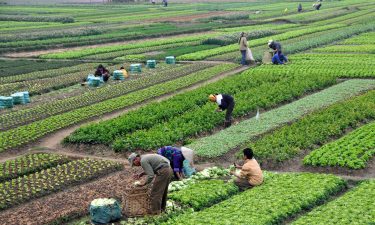
Contract farming is a pre-harvest agreement between farmers (producers) and buyers (such as food processing units, exporters, or retail chains) for the production and supply of agricultural products under forward segments at predetermined prices. It effectively integrates the primary producer with the corporate supply chain, shifting the market risk from the farmer to the purchaser.
- Legal Basis: Agriculture is a State Subject (Entry 14, List II). While many states have provisions for contract farming under their APMC Acts, the Central Government circulated the Model Contract Farming Act, 2018 to provide a uniform legal framework.
- The Agreement: It typically specifies the quantity, quality, time of delivery, and price. In many cases, the buyer also provides technical handholding, seeds, fertilizers, and credit.
Structural Models of Contract Farming
Different organizational structures exist depending on the crop and the scale of the contracting agency.
- Centralized Model: A large processor deals directly with many small farmers. It involves strict quality control and is common in crops like Tobacco, Sugarcane, and Poultry.
- Outgrower Model: Often managed by government statutory bodies or large private firms, providing high levels of technical support and inputs (e.g., Oil Palm initiatives).
- Intermediary Model: The buyer deals with an intermediary (like an FPO or a lead farmer) who then organizes a group of smallholders. This reduces the transaction cost for the buyer.
- Multipartite Model: Involves various entities including a private firm, a state agency, and perhaps a bank for credit facilitation.
Institutional Framework and Model Act 2018
The State/UT Agricultural Produce and Livestock Contract Farming and Services (Promotion & Facilitation) Act, 2018 was designed to insulate farmers from market volatility.
- Sui Generis Law: The act keeps contract farming outside the ambit of the APMC, meaning buyers do not have to pay mandi fees on such produce.
- Registering and Agreeing Authority: It proposes a state-level authority to register and record agreements to ensure transparency.
- No Land Title Transfer: A crucial clause ensures that the buyer cannot claim any permanent right or title over the farmer’s land, preventing land alienation.
- Dispute Resolution: Provides for a summary dispute settlement mechanism at the lower levels of administration (usually the Collector or a designated officer) to avoid lengthy civil court battles.
Economic Impacts of Contract Farming
| Parameter | Impact on Farmer | Impact on Buyer (Sponsor) |
| Price Risk | Eliminated through predetermined prices. | Fixed procurement cost; protected from spikes. |
| Input Access | High-quality seeds and tech provided. | Consistency in raw material quality. |
| Credit | Improved access via “tripartite agreements.” | Reduced procurement through middlemen. |
| Skill Level | Shift toward scientific farming methods. | Control over the production process. |
Successful Examples and Case Studies
- PepsiCo (Punjab): One of the most famous cases in India involving the production of high-quality “process-grade” potatoes for chips. It helped shift farmers from the traditional wheat-paddy cycle to horticulture.
- HUL (Hindustan Unilever): Engages with farmers for tomato cultivation in Maharashtra and Karnataka to ensure a steady supply for its Kissan brand.
- Amul (Dairy): While technically a cooperative, the structured procurement and pricing model shares many features with contract farming in terms of supply chain integration.
- Appachi Integrated Cotton (Tamil Nadu): A successful model where the firm provides “seed-to-garment” integration for cotton farmers.
Constraints and Challenges
- Contract Breach: If market prices rise significantly above the contract price, farmers may side-sell. Conversely, buyers may reject produce on flimsy “quality” grounds if market prices crash.
- Bargaining Asymmetry: Individual small farmers often lack the legal or economic clout to negotiate fair terms with large multinational corporations.
- Lack of Standardization: Standardized contract formats and quality parameters are still lacking for many local crops.
- Exclusion of Smallholders: Buyers often prefer “large” small-farmers to reduce administrative costs, potentially leaving the most vulnerable farmers out of the reform loop.
Policy Support and Facilitation
- Agriculture Infrastructure Fund (AIF): Provides credit for post-harvest assets that can be utilized by contracting agencies or FPOs.
- Promotion of FPOs: The government aims to form 10,000 FPOs. These organizations act as “aggregators,” making it easier for companies to enter into contract farming agreements with a single entity representing hundreds of farmers.
- PM-Kisan SAMPADA Yojana: Helps create the processing infrastructure that drives the demand for contract farming.
Facts for UPSC Prelims
- Nodal Ministry: Ministry of Agriculture & Farmers Welfare (specifically the DAC&FW).
- Section 18 of the Model Act: Explicitly prohibits the sponsor (buyer) from raising any structure on the farmer’s land unless agreed upon, and such structures must be removed after the contract expires.
- E-Contracting: The government is encouraging the integration of contract farming with digital platforms like e-NAM to record agreements electronically.
- WTO Compliance: Contract farming is generally viewed as a “Green Box” or “Blue Box” measure as it focuses on infrastructure and risk management rather than direct trade-distorting subsidies.