

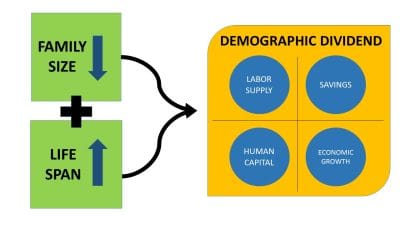
The United Nations Population Fund (UNFPA) defines demographic dividend as the economic growth potential that can result from shifts in a population’s age structure, specifically when the share of the working-age population (15 to 64 years) is larger than the non-working-age share (14 and younger, and 65 and older). India entered this “window of opportunity” around 2005-06 and is expected to stay in it until approximately 2055-56.
The Working-Age Population Dynamics
India possesses one of the youngest populations globally, with a median age of approximately 28.4 years. This creates a low dependency ratio, which theoretically boosts savings and investment rates.
- Window of Opportunity: India’s working-age population surpassed its dependent population in 2011. This bulge is expected to peak around 2041, when the working-age share will hit approximately 59%.
- Dependency Ratio: The ratio of dependents (those under 15 and over 64) to the working-age population is currently declining, providing a “first dividend” through increased labor supply.
- Regional Variation: North Indian states (UP, Bihar) have a younger profile and will reach their peak dividend later than Southern states (Kerala, Tamil Nadu), which are already witnessing an “aging” transition.
Economic Channels of Demographic Dividend
The transition from a high-dependency to a low-dependency population impacts the economy through four primary channels:
- Labor Supply: An increased number of workers contributes directly to higher output. However, this is dependent on the economy’s ability to create productive jobs.
- Savings Rate: Since the working-age group saves more than the young and the elderly, the aggregate national savings rate increases, providing capital for domestic investment.
- Human Capital: As family sizes decrease, parents and the state can invest more per child in health and education, leading to a “quality over quantity” shift in the workforce.
- Domestic Demand: A large working-age population drives consumption, making India an attractive market for both domestic and foreign investors.
Sectoral Preparedness and Challenges
To harness this dividend, the structure of the Indian economy must align with the skills and aspirations of the youth.
- The Skill Mismatch: Only about 5% of India’s workforce has undergone formal vocational training. The India Skills Report frequently highlights that a significant percentage of graduates are “unemployable” by industry standards.
- Labor Force Participation Rate (LFPR): A critical challenge is the low Female LFPR (approx. 32-37%), which prevents the economy from utilizing half of its potential demographic strength.
- Jobless Growth: While GDP grows, the employment elasticity (jobs created per unit of growth) has been declining, particularly in the manufacturing and organized service sectors.
Comparison of Global Demographic Windows
| Country | Start of Dividend | Peak of Dividend | Duration |
| Japan | 1964 | 1990s | ~30 Years |
| China | 1994 | 2014 | ~20 Years |
| South Korea | 1987 | 2012 | ~25 Years |
| India | 2005-06 | 2041 (Projected) | ~50 Years |
Government Initiatives to Maximize the Dividend
The government utilizes a multi-pronged approach focusing on Education, Health, and Employment (the “EHE” framework).
- Skill India Mission: Aims to provide market-relevant skills to over 40 crore youth through the Pradhan Mantri Kaushal Vikas Yojana (PMKVY).
- National Education Policy (NEP) 2020: Focuses on vocational integration from the middle school level and enhancing higher education enrollment.
- Startup India & Standup India: Encourages job creation by shifting the youth from “Job Seekers” to “Job Creators.”
- Ayushman Bharat: Targeted at human capital preservation by ensuring the working population does not fall into poverty due to catastrophic health expenditures.
The Risk of Demographic Disaster
If the youth are not provided with education, health, and jobs, the dividend can turn into a “demographic nightmare” or disaster.
- Structural Unemployment: Displaced agricultural workers failing to find manufacturing jobs due to automation and skill gaps.
- Social Unrest: A large, unemployed, and frustrated youth population can lead to increased crime rates and social instability.
- Premature Aging: If the dividend is not captured before the population begins to age (expected post-2050), India will “grow old before it grows rich.”
Facts and Trivia for UPSC Prelims
- Median Age Comparison: India (28.4), China (38.4), USA (38), Japan (48).
- TFR (Total Fertility Rate): India’s TFR has dropped to 2.0 (as per NFHS-5), which is below the replacement level of 2.1. This signals that the demographic window will eventually close as the population stabilizes and then ages.
- First vs. Second Dividend: The “First Dividend” is the transition period of labor growth. The “Second Dividend” occurs when a healthy and wealthy aging population continues to contribute through accumulated assets and higher productivity.
- Economic Survey 2018-19: Explicitly dedicated a chapter to the “End of the Demographic Dividend” in some states, urging the government to prepare for an aging society in the South and West.
- Demographic Dividend Index: While not a formal index, NITI Aayog monitors state-level performance through the School Education Quality Index (SEQI) and Health Index to gauge preparedness.