

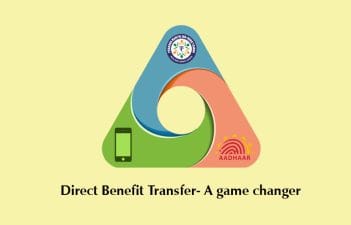
Direct Benefit Transfer (DBT) is a major governance reform initiative launched by the Government of India on January 1, 2013. It aims to re-engineer the public delivery system by transferring cash or benefits directly into the bank accounts of authenticated beneficiaries. The primary economic objective is to achieve efficiency, transparency, and target optimization by eliminating intermediate administrative layers, checking rent-seeking behavior, and minimizing delays. In welfare economics, DBT transitions the state from an in-kind provisioning model to a cash-based or targeted voucher model. This preserves consumer sovereignty and reduces the deadweight loss associated with physical commodity supply chains.
The Pillars of DBT Delivery: The JAM Trinity
The operationalization of DBT relies fundamentally on the integration of three distinct technical infrastructures, collectively termed the JAM Trinity:
- Jan Dhan Accounts: The Pradhan Mantri Jan Dhan Yojana (PMJDY) provided universal banking access by opening zero-balance, basic savings bank deposit accounts for financially excluded populations.
- Aadhaar: The Unique Identification Authority of India (UIDAI) provides a 12-digit biometric-backed identity that serves as the single source of truth for deduplication and unique beneficiary validation.
- Mobile Connectivity: Widespread telecommunication networks enable real-time transactional notifications, financial literacy, and mobile-banking linkages via Unified Payments Interface (UPI) and USSD protocols.
Institutional Framework and Financial Plumbing
The backend processing of DBT is supported by a specialized administrative and technological ecosystem that cuts across ministries:
- DBT Mission: Housed within the Cabinet Secretariat, it acts as the nodal agency for coordinating, monitoring, and driving the implementation of DBT across all central ministries and state governments.
- Public Financial Management System (PFMS): Administered by the Controller General of Accounts (CGA) under the Ministry of Finance, PFMS is an end-to-end web-based application that handles the configuration, routing, validation, and payment processing of all welfare schemes.
- National Electronic Funds Transfer (NEFT) & Aadhaar Payment Bridge (APB): The APB system, managed by the National Payments Corporation of India (NPCI), uses the Aadhaar number as a central financial address, automatically routing funds to the beneficiary’s latest Aadhaar-linked bank account without requiring explicit bank routing codes.
Typology and Classification of Direct Benefit Transfers
Cash Transfers
Under this category, the government transfers monetary benefits directly to the individual’s bank account.
- Direct Income Support: Examples include Pradhan Mantri Kisan Samman Nidhi (PM-KISAN), which provides ₹6,000 annually to farmers, and the Rythu Bandhu scheme of Telangana.
- Social Security Pensions: Examples include the National Social Assistance Programme (NSAP), which covers elderly, widowed, and disabled individuals.
- Scholarships: Central Sector and Centrally Sponsored scholarship schemes for Scheduled Castes (SC), Scheduled Tribes (ST), and Minorities.
In-Kind Beneficiary Transfers
In-kind DBT covers components where the state provides physical goods or services to validated beneficiaries rather than cash. The DBT mechanism here acts as a tracking and authentication tool at the point of sale.
- Targeted Public Distribution System (TPDS): Executed under the National Food Security Act (NFSA), where beneficiaries receive subsidized foodgrains from Fair Price Shops (FPS) only after successful Aadhaar-based biometric verification on Electronic Point of Sale (ePoS) devices.
- Fertilizer Subsidy Scheme: Fertilizer companies are reimbursed their subsidy allocations only after the actual sale of fertilizers to a farmer is authenticated via biometric ePoS devices at retail outlets.
Other Forms of Transfers
This covers indirect or hybrid transfer mechanisms where funds are sent to third-party service providers on behalf of a specific beneficiary.
- Maternity Benefits: Schemes like Pradhan Mantri Matru Vandana Yojana (PMMVY) where cash incentives are paid conditionally upon meeting health and immunization milestones.
- Voucher-Based Systems: The e-RUPI platform utilizes a purpose-specific digital voucher system that limits usage to predefined welfare provisions like healthcare, immunization, or seed procurement.
Sectoral Matrix of Major Schemes Under DBT
| Name of Scheme | Nodal Ministry | DBT Type | Operational Mechanism & Subventions |
| PM-KISAN | Ministry of Agriculture and Farmers Welfare | Cash Transfer | Direct income support of ₹6,000 per year delivered in three installments of ₹2,000 each via APB. |
| PAHAL (DBT-LPG) | Ministry of Petroleum and Natural Gas | Cash Transfer | Consumers purchase LPG cylinders at market price; the subsidy amount is automatically credited back to their bank accounts. |
| MGNREGA Wage Payments | Ministry of Rural Development | Cash Transfer | Wages are directly credited to workers’ accounts based on electronic muster rolls (e-Muster) generated at the Gram Panchayat level. |
| Pradhan Mantri Matru Vandana Yojana (PMMVY) | Ministry of Women and Child Development | Conditional Cash Transfer | Cash incentive of ₹5,000 provided in installments to pregnant women and lactating mothers for the first living child upon fulfilling health checks. |
| National Social Assistance Programme (NSAP) | Ministry of Rural Development | Cash Transfer | Comprises Indira Gandhi National Old Age, Widow, and Disability Pension Schemes, directly credited to bank accounts. |
| Targeted Public Distribution System (TPDS) | Ministry of Consumer Affairs, Food and Public Distribution | In-Kind Transfer | Distribution of highly subsidized foodgrains authenticated via ePoS devices linked to the central Aadhaar repository. |
Key Technological Components of the DBT Ecosystem
Aadhaar Enabled Payment System (AePS)
AePS is a bank-led model developed by NPCI that allows online interoperable financial transactions at Point of Sale (MicroATM) through the Business Correspondent (BC) of any bank using Aadhaar authentication. This technology enables rural beneficiaries to withdraw their DBT cash deposits within their own village, avoiding long trips to brick-and-mortar bank branches.
One Nation One Ration Card (ONORC)
ONORC is an intra-state and inter-state portability mechanism built on top of the integrated Integrated Management of Public Distribution System (IM-PDS) portal. By uploading ration card data to a central cloud server and installing ePoS devices at Fair Price Shops, migrant workers can claim their subsidized foodgrain quotas from any fair price shop across the country using biometric validation.
e-RUPI: Purpose-Specific Digital Voucher
Launched by NPCI, e-RUPI is a cashless, contactless digital payment instrument delivered via an SMS string or QR code to the beneficiary’s mobile phone. It is a pre-paid voucher that operates without requiring a debit card, mobile banking application, or internet access at the point of redemption. Crucially, it is programmed for a specific use case, meaning a vaccine voucher cannot be redeemed for any other commodity, ensuring zero diversion of welfare funds.
Macroeconomic and Governance Impacts
Fiscal Savings and Elimination of Leakages
The implementation of DBT has systematically restructured public finance management by removing structural inefficiencies:
- Deduplication: Biometric validation via Aadhaar has purged millions of duplicate, ghost, and non-existent beneficiaries from government databases across public distribution and cooking gas schemes.
- Reduced Intermediary Costs: Bypassing regional administrative layers prevents intermediate fund diversions and reduces administrative overhead.
- Interest Savings: Through the Just-in-Time (JIT) funding mechanism managed via PFMS, funds are pulled from the central exchequer only when a payment to a beneficiary is triggered, eliminating the floating of idle public money in commercial bank accounts.
Financial Inclusion and formalization of the Economy
The requirement of a bank account to access state welfare created an institutional push for the lower strata of society to enter the formal banking sector. The steady velocity of DBT funds passing through PMJDY accounts has made rural banking touchpoints commercially viable for Business Correspondents, expanding micro-credit and micro-insurance penetration across rural geographies.
Challenges and Structural Vulnerabilities in DBT Implementation
Technical and Infrastructure Deficits
- Biometric Mismatch: Manual laborers, senior citizens, and agricultural workers frequently encounter biometric authentication failures due to worn fingerprints or iris changes, leading to immediate exclusion from their legal entitlements.
- Connectivity Shadows: Rural and deep tribal pockets often suffer from poor cellular connectivity and frequent power outages, rendering ePoS devices and MicroATMs non-functional at critical times.
- Banking Redlines: The density of rural bank branches remains low, forcing beneficiaries to rely entirely on mobile business correspondents who occasionally face liquidity shortages or lack functional network access.
Administrative and Implementation Friction
- Innocent Exclusions: Rigid adherence to digital verification parameters without robust, offline fallback options can lead to structural exclusion errors, blocking vulnerable families from food rations or social security pensions.
- Account Mapping Errors: In the Aadhaar Payment Bridge system, funds are routed to the bank account most recently linked with Aadhaar. If a bank automatically links a customer’s account without explicit consent during a scheme drive, the beneficiary’s welfare money may end up in a dormant or forgotten account without their knowledge.
- Digital Divide and Literacy Gaps: The steep learning curve associated with digital transactions makes rural and elderly demographics dependent on third-party operators, which can introduce new opportunities for financial exploitation at the grassroots level.
Prelims-Centric Trivia and Analytical Pointers
Key Institutional Milestones
- The concept of direct cash transfers was extensively analyzed and recommended by the Task Force on Direct Transfer of Subsidies headed by Nandan Nilekani in 2011.
- DBT does not replace federal financial relations; rather, Centrally Sponsored Schemes utilize the state-level PFMS modules to ensure that the central share and state matching share are accurately mapped before reaching the end user.
- The Aadhaar (Targeted Delivery of Financial and Other Subsidies, Benefits and Services) Act, 2016, provides the legislative backing required to make Aadhaar mandatory for accessing benefits funded by the Consolidated Fund of India under Section 7 of the Act.
- Welfare schemes are categorized into components on the DBT Bharat Portal based on whether they involve Direct Cash, In-Kind transfers, or Other Transfers (like honorariums paid to ASHA and Anganwadi workers).