

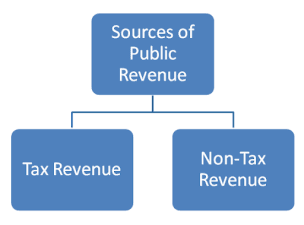
Public Revenue refers to the total income received by the government from all sources to meet its public expenditure. In the context of the Indian Economy, it represents the “Receipts” side of the Annual Financial Statement (Article 112). It is the primary tool through which the state mobilizes resources to perform its various developmental and non-developmental functions.
Classification of Public Revenue
The government’s receipts are broadly classified into two categories based on their impact on the government’s assets and liabilities.
Revenue Receipts
These are recurring receipts that do not create any liability for the government nor do they lead to a reduction in its assets.
- Tax Revenue: Compulsory payments made by citizens and corporations without any direct quid pro quo (return service).
- Non-Tax Revenue: Income derived from sources other than taxes, such as interest, dividends, and fees.
Capital Receipts
These are non-recurring receipts that either create a liability or result in a reduction of government assets.
- Debt Receipts: Market borrowings, loans from international bodies, and small savings.
- Non-Debt Capital Receipts: Recovery of loans and proceeds from disinvestment (sale of PSU shares).
Components of Tax Revenue
Tax revenue is the most significant part of public revenue and is divided based on the point of impact and incidence.
Direct Taxes
The burden of the tax cannot be shifted; the person who pays it to the government also bears the economic burden.
- Income Tax: Levied on the individual income of residents.
- Corporate Tax: Levied on the net income/profit of companies.
- Security Transaction Tax (STT): Levied on the value of securities transacted on stock exchanges.
Indirect Taxes
The burden can be shifted from the original taxpayer to the final consumer.
- Goods and Services Tax (GST): A comprehensive, multi-stage, destination-based tax that replaced most indirect taxes (Excise, VAT, Service Tax).
- Customs Duty: Levied on the import and export of goods across international borders.
Components of Non-Tax Revenue
Non-tax revenue represents the income earned by the government as a provider of services and an investor.
- Interest Receipts: Interest received on loans given by the Union to State Governments, UTs, and PSUs.
- Dividends and Profits: Profits from the Reserve Bank of India (RBI) and dividends from Central Public Sector Enterprises (CPSEs).
- External Grants: Cash grants received from foreign countries and international organizations.
- User Charges and Fees: Fees for administrative services (Passport fees, Court fees) and penalties or fines.
Comparison: Revenue Receipts vs. Capital Receipts
| Feature | Revenue Receipts | Capital Receipts |
|---|---|---|
| Nature | Regular and recurring. | Irregular and non-recurring. |
| Asset/Liability Effect | No effect on assets or liabilities. | Creates liability or reduces assets. |
| Obligation | No obligation to return the money. | Borrowed funds must be repaid with interest. |
| Examples | GST, Income Tax, Dividends. | Market Loans, Disinvestment, Recovery of Loans. |
Specific Sources of Revenue in India
- Cess: A “tax on tax” levied for a specific purpose (e.g., Health and Education Cess). The proceeds are initially credited to the Consolidated Fund of India but are earmarked for specific use.
- Surcharge: An additional tax levied on the existing tax rate, primarily on high-income earners. Unlike Cess, its proceeds are not earmarked for a specific purpose.
- Escheat: Revenue that accrues to the state when a person dies intestate (without a will) and has no legal heirs.
Canons of Taxation (Adam Smith)
To ensure an efficient revenue system, the government follows these four fundamental principles:
- Canon of Equality: Taxes should be proportional to the taxpayer’s ability to pay (Progressive Taxation).
- Canon of Certainty: The time, manner, and amount of payment should be clear and certain to the taxpayer.
- Canon of Convenience: Taxes should be levied and collected in a manner most convenient for the taxpayer.
- Canon of Economy: The cost of collecting taxes should be minimal compared to the revenue generated.
Key Economic Concepts Related to Public Revenue
- Tax Base: The total amount of assets or income that the government can tax (e.g., the number of people earning above the exemption limit).
- Tax Buoyancy: The responsiveness of tax revenue growth to changes in GDP. If tax revenue increases by 1.2% for every 1% increase in GDP, the buoyancy is 1.2.
- Tax Elasticity: The change in tax revenue in response to changes in tax rates.
- Tax-to-GDP Ratio: An indicator of how well the government finances its expenditure through tax. India’s ratio typically hovers around 10-11% for the Center.
- Laffer Curve: A theoretical representation of the relationship between tax rates and tax revenue, suggesting that there is an “optimal” tax rate that maximizes revenue.
Trivia and Fact File for Aspirants
- Consolidated Fund of India (Article 266): All public revenue (Tax and Non-Tax) is credited here. No money can be withdrawn without Parliamentary approval.
- Finance Commission (Article 280): Determines the “Vertical Devolution” (sharing of taxes between Union and States) and “Horizontal Devolution” (among States).
- Tax Expenditure: Revenue foregone by the government due to exemptions, deductions, and concessions (often referred to as “incentives”).
- Direct Tax Code (DTC): An ongoing proposal to simplify and consolidate the various direct tax laws in India.
- Corporation Tax Trend: In recent years, Corporate Tax has often been the largest single source of direct tax revenue for the Indian Government, though GST is the largest overall contributor.