
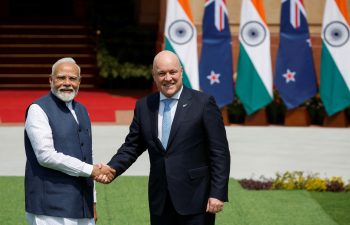
At a time of trade fragmentation and supply-chain risk, the India–New Zealand Free Trade Agreement shows India’s preference for selective liberalisation. The pact, signed by Narendra Modi and Christopher Luxon, combines market access, services mobility and domestic safeguards, with wider implications for economic diplomacy.
Why the FTA matters
India’s trade policy is moving towards agreements that open markets where it has strength and protect sectors where exposure can hurt employment or farm incomes. The New Zealand pact fits this pattern. It strengthens India’s position as a dependable partner in a period marked by protectionism, policy uncertainty and geopolitical rivalry. For New Zealand, deeper engagement with India reflects confidence in India’s growth path, reform direction and market depth. For India, the deal adds to recent agreements with Oman and the United Kingdom and shows that New Delhi is willing to negotiate faster, but not at the cost of domestic interests.
Selective liberalisation: the new FTA approach
India’s recent FTAs show a shift away from broad tariff opening towards outcome-oriented deals. The emphasis is on:
- securing access in sectors where India is competitive;
- retaining policy space in sensitive goods and agriculture;
- expanding services exports and mobility channels;
- linking trade with regulatory cooperation and standards.
This approach suits a large economy that is still building manufacturing depth and remains sensitive to import surges in labour-intensive and farm-linked sectors. It also fits India’s goal of a fair, equitable and rules-based trading system rather than one-sided market opening.
| Dimension | India–New Zealand FTA | Policy meaning |
|---|---|---|
| Goods trade | New Zealand cuts duties on 100% tariff lines; India opens 70% | Market access with calibrated domestic protection |
| Services | Wide access in IT, education, fintech, telecom, tourism and construction | Uses India’s comparative advantage |
| Mobility | Skilled professionals and post-study work opportunities | Supports talent exports and student opportunities |
| Sensitive sectors | No concessions in dairy, sugar, spices and edible oils | Protects farmers and vulnerable producers |
Services and labour mobility at the core
Services are the most important part of the agreement. India is among the top five global service exporters, yet many trade deals give limited access to Indian service suppliers. New Zealand has offered India its widest-ever access in services. This has several effects:
- It supports IT, fintech, telecom, education and tourism firms.
- It improves access for engineers, healthcare workers and teachers.
- It creates more predictable channels for Indian students through post-study work opportunities.
- It gives Indian youth a route in a period when several advanced economies have tightened migration rules.
For India, trade in services is not only about exports. It is also about mobility of people, recognition of skills, and overseas opportunities for students and professionals. In trade diplomacy, this is a direct use of India’s human capital.
Goods trade: openness with safeguards
The goods chapter is calibrated. New Zealand has removed duties on all tariff lines, which gives Indian exports duty-free entry. India has opened 70% of tariff lines, leaving space to protect sensitive products. Likely winners include:
- textiles and apparel;
- leather goods;
- engineering goods;
- pharmaceuticals;
- farm products with export potential.
India has also secured duty-free access to inputs such as wooden logs, coking coal and metal scrap. These can lower costs in steel, engineering and construction. Agriculture has been handled carefully. The agreement supports value-chain development and agri-technology cooperation in apples, kiwifruit and honey, but avoids concessions in dairy, sugar, spices and edible oils. This matters because agriculture remains politically sensitive and closely linked to rural livelihoods.
Health, traditional medicine and services exports
A dedicated annex on health and traditional medicine services opens a new channel for Indian firms. It can support:
- pharmaceutical services;
- healthcare delivery;
- wellness-related services;
- traditional medicine-based offerings.
This also supports India’s identity as a global health partner built during the pandemic period. In trade terms, it widens the range of services where Indian providers can compete on cost, skill and experience.
Utilisation remains the main test
India’s trade agreements have often suffered from low utilisation. The estimated utilisation rate is around 25%, far below the 70–80% seen in developed economies.
| Low utilisation: main reasons | Effect on exporters |
|---|---|
| Low awareness of tariff benefits and rules of origin | Exporters do not claim preferences |
| Compliance costs and paperwork | Smaller firms avoid using the agreement |
| Non-tariff barriers and standards issues | Market access on paper does not convert into sales |
| Weak coordination among agencies and industry | Trade concessions are underused |
The India–New Zealand FTA tries to correct these gaps through regulatory cooperation, streamlined customs procedures and greater transparency. Industry bodies such as the Confederation of Indian Industry have called for joint action by government, enterprises and trade associations.
Steps needed to raise utilisation
- Create sector-wise handholding for MSMEs and first-time exporters.
- Run awareness drives on rules of origin, standards and documentation.
- Use digital customs and single-window systems to cut delay.
- Build trade facilitation cells in export clusters.
- Track non-tariff barriers through regular joint review.
- Link FTAs with logistics, standards testing and certification support.
Without such measures, tariff concessions remain underused and the commercial gains stay limited.
Economic diplomacy and strategic flexibility
The deal adds to India’s broader trade diplomacy. It comes after agreements with Oman and the United Kingdom and strengthens India’s selective engagement with major trade partners. It also matters in the Indo-Pacific context. India has now concluded economic partnership agreements with all members of the Regional Comprehensive Economic Partnership except China. This gives India more room to manage supply chains, diversify partners and negotiate from a stronger position in regional trade architecture. The agreement also rests on domestic strengths:
- a growing middle class;
- a large skilled workforce;
- reform-driven growth;
- rising integration into global value chains.
With trade estimated at $2.4 billion in 2024–25 and expected to rise further, the pact can support India’s medium-term export and growth goals, including the ambition of a $7 trillion economy by 2030.
Likely UPSC analytical angles
- India’s FTA strategy is shifting from quantity to quality.
- Services and labour mobility are now central to trade negotiations.
- Protection of sensitive sectors remains part of India’s trade design.
- FTA outcomes depend as much on implementation as on negotiation.
- Trade policy is being used as an instrument of economic diplomacy and Indo-Pacific strategy.
Model Questions
- Analyse how the India–New Zealand Free Trade Agreement reflects India’s shift towards selective, outcome-oriented trade liberalisation. [GS-III: Economic Development]
- Discuss the role of services trade and skilled mobility in the India–New Zealand Free Trade Agreement and its relevance for India’s labour and education interests. [GS-III: Economic Development]
- Why do India’s free trade agreements often show low utilisation, and what measures can improve their commercial gains? [GS-III: Economic Development]
- How does the India–New Zealand Free Trade Agreement strengthen India’s economic credibility and strategic flexibility in the Indo-Pacific trade order? [GS-II: International Relations]
India is moving away from broad tariff opening towards deals that secure gains in services, mobility and key exports while protecting sensitive sectors. The New Zealand pact offers duty-free access, labour mobility and post-study opportunities, but preserves policy space in dairy and other vulnerable areas. This improves market access without exposing domestic producers to sudden shocks and fits India’s wider trade diplomacy with the UK and Oman.
The agreement gives India wide access in IT, education, fintech, telecom, tourism and construction, along with opportunities for skilled professionals and Indian students. This uses India’s comparative advantage in human capital and supports service exports, overseas employment and predictable migration channels. It is important at a time when many advanced economies are tightening migration rules and service trade faces regulatory barriers.
Low utilisation comes from poor awareness, compliance costs, complex rules of origin and non-tariff barriers. Many firms, especially MSMEs, do not have the capacity to claim preferences. Better results require customs simplification, regulatory cooperation, digital facilitation, sector-wise outreach and trade support through export clusters. Joint action by government, industry bodies and exporters is needed to convert formal access into actual trade.
The pact shows that India can negotiate balanced agreements in a fragmented trade environment. It deepens ties with a trusted partner, supports supply-chain diversification and adds to India’s network of selective partnerships. By concluding economic partnership agreements with all RCEP members except China, India gains more room in Indo-Pacific trade diplomacy while protecting domestic interests and improving its image as a dependable economic partner.