
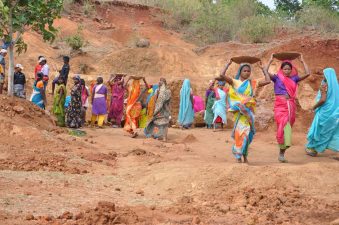
The transition from the Mahatma Gandhi National Rural Employment Guarantee Act (MGNREGA) to the Vikasit Bharat Guarantee for Rozgar and Ajeevika Mission (Gramin) Act, 2025 (VB-G RAM G Act) marks a significant pivot in India’s rural policy. This evolution represents a shift from a demand-driven safety net designed for distress relief to a “saturation-mode” developmental mission. While public debate often focuses on the rebranding and the removal of Mahatma Gandhi’s name, the substantive legislative changes fundamentally rewrite the fiscal, operational, and structural relationship between the Union Government and the States.
Substantive Shifts in the VB-G RAM G Act
The new legislative framework introduces several critical modifications to the existing rural employment paradigm:
Expanded Guarantee with a Seasonal Pause
The Act increases the statutory guarantee from 100 to 125 days of wage employment per rural household. However, it introduces a mandatory 60-day “pause period” during peak agricultural seasons. This design intended to prevent labor shortages for farmers, a feature that was notably absent in the original MGNREGA framework.
Reformed Fiscal Architecture
Financing has moved from a centrally-heavy sector scheme to a 60:40 cost-sharing model for most states, while maintaining a 90:10 ratio for North Eastern and Himalayan states. Critics and analysts highlight that while the guaranteed days are higher, the shift to “normative allocations”—budget ceilings set by the Centre—may limit a state’s ability to respond to unexpected rural distress without the state bearing the full additional cost of excess demand.
Climate Stress and Priority Verticals
Work under the new Act is strictly aligned with four thematic domains designed for long-term resilience:
- Water security, focusing on irrigation and groundwater recharge.
- Core rural infrastructure, emphasizing roads and connectivity.
- Livelihood infrastructure, targeting storage and production assets.
- Climate adaptation, specifically mitigating the impacts of extreme weather events.
Technology-Driven Accountability
The Act mandates a “comprehensive digital ecosystem.” This includes biometric authentication for attendance, geospatial tracking of worksites, and AI-based fraud detection. While these measures are intended to reduce leakages and corruption, some advocates argue these requirements can lead to technological exclusion for genuine workers in areas with poor digital connectivity.
Integrated Planning
Local plans, now known as Viksit Gram Panchayat Plans, are spatially integrated with national platforms like PM Gati Shakti. This ensures that rural assets are no longer scattered or localized but contribute to a unified national infrastructure stack.
Comparative Analysis of MGNREGA and VB-G RAM G Act
The following table illustrates the core differences between the 2005 framework and the 2025 redesign:
| Feature | MGNREGA (2005) | VB-G RAM G Act (2025) |
| Guaranteed Days | 100 days | 125 days |
| Funding Model | Demand-driven (Centre paid most) | Normative/Capped (60:40 share) |
| Agricultural Sync | No specific pause | 60-day mandatory pause |
| Asset Focus | Local works | National Infrastructure Stack |
| Monitoring | Manual/Digital mix | Mandatory Biometric & AI |
The redesign aims to transform rural employment from a standalone relief measure into a strategic tool for Viksit Bharat 2047, emphasizing durable asset creation over simple wage disbursement.
Fiscal, Administrative, and Socio-Economic Risks
Restructuring a large-scale entitlement program involves significant trade-offs as the system moves from a “rights-based” model toward a “centrally-sponsored, mission-mode” framework.
Fiscal Risks: Shifting the Burden to States
The shift to a 60:40 cost-sharing split poses risks to the fiscal health of lower-income states.
- Strain on Poorer States: States like Bihar, Uttar Pradesh, and Manipur face a massive additional financial burden. If a state cannot meet its 40% share, it may lead to “supply-driven” rationing of work, where sites are not opened despite demand.
- Normative Allocations vs. Open-Ended Demand: Unlike the open-ended budget of MGNREGA, the new Act uses budget ceilings. This allows the Centre to cap its total outlay but risks leaving states to fund 100% of any work demand during unexpected crises like droughts.
- Trade-off: The Centre gains fiscal discipline at the expense of the state’s ability to provide a flexible safety net.
Administrative Risks: The Digital Divide
The heavy reliance on a digital infrastructure stack creates new barriers to access.
- Technological Exclusion: In areas with poor internet or low literacy, biometric or GPS-tagged failures can cause “exclusion errors,” where workers lose wages through no fault of their own.
- Centralization of Control: While local planning is encouraged via Viksit Gram Panchayat Plans, actual approval is governed by central “normative asset templates,” potentially eroding the autonomy of local Panchayats.
- Trade-off: Increased transparency and reduced leakages are sought at the risk of creating a “digital gatekeeper.”
Socio-Economic Risks: Seasonal Stability and Gender
The 60-day mandatory pause marks a major departure from year-round availability.
- Impact on Landless Laborers: For the landless, the “pause” may coincide with times when private farm work is unavailable or pays poorly, potentially forcing distress migration.
- Gender Dynamics: Since the program is a critical source of independent income for rural women, a shift toward “infrastructure-heavy” projects or seasonal pauses could disproportionately affect women’s economic autonomy.
- Trade-off: Supporting the farm labor supply for owners may weaken the program’s function as a poverty-reduction tool for the poorest.
Emerging Challenges and the Future Trajectory
Climate change, rural distress, and evolving labor markets are redefining the scheme’s role in national resilience.
Climate Change: From Relief to Adaptation
Climate change is the most immediate external shock. The Act introduces a vertical for “special works to mitigate extreme weather events,” such as flood drainage. Future success depends on moving toward Green Jobs and durable, climate-resilient infrastructure like check dams, which improve groundwater levels.
Rural Distress: Navigating Capped Models
Rising rural inflation and stagnant real wages test the program’s fallback utility. The shift to a 60:40 model may limit responsiveness during crises. Despite these issues, the program remains a vital consumption stabilizer, contributing to the decline of rural poverty from 65% in 2011 to under 28% in 2022.
Evolving Labor Markets
The labor market is no longer purely agrarian. Policy is shifting from managing “distress migration” to encouraging “aspirational migration,” where workers are upskilled in fields like agro-processing. The National Rural Infrastructure Stack integrated with PM Gati Shakti allows rural work to contribute to national supply chains like warehouses and cold storage.
Philosophical and Practical Implementation Changes
The transition moves the program from a “passive safety net” to an “active economic tool.”
Implementation and Targeting
- Precision Monitoring: Work cannot officially start or be paid for without a digital footprint (Biometrics and GIS).
- Saturation Mode: Moving away from self-selection, the Act uses SECC data and Family IDs to proactively identify eligible households.
- Asset-Centric Targeting: Focus shifts to individual productive assets, like irrigation wells for small-scale farmers, targeting the “productive poor.”
Effectiveness: Durable Assets
The primary critique of the past was the creation of temporary “kucha” assets. The new framework measures effectiveness by the economic utility and climate resilience of the asset, ensuring rural roads connect to larger highway networks or warehouses via the PM Gati Shakti National Master Plan.
Questions
- Critically analyse the fiscal implications of shifting from a demand-driven funding model to a 60:40 cost-sharing arrangement under the VB-G RAM G Act, 2025. How might this transition affect the socio-economic safety nets in low-income states? {GS-II: Governance}
- Examine the role of the 60-day mandatory “seasonal pause” in balancing the needs of the agricultural sector with the livelihood security of landless rural laborers. Point out the potential impact on distress migration patterns in India. {GS-I: Indian Society}
- With suitable examples, discuss how the integration of rural employment schemes with the PM Gati Shakti National Master Plan can enhance the quality and durability of rural infrastructure. Underline the significance of this shift for achieving the Viksit Bharat 2047 vision. {GS-III: Economic Development}
- What are the administrative challenges associated with the mandatory use of AI-based fraud detection and biometric authentication in rural employment programs? Comment on the risks of technological exclusion in regions with a significant digital divide. {GS-II: Social Justice}
- Explain the significance of the “Climate Adaptation” vertical in the VB-G RAM G Act. How can employment guarantee schemes be effectively utilized as tools for climate resilience and groundwater rejuvenation in India? {GS-III: Environment & DM}
- Critically discuss the transition of the “Right to Work” from a legally enforceable demand-driven entitlement to a supply-driven “normative allocation” model. Analyze the potential consequences for the most vulnerable sections of rural society. {GS-II: Constitution of India & Polity}