
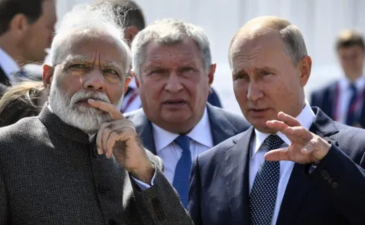
The debate over India’s continued purchase of Russian crude has intensified amid reported pressure from the United States. While Washington signals expectations of reduced imports from the Russian Federation, New Delhi reiterates that energy security for 1.4 billion people remains its guiding principle. The issue sits at the intersection of geopolitics, economics and strategic autonomy.
At stake is not merely a trade transaction, but India’s broader foreign policy posture—balancing long-standing ties with Russia and deepening strategic engagement with the United States, while safeguarding domestic economic stability.
How Russian Oil Became Central to India’s Energy Basket
Before 2022, Russian crude accounted for barely 1–2% of India’s total imports. The Ukraine conflict and subsequent Western sanctions altered global oil trade flows. Russia began offering significant discounts, and India emerged as a major buyer—at times importing nearly 1.5 million barrels per day.
The attraction was straightforward:
- Discounts ranging from $5–10 per barrel, sometimes higher.
- Competitive landed cost despite longer shipping routes.
- Crude grades suitable for India’s complex refineries.
Russian grades, similar to Middle Eastern crude, yield strong middle distillates such as diesel—critical for India’s transport and industrial demand. For refiners, this convergence of economics and technical compatibility made Russian crude commercially attractive.
Can the US Replace Russian Supply?
Technically, India’s refineries are flexible enough to process alternative grades. Prior to 2022, India sourced crude from West Asia, Africa, the US and Latin America without disruption. However, technical feasibility does not automatically translate into economic viability.
Two constraints shape the debate:
- Price Sensitivity: US crude typically trades at market-linked prices without the steep discounts that Russian barrels offered. Even after factoring freight and insurance, Russian crude has often landed cheaper.
- Quality Differences: US crude is generally lighter, while Russian crude is heavier. Substituting Russian oil would require blending US grades with others, raising costs.
Moreover, questions remain about whether the US can consistently supply large incremental volumes, given its own consumption patterns and export commitments.
Thus, while diversification is feasible, a complete one-to-one substitution appears economically costly.
Geopolitics: Between Strategic Autonomy and Strategic Partnership
India’s relationship with Russia has historically spanned defence, energy and multilateral diplomacy. At the same time, ties with the United States have deepened across trade, technology and security cooperation.
This creates a delicate balancing act:
- A sharp halt in Russian imports could strain traditional partnerships.
- Ignoring US concerns could complicate strategic alignment in the Indo-Pacific.
- Appearing to capitulate under pressure may undermine India’s strategic autonomy doctrine.
The current “non-committal” stance may therefore reflect calibrated diplomacy rather than indecision. India has historically avoided binary alignments, preferring issue-based engagement.
Economic Implications of a Shift
Moving away from discounted Russian oil would have tangible fiscal consequences. Estimates suggest that replacing discounted barrels could raise India’s monthly import bill significantly.
Higher crude costs can:
- Increase inflationary pressures.
- Widen the current account deficit.
- Strain fiscal balances if retail fuel prices are managed politically.
For public sector refiners, losing access to discounted feedstock compresses margins. While alternative suppliers in the Middle East can step in, the economics would differ.
The likely scenario, therefore, is not an abrupt halt but calibrated reduction—diversifying supply while retaining economic flexibility.
Energy Security as the Core Principle
India imports over 85% of its crude oil needs. In such a context, energy security is not merely a commercial concern; it is a macroeconomic and national security imperative.
Energy security encompasses:
- Assured availability of supply.
- Affordability and price stability.
- Diversification of sources to reduce risk.
- Resilience against geopolitical shocks.
From this perspective, India’s approach appears rooted in pragmatic diversification rather than ideological alignment. Russian crude has offered cost advantages, while US and Middle Eastern supplies provide diversification benefits.
Pause, Not Halt: The Likely Path Ahead
Recent data indicate some moderation in Russian imports without a proportional rise in US crude purchases. This suggests a tactical recalibration rather than strategic rupture.
A possible trajectory includes:
- Reducing dependence on Russian crude gradually.
- Increasing procurement from Middle Eastern producers under term contracts.
- Using US crude selectively for diversification and strategic signalling.
- Accelerating long-term energy transition investments in renewables and green hydrogen.
On pure economics, Russian oil has held an edge in recent years. On geopolitics, diversification strengthens India’s bargaining position. The policy equilibrium may lie in balancing both—maintaining energy security while preserving diplomatic space.
What to Note for Prelims?
- India imports over 85% of its crude oil requirement.
- Difference between light and heavy crude.
- Concept of landed cost (price + freight + insurance).
- Major crude suppliers to India: Russia, Iraq, Saudi Arabia, UAE, US.
- Energy security dimensions: availability, affordability, accessibility.
What to Note for Mains?
- “Energy security shapes foreign policy choices.” Discuss with reference to India’s oil imports.
- Analyse the economic and geopolitical implications of India’s Russian oil purchases.
- Examine how strategic autonomy influences India’s external economic decisions.
- Discuss the impact of crude oil pricing on inflation and macroeconomic stability in India.