
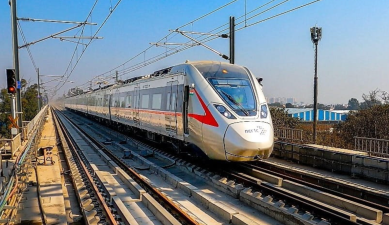
India’s transport policy is entering a new phase with the expansion of high-speed rail (HSR) as a central pillar of its future passenger mobility framework. The Union Budget 2026–27 announced seven new high-speed rail corridors, signalling a decisive move beyond the Mumbai–Ahmedabad pilot project. As inter-city travel demand rises due to urbanisation and economic clustering, high-speed rail is being positioned as a long-term, high-capacity solution aligned with growth, sustainability and regional integration goals.
Why High-Speed Rail Now?
Indian Railways, one of the largest rail networks globally, has historically enabled economic integration by connecting markets, labour and production centres. However, mobility patterns are undergoing structural change. Rapid urbanisation, rising incomes, and the expansion of metropolitan regions have significantly increased the demand for faster inter-city travel.
Conventional railways, which share tracks with freight and slower passenger services, face constraints in speed and capacity. High-speed rail — generally defined as passenger systems operating above 250 kmph on dedicated corridors — represents a structural shift. With segregated infrastructure, advanced signalling systems and purpose-built rolling stock, HSR ensures higher reliability, safety and punctuality.
For India, the rationale is multidimensional:
- Reduction in travel time between major economic hubs.
- Decongestion of existing railway and highway networks.
- Support for sustainable, energy-efficient transport systems.
The National Rail Plan up to 2030 recognises high-speed rail as a complementary layer within the broader passenger rail ecosystem.
Union Budget 2026–27 and the Seven Corridors
The Union Budget 2026–27 allocated a record capital outlay of ₹2.78 lakh crore to Indian Railways, highlighting infrastructure-led growth as a policy priority. Within this framework, seven high-speed rail corridors spanning nearly 4,000 km were announced, with estimated investments of around ₹16 lakh crore.
The corridors are geographically distributed to promote balanced regional development.
Northern and Eastern Corridors
- Delhi–Varanasi: Expected travel time of approximately 3 hours 50 minutes, strengthening connectivity between the national capital and eastern India.
- Varanasi–Patna–Siliguri: Estimated travel time of about 2 hours 55 minutes, improving access across Uttar Pradesh, Bihar and West Bengal.
Southern and Western Corridors
- Chennai–Bengaluru: Projected travel time of about 1 hour 13 minutes.
- Bengaluru–Hyderabad: Around 2 hours.
- Chennai–Hyderabad: Around 2 hours 55 minutes.
- Mumbai–Pune: Approximately 48 minutes.
- Pune–Hyderabad: Around 1 hour 55 minutes.
These corridors are designed as growth connectors linking industrial, technological and cultural hubs, fostering corridor-based economic development.
Mumbai–Ahmedabad: India’s First High-Speed Rail Project
The Mumbai–Ahmedabad High-Speed Rail (MAHSR) Corridor represents India’s first operational step into high-speed rail infrastructure.
Key features include:
- Length of approximately 508 km connecting Mumbai and Ahmedabad.
- Designed operational speed of 320 kmph.
- Implementation by the National High Speed Rail Corporation Limited (NHSRCL).
- Combination of elevated, underground and at-grade alignments.
- 12 stations planned as multimodal transport hubs.
- Estimated end-to-end travel time of about 2 hours 7 minutes.
Beyond travel-time reduction, the project has enabled the development of institutional and technical capacity in high-speed rail construction, signalling systems, project management and regulatory coordination. It serves as a learning model for future corridor expansion.
Economic and Regional Development Implications
High-speed rail is not merely a transport upgrade but a regional development instrument. Corridor-based planning can:
- Stimulate economic clusters along routes.
- Encourage transit-oriented urban development.
- Facilitate labour mobility and business travel.
- Reduce dependence on short-haul aviation and road transport.
Time compression between cities alters economic geography. For example, reducing travel between Mumbai and Pune to under an hour can integrate labour markets and industrial clusters, enhancing productivity and competitiveness.
High-speed rail also aligns with India’s sustainable development objectives by offering lower per-passenger emissions compared to road and air transport, especially when integrated with renewable energy sources.
Institutional and Financial Challenges Ahead
Despite its promise, the expansion of high-speed rail involves significant challenges:
- High capital costs and long gestation periods.
- Land acquisition and environmental clearances.
- Ensuring financial sustainability and adequate ridership.
- Building domestic manufacturing and technology capability.
- Seamless integration with conventional rail and urban transit networks.
The success of the high-speed rail programme will depend on coordinated efforts between central and state governments, robust institutional frameworks, and sustained long-term investment.
What to Note for Prelims?
- Definition of high-speed rail (above 250 kmph on dedicated tracks).
- Objectives of the National Rail Plan (2030).
- Key features of the Mumbai–Ahmedabad High-Speed Rail Corridor.
- Record capital outlay for Railways in Union Budget 2026–27.
- Role of NHSRCL in implementing high-speed rail projects.
What to Note for Mains?
- Discuss the role of high-speed rail in India’s infrastructure-led growth strategy.
- Examine how corridor-based development can transform regional economies.
- Analyse the economic and environmental implications of high-speed rail expansion.
- Evaluate the challenges in financing and implementing high-speed rail projects in India.
- Assess whether high-speed rail can complement short-haul aviation in India.