
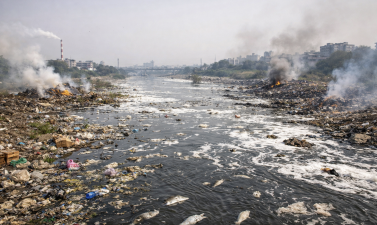
The Hindon River has recently come under severe environmental scrutiny. A five-day research survey in 2026 revealed alarming water quality issues. Tests showed zero dissolved oxygen (DO) at many locations, making the river water unfit for aquatic life. This has raised concerns about the health and environment of communities living along the river.
Recent Water Quality Findings
The survey tested water at multiple points along the Hindon. Near Star Paper Mill in Saharanpur, the water had a pH of 7.83, total dissolved solids (TDS) at 1,617 mg/L, and zero DO. Similar results were found near Rampur Maniharan and Charthawal, with DO consistently at zero despite pH values around neutral and high TDS levels. Only the river’s origin in Saharanpur showed relatively healthy water with DO at 8 mg/L. Zero DO indicates severe pollution, making survival impossible for most aquatic species.
Causes of Pollution
The main reasons for the Hindon’s pollution are untreated industrial discharge and urban sewage. Over decades, industries and cities along the river have released waste directly into the water. During non-monsoon months, the river mainly carries polluted wastewater. Despite orders from regulatory bodies like the National Green Tribunal (NGT), enforcement remains weak. This neglect has led to toxic water affecting the river ecosystem and local communities.
Impact on Communities and Environment
Toxic water has caused serious health issues, including cancer cases in villages along the riverbanks. Contaminated water has also seeped into groundwater sources. Crops irrigated with polluted water are unsafe for consumption. Residents and priests from affected areas have voiced urgent calls for action. The river’s degradation harms both human health and biodiversity.
Efforts and Awareness
The ongoing survey is part of a larger research expedition to raise awareness and engage local stakeholders. NGOs like Neer Foundation emphasise civil society’s role in river conservation. Meetings with local leaders and communities aim to push for real action beyond regulatory orders. Cleaning the Hindon requires cooperation between government, industries, and citizens.
Topics for Prelims:
Hindon River
- Tributary of the Yamuna River in northern India.
- Flows through Saharanpur, Muzaffarnagar, Meerut, Baghpat, Ghaziabad, Gautam Budh Nagar.
- Length approximately 355 km.
- Polluted mainly by industrial effluents and sewage.
- Important for local agriculture and communities.
Water Quality Parameters
- Dissolved Oxygen (DO) indicates water’s ability to support aquatic life.
- Healthy river DO level is around 5 mg/L or more.
- pH measures acidity or alkalinity; neutral is 7.
- Total Dissolved Solids (TDS) measure combined content of all inorganic substances.
- High TDS and zero DO indicate severe pollution.
Pollution Control and Regulation
- National Green Tribunal (NGT) issues environmental orders.
- Industrial effluent standards regulate discharge quality.
- Sewage treatment plants help reduce urban pollution.
- Enforcement of laws remains a challenge in many areas.
- Civil society participation is crucial for effective river cleaning.
Questions for Mains:
- Discuss the role of dissolved oxygen in maintaining river ecosystems and analyse the impact of its depletion on aquatic life. [GS-III-Environment & DM]
- Critically examine the challenges in enforcing pollution control regulations in India, with reference to rivers like the Hindon. [GS-II-Governance]
- Explain the health and socio-economic effects of river pollution on rural communities, and discuss measures to mitigate these impacts. [GS-I-Indian Society]
- With suitable examples, discuss the importance of civil society participation in environmental conservation and how it complements government efforts. [GS-II-Social Justice]
Answer Hints:
1. Discuss the role of dissolved oxygen in maintaining river ecosystems and analyse the impact of its depletion on aquatic life. [GS-III-Environment & DM]
- Dissolved Oxygen (DO) is essential for respiration of aquatic organisms, sustaining fish, invertebrates, and microbes.
- Healthy rivers have DO levels around 5 mg/L or higher, supporting biodiversity and ecological balance.
- Zero or very low DO (hypoxia/anoxia) leads to fish kills, loss of aquatic species, and disrupted food chains.
- DO depletion often results from organic pollution causing microbial oxygen consumption (eutrophication).
- Long-term DO absence degrades river ecosystems, turning water uninhabitable and affecting water quality.
- Restoring DO levels requires controlling pollution sources and improving aeration and flow in rivers.
2. Critically examine the challenges in enforcing pollution control regulations in India, with reference to rivers like the Hindon. [GS-II-Governance]
- Multiple regulatory bodies (e.g., NGT) issue orders, but implementation on ground is weak and inconsistent.
- Lack of adequate sewage treatment plants and industrial effluent management leads to untreated discharge.
- Corruption, poor monitoring, and limited manpower hinder enforcement of environmental laws.
- Industrial and urban pressures, along with political influence, often delay or dilute regulatory actions.
- Public awareness and civil society participation remain insufficient to hold violators accountable.
- Need for integrated governance, transparency, and stricter penalties to improve compliance.
3. Explain the health and socio-economic effects of river pollution on rural communities, and discuss measures to mitigate these impacts. [GS-I-Indian Society]
- Polluted river water causes serious health issues – cancer, waterborne diseases, and contamination of drinking water.
- Groundwater contamination affects agriculture and domestic use, worsening public health and livelihoods.
- Crops irrigated with toxic water become unsafe, impacting food security and farmers’ income.
- Loss of fishery resources and biodiversity reduces economic opportunities for dependent communities.
- Mitigation includes improving sewage treatment, banning untreated industrial discharge, and providing safe water alternatives.
- Community health awareness, regular monitoring, and government compensation/support schemes are vital.
4. With suitable examples, discuss the importance of civil society participation in environmental conservation and how it complements government efforts. [GS-II-Social Justice]
- Civil society raises awareness, mobilizes local communities, and pressures authorities for action (e.g., Neer Foundation’s Hindon survey).
- NGOs facilitate grassroots engagement, education, and monitoring of pollution and conservation efforts.
- Community ownership ensures sustainable practices and local enforcement beyond government reach.
- Collaborative efforts between citizens and government improve transparency and accountability.
- Examples – Public participation in river cleaning drives, advocacy for stricter pollution control, and legal activism (NGT cases).
- Complementarity arises as civil society fills gaps in governance, promotes behavioral change, and supports policy implementation.