
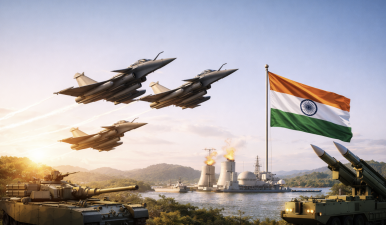
Recent developments in India’s defence sector have brought into light the strategic importance of the Rafale fighter jet procurement. The Defence Acquisition Council approved 114 Rafale jets from France’s Dassault Aviation at a cost of about Rs 3.25 lakh crore. French President Emmanuel Macron’s visit during the AI Summit saw commitments on technology transfer. However, critical source codes remain off-limits, limiting India’s ability to customise and integrate key systems independently. This raises questions about India’s defence autonomy amid growing regional threats.
Rafale Procurement and Indigenous Assembly
India plans to receive 18 Rafales fully built and manufacture 96 locally. Tata Advanced Systems will produce major fuselage parts in Hyderabad, aiming for 30% indigenous content initially, rising to 60%. Despite assembly progress, lack of access to source codes for radar and electronic warfare systems restricts operational autonomy. Software control is crucial for modern warfare, and dependence on French clearance for upgrades may limit India’s flexibility.
Strategic Implications of Source Code Restrictions
Without source code access, India cannot fully integrate indigenous weapons or perform independent upgrades. Past Mirage 2000 upgrades showed how foreign vendor dependence inflates costs. Comparatively, Russia’s Su-57 offers potential for deeper source code sharing, though its own industrial challenges limit reliability. India’s diversification across France, Russia, Israel, and the US is a strategic hedge against supplier dominance but does not guarantee full autonomy.
Defence Budget and Industrial Growth
The 2026-27 Union Budget allocated Rs 7.85 lakh crore to defence, with Rs 1.39 lakh crore for domestic procurement. This policy pushes global manufacturers to build supply chains in India. Defence production reached Rs 1.51 lakh crore in 2024-25, with private sector share at 23%. However, India’s defence spending remains far below China’s, requiring qualitative superiority and innovation rather than quantity.
Path to Strategic Autonomy
India ranks 6th globally in combat readiness but lags in industrial and technological sovereignty. Indigenous content in fighter programmes remains low, mostly in structural parts. Deep-tier supplier networks and skilled aerospace engineers are essential. The future depends on doubling R&D, securing source codes, building supply chains, and developing human capital. Indigenous jets like Tejas Mk2 and export deals signal growing maturity but true autonomy lies in owning the software architecture.
Topics for Prelims:
Rafale Fighter Jet
- Manufactured by Dassault Aviation, France.
- India to procure 114 jets; 18 fly-away, 96 assembled locally.
- Indigenous content target – 30% initially, 60% eventually.
- Source code access for radar and electronic warfare denied by France.
- Software dependency limits weapon integration and upgrades.
Indian Defence Industrial Base
- Defence budget 2026-27 – Rs 7.85 lakh crore.
- Domestic procurement budget – Rs 1.39 lakh crore.
- Private sector share in defence production – 23% (2024-25).
- Major manufacturers – Tata Advanced Systems, HAL.
- Challenges – Supply chain depth, certification, skilled workforce.
Strategic Autonomy and Technology Transfer
- Source code controls software and mission systems.
- France restricts critical software access in Rafale deal.
- Russia offers deeper access for Su-57 co-production.
- Diversification reduces supplier monopoly risks.
- Indigenous platforms like Tejas Mk2 build intellectual property.
Questions for Mains:
- Discuss in the light of India’s Rafale deal how technology transfer impacts strategic autonomy in defence manufacturing. [GS-III-Economic Development]
- Analyse the role of indigenous defence production in strengthening India’s national security, taking examples of Rafale and Tejas fighter jets. [GS-III-Internal & External Security]
- With suitable examples, examine the challenges and benefits of diversifying defence technology partners for India’s aerospace sector. [GS-II-International Relations]
- Critically discuss the importance of software sovereignty in modern warfare and its implications for India’s defence policy. [GS-III-Science & Technology]
Answer Hints:
1. Discuss in the light of India’s Rafale deal how technology transfer impacts strategic autonomy in defence manufacturing. [GS-III-Economic Development]
- Technology transfer enables domestic manufacturing, increasing indigenous content (30% initially, targeting 60%).
- Restricted access to critical source codes (radar, electronic warfare) limits software control and customization.
- Dependence on foreign vendors for upgrades increases costs and delays (Mirage 2000 example – €1 billion extra).
- Assembly without design authority shifts production location but not bargaining power or autonomy.
- Diversification (France, Russia, Israel, USA) hedges against supplier monopoly but full autonomy requires deeper tech sharing.
- Strategic autonomy hinges on owning proprietary design and software architecture, not just airframe assembly.
2. Analyse the role of indigenous defence production in strengthening India’s national security, taking examples of Rafale and Tejas fighter jets. [GS-III-Internal & External Security]
- Indigenous production reduces reliance on imports, enhancing supply chain security and quick deployment.
- Rafale’s local assembly (96 jets) and Tejas Mk2 development build industrial capabilities and intellectual property.
- Indigenous content in Rafale limited to structural parts, denoting need to deepen subsystem ownership.
- Tejas export to Armenia with indigenous AESA radar and Astra missile marks shift from licensee to modifier-exporter.
- Boosts national security by enabling customized upgrades, integration of indigenous weapons, and operational flexibility.
- Challenges include limited skilled workforce, certification barriers, and capital-intensive aerospace infrastructure.
3. With suitable examples, examine the challenges and benefits of diversifying defence technology partners for India’s aerospace sector. [GS-II-International Relations]
- Diversification reduces dependency on a single supplier, mitigating geopolitical risks and supply bottlenecks.
- France offers advanced platforms but restricts source code access, limiting autonomy.
- Russia’s Su-57 co-production offers deeper source code sharing but faces sanctions and industrial constraints.
- Israel and USA provide complementary technologies; however, US industrial delays affect engine deliveries.
- Challenges include integrating heterogeneous platforms and coordinating software systems (Operation Sindoor example).
- Benefits include enhanced bargaining power, technology hedging, and broadening defence industrial base.
4. Critically discuss the importance of software sovereignty in modern warfare and its implications for India’s defence policy. [GS-III-Science & Technology]
- Modern warfare is software-defined – source codes control mission systems, sensors, and weapon integration.
- Without source code access, India depends on foreign vendors for upgrades, limiting operational autonomy.
- Software sovereignty enables independent customization, faster upgrades, and integration of indigenous weapons.
- Rafale deal’s restricted software access exemplifies risks of vendor lock-in and increased costs.
- Developing indigenous software capabilities requires doubling R&D, building skilled workforce, and robust supply chains.
- Policy implication – prioritizing software ownership is critical for strategic autonomy and future aerospace competitiveness.