
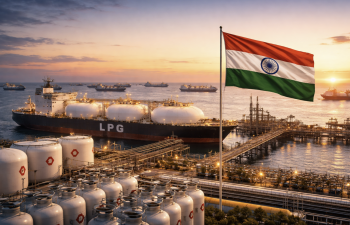
India is facing its worst cooking gas supply crisis in recent history. The ongoing conflict in West Asia has disrupted energy flows through the Strait of Hormuz. This has severely impacted India’s liquefied petroleum gas (LPG) imports. LPG is a major cooking fuel used by millions of households and businesses across the country. The government has responded by increasing domestic LPG production and extending booking periods for gas cylinders.
Rising LPG Import Dependence
India’s LPG imports have surged dramatically over the last two decades. In 1998-99, LPG imports stood at 1,722 thousand metric tonnes (TMT). By 2024-25, imports reached 20,667 TMT, a twelvefold rise. LPG now constitutes 40% of all petroleum product imports by volume. The import bill for LPG has grown from Rs 1,274 crore in 1998-99 to Rs 1.06 lakh crore in 2024-25. This makes LPG the largest imported petroleum product in India.
Demand Growth and Supply Gap
LPG consumption has increased over five times between 1998-99 and 2023-24. Urbanisation, rising middle-class households, and government subsidy schemes like the Pradhan Mantri Ujjwala Yojana (PMUY) have driven demand. In 1998-99, India consumed 5,352 TMT of LPG but produced only 3,599 TMT. By 2023-24, consumption reached 29,664 TMT while production was 12,779 TMT. This created a supply deficit of 16,885 TMT, met mainly through imports.
Domestic Production Constraints
Despite expanding crude oil refining capacity, LPG production has plateaued since 2017-18, staying below 13,000 TMT annually. LPG is a byproduct of refining crude oil and processing liquefied natural gas (LNG). While production of other petroleum products like petrol and diesel has increased, LPG production share in refinery output has declined from 5.2% in 1998-99 to 4.2% in 2024-25. This limits India’s ability to reduce LPG import dependence.
Government Measures and Challenges
To ensure steady LPG supply, the government increased domestic LPG production by 25%. Booking periods for cylinders were extended to 25 days in urban areas and 45 days in rural areas. Alternative fuels like kerosene, biomass, and coal have been made available for commercial users. However, with nearly 90% of LPG imports passing through the geopolitically sensitive Strait of Hormuz, supply remains vulnerable to external shocks.
Topics for Prelims:
Liquefied Petroleum Gas (LPG)
- LPG is a byproduct of crude oil refining and LNG processing.
- Used mainly as cooking fuel in households and commercial kitchens.
- India’s LPG consumption has grown over five times since 1998-99.
- 60% of India’s LPG demand is met through imports.
- Strait of Hormuz is a critical transit route for LPG imports.
Pradhan Mantri Ujjwala Yojana (PMUY)
- Launched in 2016 to provide free LPG connections to poor households.
- Majority of beneficiaries are rural families.
- Boosted LPG consumption growth after 2016.
- Helped reduce dependence on traditional biomass fuels.
- Has over 10 crore active connections as of 2026.
Strait of Hormuz
- Strategic chokepoint connecting the Persian Gulf to the Arabian Sea.
- Handles nearly 20% of global oil trade by sea.
- Essential route for India’s energy imports including LPG.
- Geopolitical tensions in the region affect global energy security.
- Disruptions here cause global fuel price volatility.
Questions for Mains:
- Analyse the impact of India’s LPG import dependence on its energy security. Discuss in the light of geopolitical risks in the Strait of Hormuz. [GS-III-Economic Development]
- With examples, examine the role of government schemes like Pradhan Mantri Ujjwala Yojana in transforming rural energy consumption patterns. Critically discuss challenges faced in achieving universal clean cooking fuel access. [GS-II-Social Justice]
- Discuss the implications of rising LPG imports on India’s foreign policy and international relations with West Asian countries. How can India diversify its energy import sources? [GS-II-International Relations]
- Critically discuss the limitations of domestic petroleum refining capacity in meeting India’s growing LPG demand. Analyse the potential of alternative energy sources in reducing import dependence. [GS-III-Science & Technology]
Answer Hints:
1. Analyse the impact of India’s LPG import dependence on its energy security. Discuss in the light of geopolitical risks in the Strait of Hormuz. [GS-III-Economic Development]
- India imports about 60% of its LPG demand, making it highly dependent on external sources.
- Nearly 90% of LPG imports transit through the Strait of Hormuz, a strategic chokepoint vulnerable to geopolitical tensions.
- Disruptions in the Strait due to conflicts or blockades can severely impact India’s LPG supply and cause price volatility.
- High import dependence exposes India to supply shocks, impacting domestic cooking fuel availability and inflation.
- Energy security is compromised as domestic LPG production has plateaued despite rising demand.
- Government measures (increasing domestic production, alternative fuels) mitigate but do not eliminate risks.
2. With examples, examine the role of government schemes like Pradhan Mantri Ujjwala Yojana in transforming rural energy consumption patterns. Critically discuss challenges faced in achieving universal clean cooking fuel access. [GS-II-Social Justice]
- PMUY launched in 2016 to provide free LPG connections to poor and rural households.
- About 80% of PMUY beneficiaries are rural, increasing LPG adoption in villages.
- PMUY reduced dependence on traditional biomass fuels like firewood and dung, improving health and environment.
- Boosted LPG consumption growth, with a sharp rise in cylinder bookings and imports post-2016.
- Challenges include affordability of refills, supply chain issues in remote areas, and cultural preferences for traditional fuels.
- Universal clean cooking fuel access remains incomplete due to economic, infrastructural, and behavioral barriers.
3. Discuss the implications of rising LPG imports on India’s foreign policy and international relations with West Asian countries. How can India diversify its energy import sources? [GS-II-International Relations]
- Rising LPG imports increase India’s strategic engagement with West Asian countries like UAE, Saudi Arabia, Qatar, and Iran.
- India must balance relations amid regional conflicts and sanctions, especially involving Iran and Gulf states.
- Energy diplomacy becomes crucial to ensure uninterrupted LPG supply amid geopolitical tensions.
- Diversification options include increasing LNG imports from other countries, expanding domestic production, and exploring alternative fuels.
- Strengthening ties with energy-rich nations outside West Asia (e.g., US, Australia) can reduce over-reliance on the Strait of Hormuz.
- Investing in renewable energy and biofuels aligns with long-term energy security and foreign policy goals.
4. Critically discuss the limitations of domestic petroleum refining capacity in meeting India’s growing LPG demand. Analyse the potential of alternative energy sources in reducing import dependence. [GS-III-Science & Technology]
- Despite expanding refining capacity, LPG production share has declined from 5.2% (1998-99) to 4.2% (2024-25), indicating production plateau.
- LPG is a byproduct of crude oil refining and LNG processing; refining expansion benefits petrol/diesel more than LPG.
- Domestic LPG production has stagnated below 13,000 TMT annually since 2017-18, insufficient for rising demand.
- Alternative energy sources like biogas, electric cooking (induction), and solar cookers can reduce LPG demand.
- Government promotion of kerosene, biomass, and coal for commercial use eases LPG pressure but may have environmental downsides.
- Scaling up renewable energy and clean cooking technologies is essential for sustainable import reduction and energy security.