
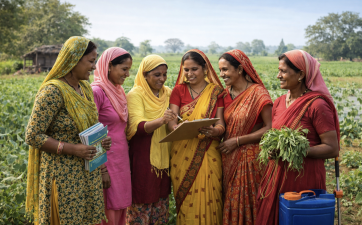
The year 2026 has been declared the International Year of the Woman Farmer by the United Nations through the Food and Agriculture Organization (FAO). In response, the Agriculture Insurance Company of India Limited (AIC) launched the Krishi Sakhi Initiative. This programme aims to empower women farmers and promote inclusive growth in Indian agriculture. It involves month-wise activities across AIC’s Head Office and Regional Offices to raise awareness and encourage women’s participation in agriculture and crop insurance.
Introduction to Krishi Sakhi Initiative
The Krishi Sakhi Initiative began in January 2026 with the release of an introductory video on social media. This video aimed to create awareness about the role of women in agriculture and the benefits of crop insurance. The initiative marks the vital contribution of women farmers in strengthening India’s agricultural sector.
Key Activities in Early 2026
In February, AIC organised a Walkathon at its Head Office. Employees participated carrying a cardboard with the hashtag #AICforHer. This event symbolised unity, resilience and support for women farmers. In March, workshops and awareness programmes were conducted focusing on crop insurance schemes and their benefits for women farmers. These efforts aim to educate women about financial protection and risk management in farming.
Ongoing and Future Programmes
Throughout 2026, AIC plans various activities including publication of articles and interviews related to women in agriculture. Awareness campaigns on sanitation and hygiene in rural areas target women farmers and rural households. These programmes are designed to empower women, improve health standards and promote sustainable agricultural practices.
Impact on Women Farmers and Agriculture
The initiative supports inclusive growth by recognising women’s contributions and encouraging their active participation. It helps women access crop insurance, reducing their vulnerability to crop failures. By improving awareness and education, the programme encourages resilience and economic security in rural farming communities.
Topics for Prelims:
Women Farmers in India
- Women contribute nearly 33% to India’s agricultural labour force.
- They often face barriers in land ownership and credit access.
- Women farmers manage crops, livestock and household food security.
- Empowerment improves agricultural productivity and rural livelihoods.
- Government schemes increasingly target women’s inclusion in agriculture.
Agriculture Insurance Company of India Limited (AIC)
- Established to provide crop insurance and risk management services.
- Operates under the Ministry of Agriculture and Farmers Welfare.
- Offers schemes like Pradhan Mantri Fasal Bima Yojana (PMFBY).
- Focuses on increasing insurance penetration among small farmers.
- Engages in awareness drives and capacity building for farmers.
International Year of the Woman Farmer 2026
- Declared by United Nations through FAO in 2026.
- Aims to show women’s role in global food security.
- Promotes gender equality in agriculture worldwide.
- Encourages policies supporting women’s agricultural participation.
- Supports sustainable development and poverty reduction goals.
Questions for Mains:
- Critically analyse the role of women farmers in India’s agricultural development and the challenges they face in accessing resources. [GS-I-Indian Society]
- Underlining the significance of crop insurance schemes, estimate their impact on the economic security of small and marginal farmers in India. [GS-III-Economic Development]
- Point out the importance of international observances like the International Year of the Woman Farmer in promoting gender equality in agriculture and rural development. [GS-II-International Relations]
- With suitable examples, discuss how awareness campaigns and grassroots initiatives can improve participation of women in agriculture and allied sectors. [GS-II-Governance]
Answer Hints:
1. Critically analyse the role of women farmers in India’s agricultural development and the challenges they face in accessing resources. [GS-I-Indian Society]
- Women constitute nearly one-third of India’s agricultural labor force, contributing to crop production, livestock management, and food security.
- They often lack land ownership rights, limiting their access to credit, subsidies, and government schemes tied to landholding.
- Gender-based social norms restrict their decision-making power and participation in agricultural extension services.
- Women’s empowerment leads to improved productivity, rural livelihoods, and food security.
- Government initiatives increasingly target women’s inclusion but gaps remain in implementation and awareness.
- Addressing these challenges requires policy reforms, capacity building, and social attitude changes to ensure equitable resource access.
2. Underlining the significance of crop insurance schemes, estimate their impact on the economic security of small and marginal farmers in India. [GS-III-Economic Development]
- Crop insurance schemes like PMFBY provide financial protection against crop failures due to natural calamities, pests, and diseases.
- They reduce vulnerability and income volatility among small and marginal farmers who lack savings or alternative income sources.
- Insurance coverage encourages farmers to adopt modern inputs and technologies, increasing productivity.
- Challenges include low awareness, delayed claim settlements, and limited coverage in some regions.
- Effective implementation enhances rural economic stability and supports sustainable agricultural growth.
- Awareness and capacity-building initiatives improve enrolment and trust in insurance mechanisms.
3. Point out the importance of international observances like the International Year of the Woman Farmer in promoting gender equality in agriculture and rural development. [GS-II-International Relations]
- International observances show global recognition of women’s crucial role in food security and agriculture.
- They mobilize governments, organizations, and societies to formulate gender-sensitive policies and programs.
- Such observances raise public awareness and challenge gender stereotypes in rural communities.
- They facilitate international cooperation, knowledge sharing, and resource mobilization for women farmers.
- Promote Sustainable Development Goals (SDGs) related to gender equality, poverty reduction, and zero hunger.
- Encourage inclusive growth by integrating women’s perspectives in agricultural development strategies.
4. With suitable examples, discuss how awareness campaigns and grassroots initiatives can improve participation of women in agriculture and allied sectors. [GS-II-Governance]
- Awareness campaigns educate women on crop insurance, modern farming techniques, and government schemes, enhancing informed participation.
- Grassroots initiatives like AIC’s Krishi Sakhi provide training, workshops, and community support tailored for women farmers.
- Examples include Walkathons, video campaigns, and sanitation drives that build solidarity and break social barriers.
- Such programs improve access to credit, inputs, and markets by empowering women economically and socially.
- Increased awareness leads to better health, hygiene, and sustainable practices in rural households.
- These initiatives encourage resilience, economic security, and gender-inclusive rural development.