
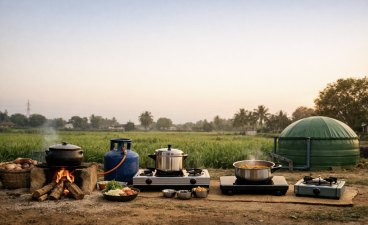
India faces a growing fuel crisis as the war involving Israel, the US, and Iran disrupts LPG imports through the Strait of Hormuz. This has led to shortages and rising prices of liquefied petroleum gas (LPG), a key cooking fuel. States like Kerala, Gujarat, and Maharashtra are increasingly adopting biogas and other renewable fuels to reduce dependence on imported LPG.
Biogas Adoption in Kerala and Urban Areas
Biogas plants are regaining popularity in Kerala and Mumbai as practical LPG alternatives. Biogas is produced by processing organic waste and compressed to a clean fuel form. Despite limited subsidies, demand is rising. In Kerala, over 20,000 biogas units were installed in the last five years. Urban plants mainly compost waste, while rural units focus on cooking fuel. The National Policy on Biofuels 2018 supports establishing 195 compressed biogas plants nationwide, including seven in Kerala.
Waste-to-Energy Initiatives in Mumbai and Gujarat
Institutions like the Tata Institute of Social Sciences and IIT Bombay use biogas from food waste to supplement cooking fuel. In Gujarat, solar-steam kitchens and dung-based biogas systems help rural communities manage fuel shortages. These local renewable energy projects reduce reliance on LPG and improve energy security amid disruptions.
India’s LPG Dependence and Supply Challenges
India consumes 31 million tonnes of LPG annually but produces only 13 million tonnes domestically. Imports meet over 65% of demand, mostly from West Asia. The Strait of Hormuz disruption has stalled many LPG shipments, causing tight supplies. India’s limited LPG storage capacity, with only two underground caverns, worsens vulnerability to supply shocks. The government has temporarily increased kerosene distribution and allowed alternative fuels in commercial kitchens.
Energy Diversification and Future Prospects
Experts urge diversifying India’s cooking fuel mix to reduce import dependence and price volatility. Expanding electric cooking, which is now cheaper than LPG, is recommended for urban households. Scaling up biogas and electric cooking could cut LPG demand by 50% by 2050. This transition supports clean energy goals and strengthens India’s energy security.
Topics for Prelims:
Biogas Technology
- Produced by anaerobic digestion of organic waste.
- Used for cooking and composting in rural and urban areas.
- Compressed biogas (CBG) is a renewable clean fuel.
- Supported under India’s National Policy on Biofuels 2018.
- Helps reduce fossil fuel dependence and waste landfill.
India’s LPG Supply Chain
- Annual consumption about 31 million tonnes.
- Domestic production only 13 million tonnes.
- Imports mainly from West Asia, over 65% of demand.
- Limited underground storage capacity (two caverns).
- Vulnerable to geopolitical disruptions like Strait of Hormuz blockade.
Alternative Cooking Fuels
- Biogas, solar-steam, biomass, fuel pellets, kerosene, coal.
- Used temporarily in commercial kitchens during LPG shortage.
- Electric cooking is cheaper than LPG and gaining popularity.
- Renewable fuels support circular economy and waste management.
- Key to reducing energy import dependence and price volatility.
Questions for Mains:
- Critically discuss the impact of geopolitical tensions on India’s energy security and the role of alternative fuels in mitigating these risks. [GS-III-Economic Development]
- Examine the challenges and opportunities in scaling up biogas and electric cooking in India, and estimate their potential to reduce LPG dependence by 2050. [GS-III-Environment & DM]
- Analyse India’s LPG supply chain vulnerabilities and point out the policy measures needed to enhance strategic storage and diversify the energy mix. [GS-II-Governance]
- Estimate the social and environmental benefits of adopting decentralised waste-to-energy systems in urban and rural India, and discuss their role in sustainable development. [GS-I-Indian Society]
Answer Hints:
1. Critically discuss the impact of geopolitical tensions on India’s energy security and the role of alternative fuels in mitigating these risks. [GS-III-Economic Development]
- India imports over 65% of its LPG, mainly from West Asia, making it vulnerable to geopolitical disruptions like the Strait of Hormuz blockade.
- Supply disruptions cause fuel shortages, price volatility, and increased subsidy burdens, impacting households and industries.
- Geopolitical tensions show risks of overdependence on imported fossil fuels and limited domestic storage capacity.
- Alternative fuels such as biogas, electric cooking, and biomass reduce reliance on imports and enhance energy resilience.
- Government policies (e.g., National Policy on Biofuels 2018) promote biogas and renewable energy to diversify the cooking fuel mix.
- Scaling up alternative fuels can stabilize supply, lower environmental impact, and support energy security amid global uncertainties.
2. Examine the challenges and opportunities in scaling up biogas and electric cooking in India, and estimate their potential to reduce LPG dependence by 2050. [GS-III-Environment & DM]
- Challenges – limited subsidies, infrastructure gaps, urban-rural usage differences, and behavioral resistance to new fuels.
- Opportunities – abundant organic waste for biogas, cheaper electric cooking (20% less than LPG), and government support for renewable energy.
- Biogas plants serve dual roles—cooking fuel in rural areas and waste composting in urban areas, enabling circular economy benefits.
- Electric cooking expansion in urban areas with reliable electricity can reduce LPG demand and ease supply pressure.
- Reports estimate up to 50% reduction in LPG demand by 2050 through combined biogas and electric cooking adoption.
- Scaling up supports clean cooking goals, reduces emissions, and enhances energy affordability and security.
3. Analyse India’s LPG supply chain vulnerabilities and point out the policy measures needed to enhance strategic storage and diversify the energy mix. [GS-II-Governance]
- India’s LPG consumption (~31 mt) far exceeds domestic production (~13 mt), with heavy import dependence (~65%).
- Supply chain is vulnerable due to geopolitical risks, limited storage (only two underground caverns covering ~2 days of demand), and shipping disruptions.
- Current storage capacity is insufficient to buffer against prolonged supply shocks, risking household and commercial fuel shortages.
- Policy measures needed – expand strategic LPG storage infrastructure, increase domestic production, and diversify fuel sources.
- Promote alternative fuels (biogas, electric cooking) and improve supply chain resilience with better logistics and emergency protocols.
- Encourage decentralised energy solutions and strengthen regulatory frameworks for fuel substitution during crises.
4. Estimate the social and environmental benefits of adopting decentralised waste-to-energy systems in urban and rural India, and discuss their role in sustainable development. [GS-I-Indian Society]
- Decentralised waste-to-energy reduces landfill use and associated environmental pollution through efficient organic waste processing.
- Generates clean cooking fuel (biogas), improving indoor air quality and reducing health risks linked to biomass burning.
- Promotes circular economy by converting waste into energy and compost, supporting sustainable agriculture and waste management.
- Empowers rural and urban communities with local energy solutions, enhancing energy access and resilience during fuel shortages.
- Reduces dependence on imported fossil fuels, lowering carbon footprint and supporting India’s climate commitments.
- Supports livelihoods through biogas plant installation, operation, and waste segregation initiatives, encouraging inclusive development.